
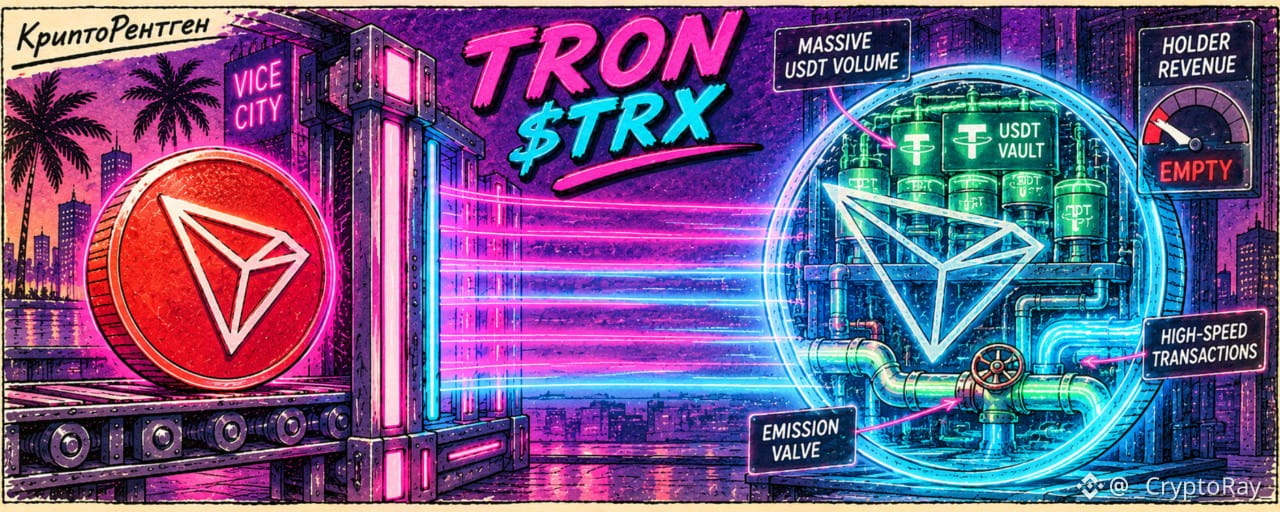

TRON is a DPoS-consensus L1 designed for low-cost stablecoin transfers. According to DefiLlama, as of November 2, 2026, the network holds around $94.37 billion in stablecoins, 97.85% of which is USDT. TRX itself has a market capitalization of around $30.03 billion, at a price of about $0.32.
The main conflict: the network is heavily used, but the direct path from this activity to the token holder’s wallet $TRX is limited. Fees are burned, but issuance continues, and deflation has not been proven.
This analysis is for readers who want to distinguish the network's success from the token's economics.
Technology
DPoS consensus. Holders vote with TRX for Super Representatives (SRs). Blocks are produced by 27 SRs, while voting rewards are shared among 127 candidates: 27 SRs and 100 SR Partners.
One block every 3 seconds. Eight slots per day are designated to be skipped (a six-hour maintenance cycle), so the maximum is 28,792 blocks per day.
Bandwidth and Energy. Staking TRX provides network resources. If you have enough resources, you can avoid paying a fee. If not, the cost is paid in TRX, which is then burned.
In practice, this means TRX is needed by the network as fuel and as collateral for resources. But the amount of USDT on the network does not in itself imply proportional demand for the token.
Tokenomics
Maximum supply: not defined by the protocol. Max Supply is more accurately described as unlimited, rather than equated with Total Supply.
Block reward: the SR that produces a block receives 8 TRX; 128 TRX are shared among 127 candidates.
Theoretical issuance:
8 TRX × 28,792 = 230,336 TRX per day for block production.
128 TRX × 28,792 = 3,685,376 TRX per day in voting rewards.
Total: 3,915,712 TRX per day, or about 1.429 billion TRX per year.
This is the maximum, assuming all blocks are produced. If any are missed, actual issuance is lower. Reward amounts can be changed through governance mechanisms. Based on a rough estimate from the price and market capitalization (about 94 billion TRX in circulation), this is around 1.5% per year.
Burning. TRX is burned when a user pays a fee instead of covering it with staked resources. The dollar value of fees is not equal to the number of tokens burned, so you cannot divide fees by the price and call the result a net reduction in supply. TRX can only be called deflationary after comparing issuance and burning over the same period.
Institutional backdrop
TRON Inc. (Nasdaq: TRON) uses TRX as part of its corporate treasury strategy. Reports cite figures of 712.8 million and 720 million TRX, but the current balance as of November 2 cannot be confirmed without a recent company disclosure. Tokens held on a corporate balance sheet are not necessarily locked up: this does not imply a restriction on selling or transferring them.
The Canary Staked TRX ETF (TRXS) has traded on Cboe BZX since September 9, 2026.
Sponsor fee: 1.10%.
Staking provider: Luganodes.
As of September 21, 90% of assets were staked or in the queue to be staked. The proportion changes with liquidity, and the creation and redemption of shares.
Rewards are not paid directly to investors; they are reflected in the fund's NAV.
The listing broadens access for traditional investors, but does not in itself prove sustained demand. Assessing this requires looking at inflows, outflows, and assets under management.
The October 29 incident and TRON's role
On October 29, 2026, Binance lost around $6.3–6.43 billion. Elliptic estimates the loss at $6.43 billion, while TRM Labs puts it at $6.36 billion. The difference reflects their methodologies and the timing of their estimates. Funds were withdrawn from hot wallets across 11 blockchains.
What happened on the TRON network (TRM Labs):
about 612.7 million USDT and 46.4 million TRX were withdrawn, worth approximately $628 million at the time of the incident;
about 234 million USDT was exchanged for 638 million TRX via SunSwap (Elliptic). This was a purchase of TRX, not a sale;
TRX was distributed across addresses, then moved through new wallets, a DEX, a lending protocol, and cross-chain bridges.
According to Elliptic's November 1 update, almost all of the stolen TRX had already passed through exchanges and bridges. The claim that “the attacker still has 475–630 million TRX” is outdated. Elliptic tracked about $122 million in outflows through bridges, but these are traced transfers, not confirmed conversion to fiat.
TRX price:
October 28 — about $0.329;
October 29 — about $0.350–0.354 (briefly reaching $0.36);
October 30 — about $0.328–0.329;
October 31 — about $0.302–0.303
November 1 — about $0.313.
The rise came on October 29, while the main decline occurred on October 30–31. The entire price movement cannot be attributed to the hack: overall market liquidity and the actions of large participants also affected the price.
TRON's use in the transaction route does not prove that the protocol itself is vulnerable. However, reputational risks remain.
On-chain activity (DefiLlama, November 2, 2026)
DeFi TVL: about $5.36 billion.
Stablecoins: about $94.37 billion, of which USDT accounts for about 97.85%.
Transactions in 24 hours: about 11.55 million.
Active addresses in 24 hours: about 3.85 million.
Network fees in 24 hours: about $795.9 thousand.
Network fees in 30 days: about $23.82 million.
The figures show that the value of stablecoins on the network is about three times TRX's market capitalization, while the average fee is around 7 cents per transaction (my estimate based on daily data).
Important distinction. About $23.82 million in 30 days represents network fees, reflected as TRX burned. It is not income received by holders. Fees are payments made by users; revenue is the portion retained by the protocol; holder revenue is what is distributed to token holders. High fees indicate network activity, not payments to holders' wallets.
Value returned to holders
TRX has practical functions: paying for resources, staking, voting for SRs, and use in applications. But a token's utility is not the same as income for its holder. The materials reviewed show no mechanism for regularly distributing network fees among TRX holders. Staking provides rewards from protocol issuance and depends on voting, not on a share of network profits. Burning is not the same as a payout.
The inside story
Facts
The October 29 incident was confirmed by Elliptic and TRM Labs.
Rewards: 8 TRX per block to the block producer and 128 TRX per block shared among 127 candidates (official documentation).
TRXS has traded since September 9, 2026.
About $23.82 million in fees over 30 days represents network fees, not holder income.
Rumors and inside information
“The attacker has 475–630 million TRX and is still selling.” Status: disproven by Elliptic's November 1 update.
“$23.4 million in fees is holder income.” Status: disproven: these are network fees burned in TRX.
“TRX is deflationary.” Status: unproven: there is no comparable accounting of issuance and burning.
“TRON Inc. holds more than 720 million TRX.” Status: not confirmed by a recent disclosure.
“The ETF is only at the filing stage.” Status: disproven: TRXS has traded since September 9.
Strengths and weaknesses
Strengths
About $94.37 billion in stablecoins on the network.
11.55 million transactions and 3.85 million active addresses per day.
About $23.82 million in network fees over 30 days.
TRX has a practical role: resources, staking, and voting.
The launch of the TRXS exchange-traded product.
Weaknesses
No maximum supply is defined; annual issuance is up to ~1.43 billion TRX.
Net deflation has not been proven.
Fees are not distributed to holders, limiting direct value accrual.
USDT accounts for 97.85% of stablecoins.
Corporate TRX holdings have not been confirmed by a recent disclosure.
The impact of TRXS has not been measured, and reputational risks remain after October 29.
Sources
DefiLlama — market and on-chain metrics as of November 2, 2026.
Elliptic and TRM Labs — investigation and loss estimates.
developers.tron.network — reward documentation.
Canary Capital and cboe.com — TRXS details and listing.
