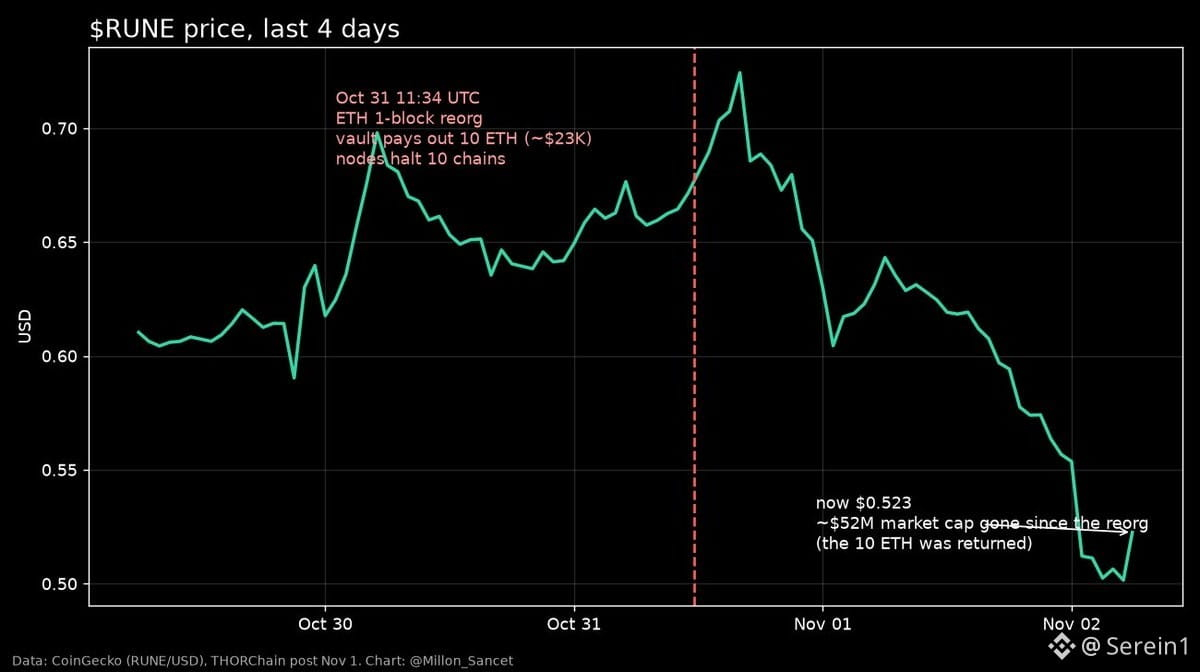
The same thing happened both times: hackers laundered money through THORChain. Why did RUNE surge last time but plunge this time?
The key difference: Last time, the market was trading on rising fees. This time, it’s trading on regulatory and security risks.
During the earlier Bitget hack, large amounts of funds were exchanged across chains through THORChain, driving a surge in trading volume and fees. The market saw this as a boost to protocol revenue, and RUNE rose accordingly.
But the Binance hack created a very different situation:
- Direct FBI involvement: The FBI, U.S. Secret Service, and IRS-CI jointly asked THORNode operators, RPC nodes, and DeFi service providers to block fund flows linked to North Korean hackers.
- The permissionless model faces a challenge: THORChain’s core selling point is that it’s permissionless. But refusing to help block the funds could bring greater regulatory pressure, while cooperating could undermine the protocol’s neutrality.
- Security incidents compound the problem: An Ethereum reorg led to a double refund of 10 ETH, triggering a pause in transactions across multiple chains. THORChain had also previously suffered a security attack involving approximately $10.7 million.
- Revenue quality comes under scrutiny: Trading volume and fees generated by hackers laundering money don’t amount to sustainable growth. Once the abnormal fund flows disappear, the key question is whether the protocol can sustain its revenue through regular users.
The irony is:
Last time, the more hackers there were, the more the market thought THORChain was earning. This time, the more hackers rely on THORChain, the more the market worries that it could become a focal point for regulatory and security risks.
The real issue facing RUNE isn’t just whether trading volume can recover. It’s whether THORChain can resolve the conflict between security and regulation while remaining permissionless.
Fees can bring short-term prosperity, but security and trust determine how far a protocol can go.
$RUNE
The key difference: Last time, the market was trading on rising fees. This time, it’s trading on regulatory and security risks.
During the earlier Bitget hack, large amounts of funds were exchanged across chains through THORChain, driving a surge in trading volume and fees. The market saw this as a boost to protocol revenue, and RUNE rose accordingly.
But the Binance hack created a very different situation:
- Direct FBI involvement: The FBI, U.S. Secret Service, and IRS-CI jointly asked THORNode operators, RPC nodes, and DeFi service providers to block fund flows linked to North Korean hackers.
- The permissionless model faces a challenge: THORChain’s core selling point is that it’s permissionless. But refusing to help block the funds could bring greater regulatory pressure, while cooperating could undermine the protocol’s neutrality.
- Security incidents compound the problem: An Ethereum reorg led to a double refund of 10 ETH, triggering a pause in transactions across multiple chains. THORChain had also previously suffered a security attack involving approximately $10.7 million.
- Revenue quality comes under scrutiny: Trading volume and fees generated by hackers laundering money don’t amount to sustainable growth. Once the abnormal fund flows disappear, the key question is whether the protocol can sustain its revenue through regular users.
The irony is:
Last time, the more hackers there were, the more the market thought THORChain was earning. This time, the more hackers rely on THORChain, the more the market worries that it could become a focal point for regulatory and security risks.
The real issue facing RUNE isn’t just whether trading volume can recover. It’s whether THORChain can resolve the conflict between security and regulation while remaining permissionless.
Fees can bring short-term prosperity, but security and trust determine how far a protocol can go.
$RUNE