Your Stop Loss Is Not Hidden. It's the Target. 🎯
Advanced lesson: the Liquidity Sweep — and how to stop donating your stops to it.
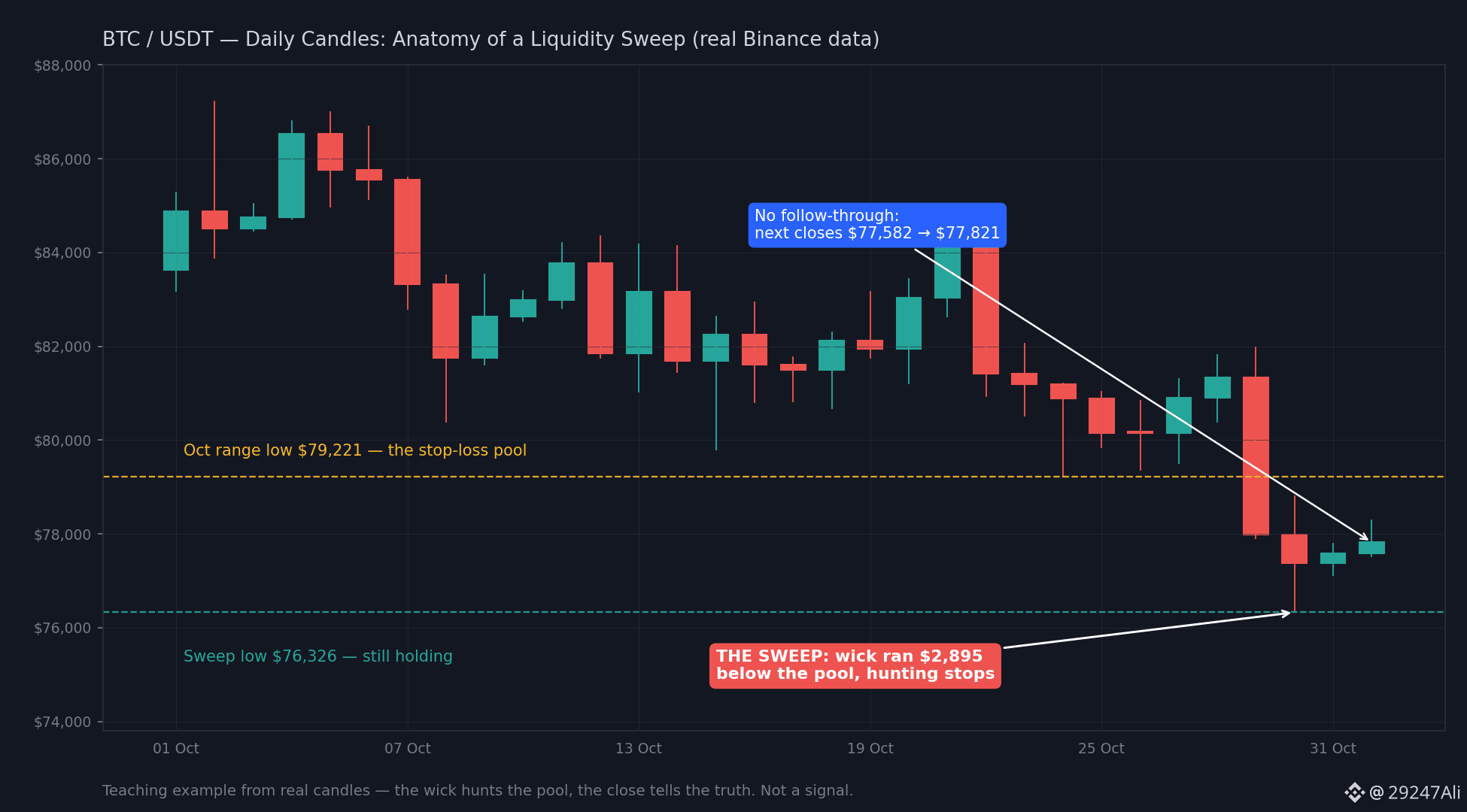
Look at what $BTC just did (real Binance daily candles):
• Oct 5–28 range low: $79,221. Thousands of traders parked their stop losses just under it — an obvious liquidity pool.
• Oct 29–30: price didn't just break it, it speared $2,895 below it to $76,326 — straight through every stop in that pool.
• Then? No continuation. Oct 31 held $77,114, and Nov 1 closed at $77,821. Days later, the sweep low still holds.
That wick was not random. Big players cannot buy size without sellers — and a pool of stop losses is guaranteed sell orders. Price goes where the orders are, fills its bags, and only then makes its real move.
The playbook:
1️⃣ Mark the obvious levels: equal highs/lows, round numbers, range edges. That's where the pools sit.
2️⃣ Never enter on the first poke through a level — that poke is usually the hunt, not the breakout.
3️⃣ Wait for the sweep + reclaim: a wick beyond the level, then a 4H/daily CLOSE back inside. The close is the signal; the wick is the trap.
4️⃣ Place your stop beyond the sweep wick, not at the level. If the wick itself gets taken out, the idea is dead — accept it.
5️⃣ Size by the stop distance: position = (account × risk %) ÷ (entry − stop). A 1% risk rule survives the sweeps that end 10% gamblers.
6️⃣ Targets: the NEXT pool — the opposite side of the range. Liquidity pulls price both ways.
⚠️ The discipline check: not every poke is a sweep. If price CLOSES beyond the level and holds it on a retest, that's a real breakout — a different trade. Don't fade it.
Trade the close, not the wick.
Not financial advice. DYOR.
#tradingtips #TechnicalAnalysis #BTC #CryptoTrading