

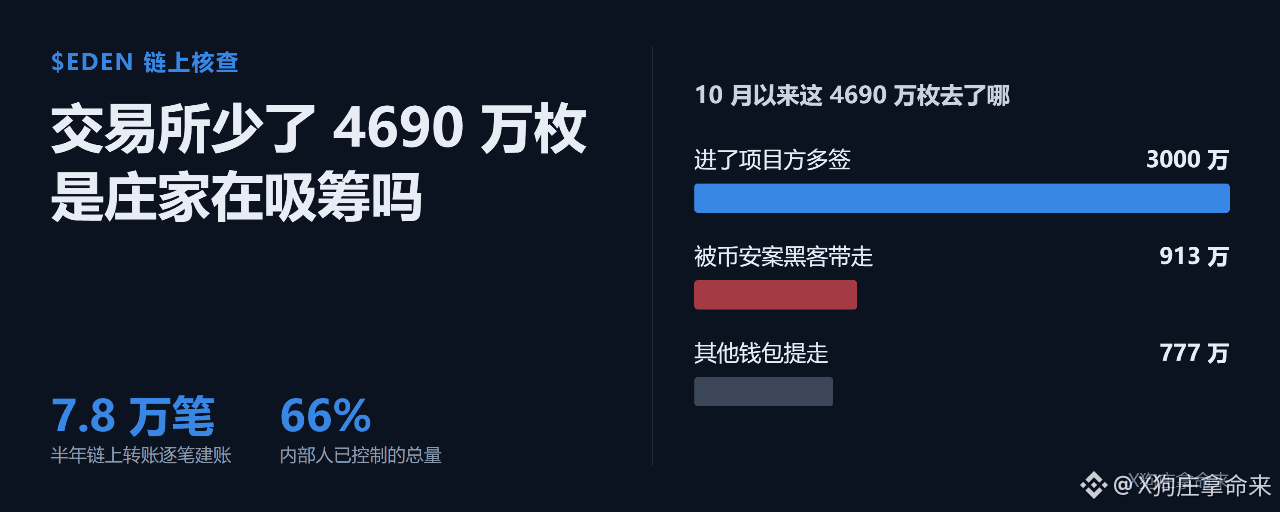

In one month, $EDEN tokens on exchanges fell by 46.9 million—more than a tenth of the circulating supply listed by CMC. If this were another coin, people in the chat would already be shouting, “The whales are accumulating.”
I mapped out all 78,000 on-chain transfers involving EDEN over the past six months, one by one. Where these coins went wasn’t what I’d expected. The most intriguing transfer was 7.5 million tokens deposited into Binance more than five hours before the sharp August rally.
▍The business is real, but niche
OpenEden tokenizes U.S. Treasuries. You give it stablecoins, it uses them to buy short-term U.S. Treasury bills, and gives you a token called TBILL. The interest is reflected in the token’s price. The fund behind it is managed and custodied by BNY Mellon, and has an AA+ rating from S&P. Its investors include YZi Labs, Ripple, and FalconX.
These aren’t just hype. I read the contracts myself: TBILL is currently worth around $275 million.
But there are two figures to look at.
First, $253 million of that $275 million is held in a single multisig wallet on BSC, or 92%. The official team hasn’t disclosed who controls this wallet. If it leaves, TBILL will be left with just over $20 million.
Second, its stablecoin USDO had a market cap of $288 million last August. Now it’s under $15 million, down by more than 90%.
What about revenue? DefiLlama records $76,000 over the past 30 days, or a little over $900,000 a year. All 1 billion EDEN tokens are worth around $56 million at the current price—about 60 times annual revenue, before expenses.
▍Token holders don’t get a share of the money
That’s the real issue. The official documentation says EDEN can be used for governance voting, staking rewards, and fee discounts. Buybacks and burns are described as a “potential future use case” and are subject to legal review. There’s not a word saying token holders are entitled to a share of the company’s revenue.
Staking does generate returns. I checked the blockchain: exactly 5,248 tokens are sent to the staking contract every day, which works out to an annualized yield of around 4%. But these tokens come from the project team’s wallet. They’re issued by the project team itself, not purchased with money earned by the business.
So right now, there’s no link between how well the company’s business is doing and the tokens you hold.
▍Where did the 46.9 million tokens go?
Back to the beginning. On October 1, Binance, Bithumb, Gate, and other exchanges held a combined 196 million tokens in their Ethereum wallets. Now they hold 149 million.
Of those, 30 million tokens were withdrawn from Binance around October 8 and sent to a multisig wallet. All four signers of this wallet are also signers for the EDEN ecosystem treasury or reserve, and Binance’s research report has published the addresses of both treasuries.
Another 9.13 million tokens were sent from Binance wallet 14 to the wallet of a hacker in a theft case on the morning of October 30. Not a single token has moved since. They’re worth around $510,000.
These two transfers account for 83% of the total. The remaining 7.77 million tokens were withdrawn by other wallets.
▍30 million deposited, 30 million withdrawn
Let’s take a closer look at where those 30 million tokens came from.
After EDEN was listed on Upbit on August 10, the price barely moved. At 7:47 p.m. Beijing time on August 13, a wallet deposited 7.5 million tokens into Binance when the price was $0.048. A little over five hours later, the price started surging and reached $0.0869 within a day.
At 6:30 a.m. on August 14, with the price at $0.074, the same wallet deposited another 7.5 million tokens. Then, in the early hours of August 19, it deposited 15 million more.
That’s exactly 30 million tokens in total.
The amount withdrawn on October 8 and returned to the project’s multisig was also 30 million tokens—just 73 tokens short.
What is the relationship between this deposit wallet and the project team? On October 7, it transferred tokens into two project multisigs in the same block as another wallet holding 200 million tokens. In another block that same day, it made a transfer alongside a wallet holding 193 million tokens and one holding 25.19 million. Ordinary whales can’t synchronize like this; the same group of people is operating these wallets.
We can’t tell from the blockchain whether the 30 million tokens were sold after they went into Binance, so I can’t say they were sold. The most common explanation is market making: the project team puts its inventory on an exchange, places orders when market conditions are right, then takes the tokens back later.
There’s some supporting evidence. A market-maker wallet identified in a Binance research report also withdrew 4.98 million tokens from Binance on September 29 and 30, then sent 3.61 million back to the ecosystem treasury on October 6. EDEN had just passed its first anniversary of listing.
There was also a wave in July, when around 25 million tokens were withdrawn from Binance. Half of them passed through the wallet of investor FalconX and ultimately went into the same multisig.
On a chart, these large withdrawals all look like whale accumulation. In reality, the project team is taking back its own inventory.
▍The 590 million “locked” tokens can be withdrawn
In the early hours of October 8, the project team moved 430 million tokens into several vesting contracts. Most of these tokens had previously been held in regular wallets. There are now 594 million tokens across five vesting contracts.
That sounds like a good thing, but this isn’t a hard lock. The contract code explicitly includes a withdrawal function. In the early hours of October 15, the project multisig withdrew 119 million tokens from one of the contracts, then returned the same amount eight days later.
Add the more than 70 million tokens in the project team’s other wallets, and insiders hold over 660 million tokens—66% of the total supply. On-chain calculations put the amount actually in circulation at around 300 million, fewer than the 400 million reported by CMC.
A project team that already holds over 60% of the tokens has no need to accumulate more on the market.
To be fair, there’s a positive side too. Media reports say the team extended the vesting period by another nine months in March, so the earliest tokens won’t enter the market until January 2027. The 210 million-token contract funded in October is close to the team’s allocation, and not a single token has been claimed from it so far. The contract that releases tokens monthly has only been disbursing 3.2 to 4.8 million tokens per month from May through September—not much selling pressure.
▍How many people are actually buying?
I looked through the wallets with the largest increases in holdings over the past 90 days. Excluding the project team and exchanges, most of the tokens weren’t bought. Some were mining rewards that were later split up. For one 3-million-token wallet, the transaction fees came from an over-the-counter wallet belonging to Galaxy Digital, which looks more like an OTC trade.
Only one pair of wallets looks like it might be buying. They share the same funding source and have received around 6 million tokens since October 13, for a combined total of 7.14 million, worth about $400,000. But on October 28, one of them deposited 2 million tokens into Binance—a trading strategy that looks like trying to profit from price swings.
Two other figures don’t support the accumulation theory either. From May to September, exchange balances rose from 136 million to 196 million tokens, meaning tokens were flowing onto exchanges. During the rally in May, when the price rose from $0.035 to $0.175, stakers left and the amount staked fell from 88.7 million to 51.4 million.
▍Futures: more shorts, but a small market
Total futures open interest is 43.5 million tokens, around $2.46 million. It’s been hovering between 44 million and 50 million tokens for a month, with no one adding to their positions. Funding rates are at a normal level.
On Binance’s Smart Money page, whales are short 19.42 million tokens at an average price of $0.0524, while longs total just 4.81 million. Shorts are currently down around 7%.
Worth noting, but don’t treat it as conclusive. Binance’s other large-trader position ratio shows longs making up over 60%, and the two rankings don’t track the same people. These short positions could also be hedges against spot holdings. The market is so small that these positions aren’t enough to drive a major move.
▍What happened to tokens in a similar situation?
I looked through the futures histories for tokens in a situation similar to EDEN’s current one: they had spot markets, had fallen over 90%, had rallied more than 3.5x and then given back 60% or more within the past six months, and had traded sideways for the past 45 days. The sample contained 49 tokens across 203 time periods.
Within 90 days, 9.4% doubled and 2.0% reached 5x. In most cases, the closing price on day 90 was down 29%. For all older tokens with spot markets, the figures were 9.9% and 0.8%, with a 25% decline.
In other words, this pattern doesn’t give you an edge. The equal-weighted multiple is a little higher, at 15.8%, but the sample is small, so don’t read too much into it.
▍My take
Does EDEN have value? The company does; the token currently doesn’t. Tokenized U.S. Treasuries are a promising sector, and BNY and S&P are real partners. But the business has contracted sharply, and revenue has no connection to token holders. Everything depends on whether buybacks are ever implemented.
Are whales accumulating? I haven’t seen evidence of that. What I’ve seen is the project team taking back its inventory, with tokens moving from exchanges back into its own hands. On a chart, that looks just like accumulation, but it means something completely different.
I’ll be watching four things next:
· The 31 million tokens that haven’t been locked in that multisig yet. If they go into an exchange, it’ll mean another round of inventory hitting the market.
· The hacker’s wallet holding 9.13 million tokens. Daily trading volume is already thin, so any movement will stand out.
· Buybacks. Only buying tokens on the market with business revenue would count; that would change the picture.
· The wallet holding $253 million in TBILL. If it leaves, the business is gone.
Do you think tokens in U.S. Treasury projects like this should share revenue with token holders? Let’s discuss in the comments.
This is not investment advice.