🎓 A simple explanation: What is proof of reserves—and why is November 3 the real test?
$BTC A week after the breach, two terms are everywhere: proof of reserves and the SAFU fund. Here’s a quick, no-frills explanation:
📌 Proof of reserves, simply put:
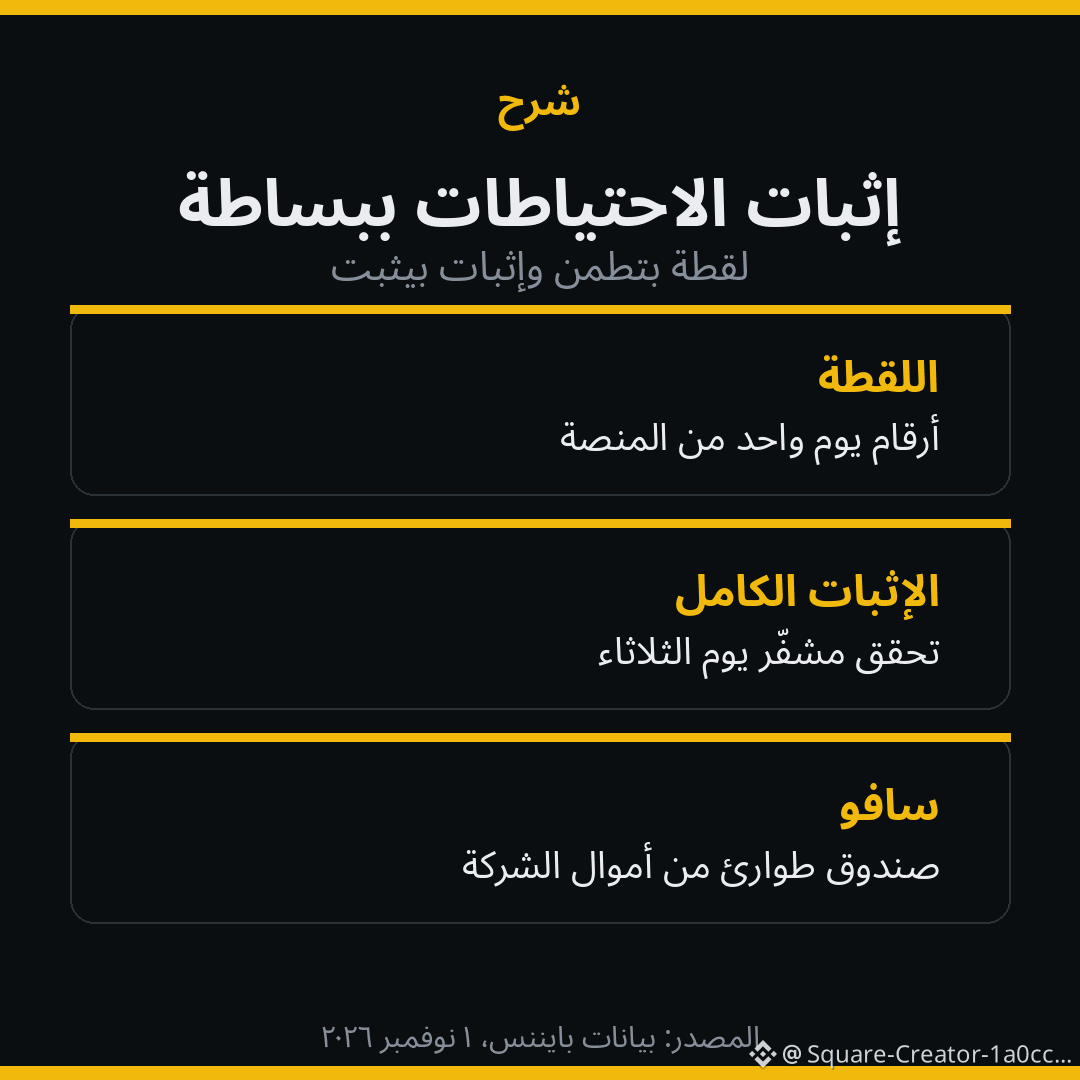
• It’s the platform’s statement: “These are the assets we hold, and these are the funds we owe users”—and the assets are supposed to cover the liabilities at least one-to-one
• The snapshot Binance published on October 31 says coverage is 100 percent or more for the top ten coins—but the snapshot alone is a claim, not verification
• The full cryptographic proof expected on November 3 uses a Merkle tree and zero-knowledge proofs—meaning any user can verify that their balance is included in the accounting, without revealing anyone else’s data
📌 The SAFU fund, simply put:
• It’s an emergency fund made up of the company’s own money, used to cover losses in emergencies—not funded by users’ money
• Binance withdrew some of it to cover the breach and committed to restoring it to around $1 billion
📌 What proof of reserves doesn’t prove:
• It doesn’t prove that the liabilities are complete—if there’s a hidden liability, the figures are still incomplete
• And it doesn’t prove that the assets aren’t encumbered by corresponding debt—which is why independent verification and ongoing transparency matter more than a one-day snapshot
The bottom line:
The October 31 snapshot is reassuring, and the November 3 proof will provide verification—the difference between the two is the difference between “trust me” and “verify it yourself.”
Quick question: When the full proof is released, will you look for your balance in it, or just settle for the news? Write “I’ll check” or “I’ll settle.”
Source: Binance data, Crypto Briefing — November 1, 2026
#تعليم_الكريبتو #Binance