


How to Choose a Digital Asset Exchange Service: Five Practical Criteria
DVA — Facts Without the Hype
FACT • MECHANISM • RISK • PRACTICAL CHECK • DECISION
Cryptocurrency Is Becoming Part of the Financial Infrastructure
In 2026, the digital asset market can no longer be viewed solely as an arena for speculative trading. Stablecoins, cryptocurrency exchanges, payment platforms, and decentralized protocols are increasingly being used for international transfers, payments, and preserving value.
According to analytics firm TRM Labs, stablecoins accounted for around 30% of cryptocurrency transaction volume from January to July 2025. The total volume of transactions involving stablecoins exceeded $4 trillion, approximately 83% higher than in the same period in 2024.
This trend is changing what users need from exchange services. Previously, users could choose a platform mainly based on its exchange rate and transaction speed. Now, they also need to consider the operator’s legal status, how securely assets are held, liquidity, technological compatibility, and how disputed transactions are handled.
It is especially important to understand that the same cryptocurrency platform may have different legal status in different countries.
To show how this works in practice, let’s look at four examples: California, Ukraine, Romania, and Japan.
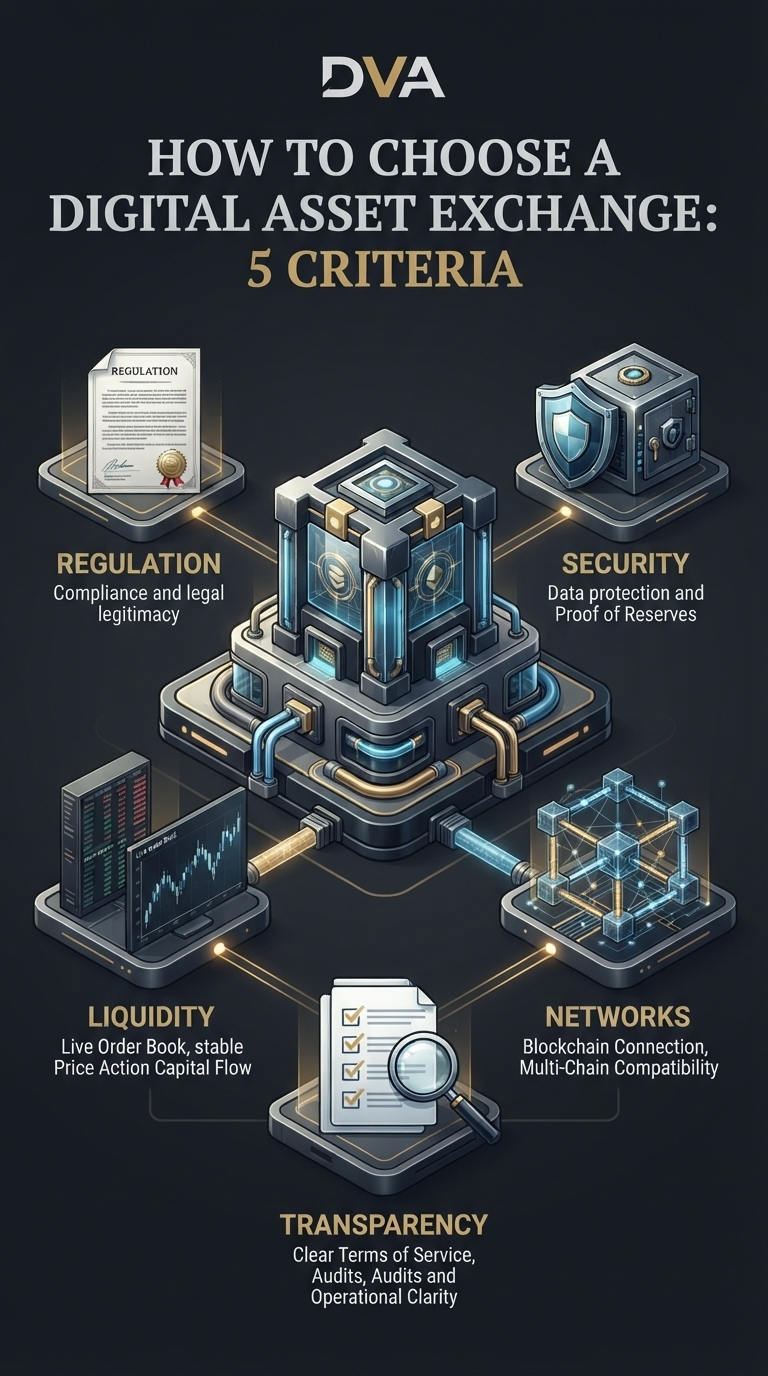
1. Regulatory legitimacy: a license, not just a polished website
The first criterion is to establish who legally provides the service, which jurisdiction the company operates in, and which regulator oversees its activities.
To do this, you need to distinguish between several concepts.
State registration confirms that a company has been entered in the relevant registry, but by itself does not authorize it to conduct any kind of financial activity.
Licensing or authorization means obtaining permission to conduct a specific type of activity in accordance with legal requirements.
Regulatory oversight involves monitoring compliance with established rules, capital requirements, reporting obligations, customer protection standards, and other regulations.
AML/KYC refers to procedures for combating money laundering and terrorist financing, as well as identifying and verifying customers.
These concepts are not interchangeable. For example, completing KYC does not confirm that a platform is trustworthy, and registering a legal entity does not automatically authorize it to provide cryptocurrency services.
California, USA: regulation at the state level
California shows how digital assets can be regulated at the state level, even while US federal law remains a separate layer of regulation.
In 2023, California enacted the Digital Financial Assets Law (DFAL). The law provides for licensing and oversight by the California Department of Financial Protection and Innovation (DFPI).
From July 1, 2026, companies conducting transactions with digital financial assets covered by the law for California residents must comply with DFAL requirements, including licensing or applicable transitional provisions. The law also provides specific exemptions for certain types of activity.
Regulated activities may include exchanging, holding, and transferring digital financial assets.
Practical takeaway: if a platform claims to operate in California, users need to check not merely whether the company is registered in the United States, but its specific status under DFAL.
At the same time, a state license does not automatically mean that all of a company’s services have federal approval.
Ukraine: developing a national regulatory system
The Ukrainian market presents a different situation. Despite the widespread use of cryptocurrencies, a comprehensive regulatory framework for virtual asset service providers is still being developed through legislation.
The key document is draft law No. 10225-д, which provides for amendments to the Tax Code and other legislative acts concerning the regulation of virtual asset circulation.
Its goal is to establish legal conditions for market participants, define regulatory powers, and bring Ukrainian legislation closer to European standards.
Until the new system is fully launched, users should not automatically assume that every international cryptocurrency exchange is authorized by the Ukrainian regulator.
When choosing a platform, check the legal entity, its country of registration, its regulatory status, the terms for serving Ukrainian residents, and whether deposits and withdrawals are available.
Practical takeaway: a foreign license can be an important indicator of regulatory compliance, but it does not automatically confirm Ukrainian authorization or that all services are available to Ukrainian residents.
Romania: the European MiCA regulatory model
Romania is a notable example of the application of Europe-wide digital asset regulation.
The foundation of this system is the MiCA regulation (Markets in Crypto-Assets Regulation), which sets requirements for crypto-asset service providers (CASPs).
Under MiCA, companies providing services covered by the regulation must obtain authorization from the competent authority of the relevant European Union member state.
An important feature of MiCA is the ability to provide services across borders within the EU through a passporting mechanism. After obtaining the appropriate authorization and completing the notification procedure with the competent authorities, a company can operate in other EU countries within the scope of its permitted services.
In Romania, the transitional period for providers already operating was limited to June 30, 2026. National implementation procedures and the powers of the competent authorities must also be taken into account.
The European Securities and Markets Authority (ESMA) publishes registers of authorized crypto-asset service providers and other regulatory information.
Practical takeaway: if an exchange claims to operate in compliance with MiCA, check the specific legal entity and its authorization. Simply displaying “MiCA” on a website is not enough.
Japan: registration as a requirement for providing cryptocurrency services
Japan has established one of the most structured regulatory systems for cryptocurrency exchanges.
Conducting crypto-asset exchange activities in the country requires registration as a Crypto-Asset Exchange Service Provider under the Payment Services Act.
Oversight is carried out by Japan’s Financial Services Agency (FSA) and the relevant local finance bureaus.
The Japanese regulator publishes an official list of registered service providers. This allows users to check whether a specific legal entity is authorized to conduct the relevant activities.
Services involving electronic payment instruments, including certain categories of stablecoins, are regulated separately. Special requirements and registration categories apply to them.
Practical takeaway: Japan’s model demonstrates the importance of checking not only an exchange’s brand, but also the specific legal entity in the FSA registers.
What do the four regulatory models have in common?
California uses a state-level licensing system. Ukraine is developing a national legislative model. Romania applies the Europe-wide MiCA framework. Japan uses a specialized registration system for cryptocurrency service providers.
These are different legal mechanisms, but they share one principle: users must be able to determine who provides the service, on what legal basis, and which authority is responsible for oversight.
2. Asset custody security: Proof of Reserves is not a guarantee of solvency
The second criterion is how transparently a platform demonstrates that it holds the assets it manages.
Since the collapse of FTX in 2022, proof of reserves has become one of the central issues for the cryptocurrency industry.
To address this, many exchanges use Proof of Reserves (PoR)—a mechanism for publicly confirming that certain assets are held to cover liabilities to customers.
One common approach uses a Merkle Tree. This cryptographic structure allows users to verify whether their balance is included in a published dataset without revealing all the information about other customers.
However, there is an important caveat.
Proof of Reserves is not the same as a full financial audit.
PoR can confirm that certain assets were held at a specific point in time, but it does not by itself prove that there are no hidden liabilities or off-balance-sheet debts, or that the company will not face bankruptcy in the future.
For example, an exchange may show reserves equal to 110% of a particular set of liabilities, but that does not mean its overall financial position is positive when all debts are taken into account.
When assessing PoR, pay attention to four factors.
First, whether all liabilities to customers are included, rather than just certain categories of balances.
Second, who conducted the verification: the exchange itself, an external audit firm, or an independent attestation provider.
Third, when the report was produced and how often the data is updated.
Fourth, whether users can independently verify that their balance is included in the Merkle Tree.
Reserve and insurance funds should also be assessed separately.
For example, Binance uses SAFU (Secure Asset Fund for Users)—a special fund designed to protect users in certain crisis situations.
However, the existence of such a fund does not mean that every loss will automatically be compensated. Consider the terms governing use of the fund, its structure, and the actual value of its assets.
In summary, PoR, independent audits, insurance, and reserve funds are different mechanisms. They can complement one another, but they do not replace a comprehensive assessment of an operator’s financial condition.
3. Actual liquidity and the total cost of a transaction
The third criterion is the economic efficiency of an exchange.
The advertised rate on an exchange’s homepage does not always reflect the actual amount a user will receive.
The total cost of a transaction consists of several components: trading fees, the spread, slippage, blockchain network fees, deposit and withdrawal costs, and any fees charged by intermediaries.
It is important to understand three key terms here.
Maker—a participant who places a limit order that adds liquidity to the order book, provided the order is not executed immediately.
Taker—a participant whose order is matched against existing orders and removes liquidity from the order book.
Maker and taker fees may vary depending on the fee tier, trading volume, and the terms of the specific platform.
Spread—the difference between the best buy price and the best sell price.
Slippage—the difference between the expected price and the actual execution price of a transaction.
Let’s look at a hypothetical example.
A user plans to make an exchange worth 10,000 USDT.
The first platform charges a trading fee of 0.10%, while the second charges 0.60%.
Assuming the same calculation basis and execution price, the fee on the first platform would be 10 USDT and on the second, 60 USDT. That is a difference of 50 USDT on a single transaction.
This is an illustration, not a snapshot of the current fees charged by any particular exchanges. Actual rates depend on the user’s tier, order type, trading pair, and other conditions.
But even identical fees do not guarantee that the total transaction cost will be the same.
Liquidity is decisive.
Liquidity determines how much of an asset can be bought or sold without significantly affecting its market price.
For example, two platforms may show the same BTC/USDT rate but have different order book depths.
On the first platform, an order for 5,000 USDT is executed close to the quoted price. On the second, insufficient opposing orders result in significant slippage.
As a result, the user receives less of the asset, even though the visible trading fee may be the same.
So compare not only the fee schedule, but also the spread for the specific trading pair, order book depth, actual slippage, and the final amount after all costs.
This is especially important for lesser-known tokens, where the reported trading volume may not reflect how easily the asset can actually be sold.
The key principle: assess the total transaction cost, not the advertised rate.
4. Functional suitability: networks, assets, and withdrawal methods
The fourth criterion is whether the platform’s technology is compatible with your intended use.
A large number of supported cryptocurrencies does not necessarily mean that a service is suitable for a particular user.
For example, USDT exists on several blockchain networks, including Ethereum (ERC-20), Tron (TRC-20), BNB Smart Chain (BEP-20), and others.
It is one stablecoin, but it operates in different technical environments. Each network has its own transaction processing rules, fees, and address requirements.
If a user sends USDT over a network that the service does not support, they risk losing access to their funds or facing a complicated recovery process.
Before making an exchange, check five things.
Supported network. Does the platform support the specific network your assets are on?
Withdrawal method. Are bank transfers, payment cards, cash, or transfers to an external wallet available?
Geographic restrictions. Is a user in a particular country allowed to use the platform’s required features?
Limits and timeframes. What are the minimum and maximum transaction amounts, processing times, and withdrawal conditions?
Technical confirmation. Can you track the transaction in a blockchain explorer using its TXID (Transaction ID)?
Pay particular attention to geographic restrictions.
A company may be authorized in the European Union but not provide certain services to residents of other countries.
An exchange may allow a user to register but restrict deposits or withdrawals through certain payment channels.
So being able to access a website does not mean that all financial services are available.
For users in Ukraine, it is especially important to check whether the service supports the specific method of withdrawing funds to a Ukrainian bank account or card, what fees apply, and whether there are any additional restrictions.
It is also important to understand the difference between custodial and non-custodial services.
A custodial service holds private keys or controls users’ assets through its own infrastructure. The user depends on the operator’s rules and operational stability.
A non-custodial service allows users to retain control of their private keys and interact with the blockchain without transferring ongoing control of their assets to a centralized intermediary.
However, non-custodial services do not eliminate all risks. Smart contract vulnerabilities, malicious permissions, and mistakes when signing transactions can result in lost funds.
Therefore, choosing between these models depends on the user’s needs and ability to manage wallet security independently.
5. Transparent terms and the quality of support when disputes arise
The fifth criterion is how the platform behaves when problems occur.
The biggest difficulties often arise not during routine exchanges, but when the system detects an unusual transaction.
This could be a delayed blockchain transaction, an additional check on the source of funds, a temporary transaction restriction, a crediting error, or the need to return funds.
It is important to understand that an additional check or temporary restriction does not always indicate fraud by the platform. Regulated operators may be required to carry out such procedures under financial monitoring requirements.
A problem arises when users do not understand why a restriction was imposed, cannot get an explanation, or have no way to appeal it.
Before using a service, read the terms for freezing and unfreezing assets, AML/KYC rules, procedures for returning mistaken transfers, response times for inquiries, and the process for filing a formal complaint.
A particularly dangerous warning sign is being asked to transfer additional funds to an unknown address to unlock an existing balance.
This should be distinguished from an official fee set out in the platform’s terms and confirmed through its official channels.
It is also worth assessing independent user reviews.
A few negative comments are not proof of fraud. But repeated complaints about non-payment, hidden fees, unjustified account freezes, and lack of support should prompt further checks.
A good support service should offer clear contact channels, a way to log inquiries, and a defined process for handling them.
The key principle: a platform’s reliability is measured not only by how it handles routine transactions, but also by how it resolves problems.
The DVA practical checklist: assess a service before your first exchange
The five criteria can be turned into a step-by-step preliminary assessment.
Step 1. Identify the legal entity.
Find the legal entity that actually provides the service. Check its registration, license, or authorization in the official registers of the relevant jurisdiction.
Step 2. Check security.
Find out who controls the private keys, whether Proof of Reserves is available, whether independent checks have been conducted, and what safeguards the platform uses.
Step 3. Assess the costs.
Calculate the total cost of the exchange, including trading fees, spread, slippage, network costs, and withdrawal fees.
Step 4. Run a technical test.
Make sure the service supports the required asset and blockchain network. Check the receiving address and make a small test transaction—an amount you can afford to lose without financial difficulty.
Step 5. Check customer support.
Before depositing a significant amount, ask customer support a specific question about a delayed transaction, a refund, or a restricted transaction. Assess how clear and relevant the response is.
A test transaction does not guarantee the platform will be reliable in the future, but it can help uncover some technical and operational problems before you make a significant transfer.
DECISION. Trust in a service should be based on verification
The digital asset market is evolving faster than the laws of many countries. California, Ukraine, Romania, and Japan demonstrate different approaches to setting rules for cryptocurrency platforms.
However, no regulatory model eliminates all risks.
A license does not guarantee solvency. Proof of Reserves is not a full audit. Low fees do not guarantee favorable order execution. A non-custodial wallet does not protect against every user error.
So choosing the right service is not about finding the platform with the biggest reputation; it is about systematically checking five criteria.
For users, this means following three practical rules.
First, do not transfer funds until you have identified the legal operator and understood the terms of service.
Second, do not rely solely on the exchange rate, rating, or stated volume of reserves.
Third, do not keep more assets on a trading platform than you need for current transactions unless you have a good reason to store them there.
DVA’s key message: in the digital economy, it is important not only to own an asset, but also to understand how to access it, the terms on which it can be exchanged, and the limits of an intermediary’s responsibility.
Financial autonomy begins with taking control of your own decisions, not trusting someone else’s promises.
DVA — facts, without the hype.
FACT • VERIFICATION • DECISION
Crypto assets are a tool, not a guarantee of profit.
Not financial advice. Preserve your assets and your time.
#DVA #Crypto #Bitcoin #USDT #MiCA #DYOR #USDC #ENA #BTC