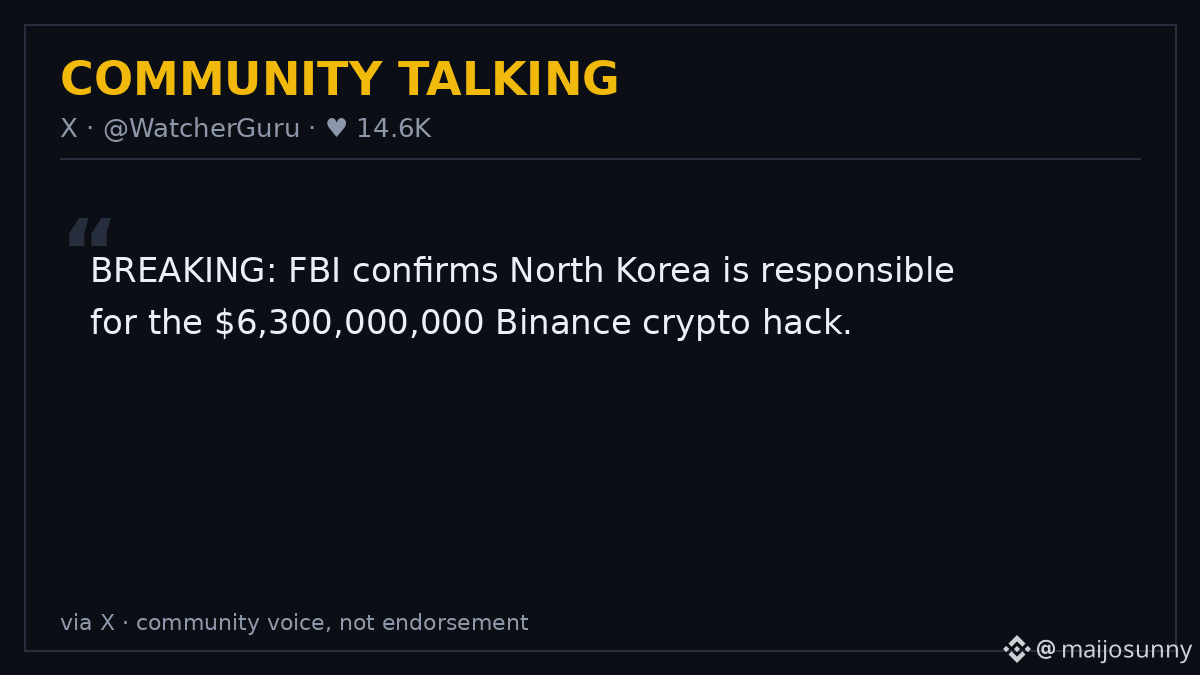
Traders on X are calling it the moment this hack stopped being a mystery and started being a manhunt. WatcherGuru's post on the FBI confirmation pulled 14.6K likes overnight, and the details matter more than the headline.
📊 WHAT HAPPENED
The FBI confirmed on Oct 31 that North Korea's TraderTraitor unit was behind the Oct 29 theft of more than $6 billion from Binance, the largest exchange hack on record. The bureau says the attackers are converting the loot mainly into $ETH, and it published hundreds of addresses (600+ ETH, just under 20 BTC, 1 SOL) asking exchanges, DeFi services and swap platforms to block them. Chainalysis expects tens of thousands more addresses to surface as laundering continues (CoinDesk).
Trump weighed in too, saying he is "not concerned" and that the US will "talk to North Korea about it" (WatcherGuru).
⚡ WHY IT MATTERS
Attribution is not recovery. Freezing funds is not the same as returning them, and replenishing user balances is not the same as recovering the original stolen coins. Binance says coverage has now reached 95% (Reuters, Nov 1), up from 90% a day earlier, and withdrawals reopen in phases starting 14:00-17:00 Beijing today, beginning with BTC, ETH, BNB, SOL, XRP and DOGE.
My take: this is bigger than one exchange's bad week. It is the test case for whether state-level attribution plus an industry-wide address blocklist can actually slow a laundering machine built for exactly this moment. The real test now is execution, not promises: withdrawals reopening without a hitch, the remaining illiquid 5% sourced, and the full proof of reserves due Nov 3.
🟢 If withdrawals reopen smoothly and the blocklist sticks, trust rebuilds fast.
🔴 If laundering outruns the blocklist or the last 5% drags, the story stays open.
What to watch: withdrawal phase timing today, exchange inflows from flagged addresses, and the Nov 3 proof of reserves.
Does naming the attacker change how safe you feel keeping funds on a centralized exchange, or does only the withdrawal restart count? 👇
Not financial advice. DYOR.
#crypto #BinanceHack