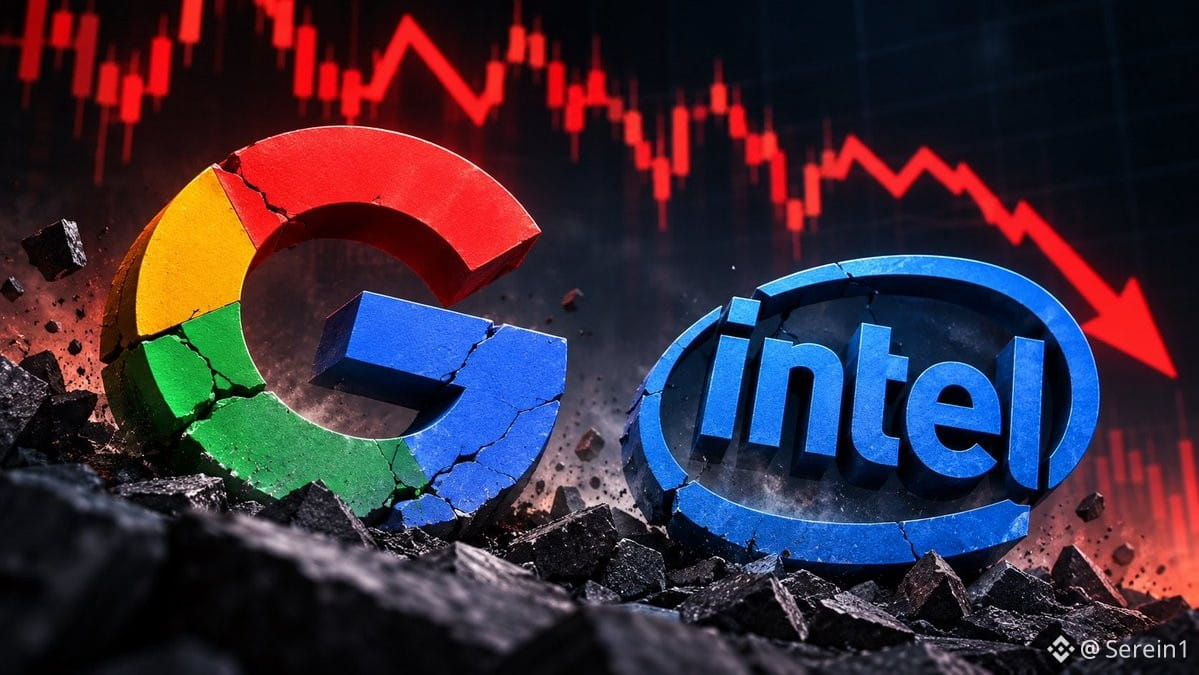
U.S. stocks are repricing the AI frenzy.
Alphabet’s shares plunged nearly 12% at one point after its earnings report, wiping out nearly $500 billion in market value. Intel plunged 28.58% in a single day, its worst one-day performance since the 1970s. The U.S. government’s stake in Intel lost about $12 billion on paper in a single day.
But the two companies face different problems.
Alphabet’s problem is this: revenue is still growing rapidly, but the market is beginning to worry that AI infrastructure spending is too high, and question whether profitability and free cash flow can keep pace. The growth story in its AI business is still intact, but investors are no longer willing to pay for growth alone.
Intel faces a different kind of predicament: the PC market’s recovery is weaker than expected, and its fourth-quarter revenue guidance of just $15 billion to $16 billion is below the market expectation of $17.1 billion. Adjusted earnings per share are also just $0.25, far below the expected $0.43. Add in supply chain disruption caused by an incident at its Israeli wafer fabrication plant, and the pressure on its fundamentals has intensified.
One is spending too much on AI, prompting the market to demand returns; the other is under pressure in its traditional business, with its transformation yet to deliver.
This reflects the most important shift in U.S. stocks today: the market is no longer buying the AI story unconditionally. Instead, it is starting to demand commensurate returns for every dollar of capital expenditure.
In the past, the larger the AI investment, the easier it was to command a valuation premium. Now, the bigger the investment, the more companies need to prove they can make money from it.
The long-term AI trend may not have changed, but the valuation logic in U.S. stocks is shifting. In the next phase, the market may no longer reward whoever is most willing to burn cash, but whoever can truly turn AI into profits.
$GOOGL
Alphabet’s shares plunged nearly 12% at one point after its earnings report, wiping out nearly $500 billion in market value. Intel plunged 28.58% in a single day, its worst one-day performance since the 1970s. The U.S. government’s stake in Intel lost about $12 billion on paper in a single day.
But the two companies face different problems.
Alphabet’s problem is this: revenue is still growing rapidly, but the market is beginning to worry that AI infrastructure spending is too high, and question whether profitability and free cash flow can keep pace. The growth story in its AI business is still intact, but investors are no longer willing to pay for growth alone.
Intel faces a different kind of predicament: the PC market’s recovery is weaker than expected, and its fourth-quarter revenue guidance of just $15 billion to $16 billion is below the market expectation of $17.1 billion. Adjusted earnings per share are also just $0.25, far below the expected $0.43. Add in supply chain disruption caused by an incident at its Israeli wafer fabrication plant, and the pressure on its fundamentals has intensified.
One is spending too much on AI, prompting the market to demand returns; the other is under pressure in its traditional business, with its transformation yet to deliver.
This reflects the most important shift in U.S. stocks today: the market is no longer buying the AI story unconditionally. Instead, it is starting to demand commensurate returns for every dollar of capital expenditure.
In the past, the larger the AI investment, the easier it was to command a valuation premium. Now, the bigger the investment, the more companies need to prove they can make money from it.
The long-term AI trend may not have changed, but the valuation logic in U.S. stocks is shifting. In the next phase, the market may no longer reward whoever is most willing to burn cash, but whoever can truly turn AI into profits.
$GOOGL