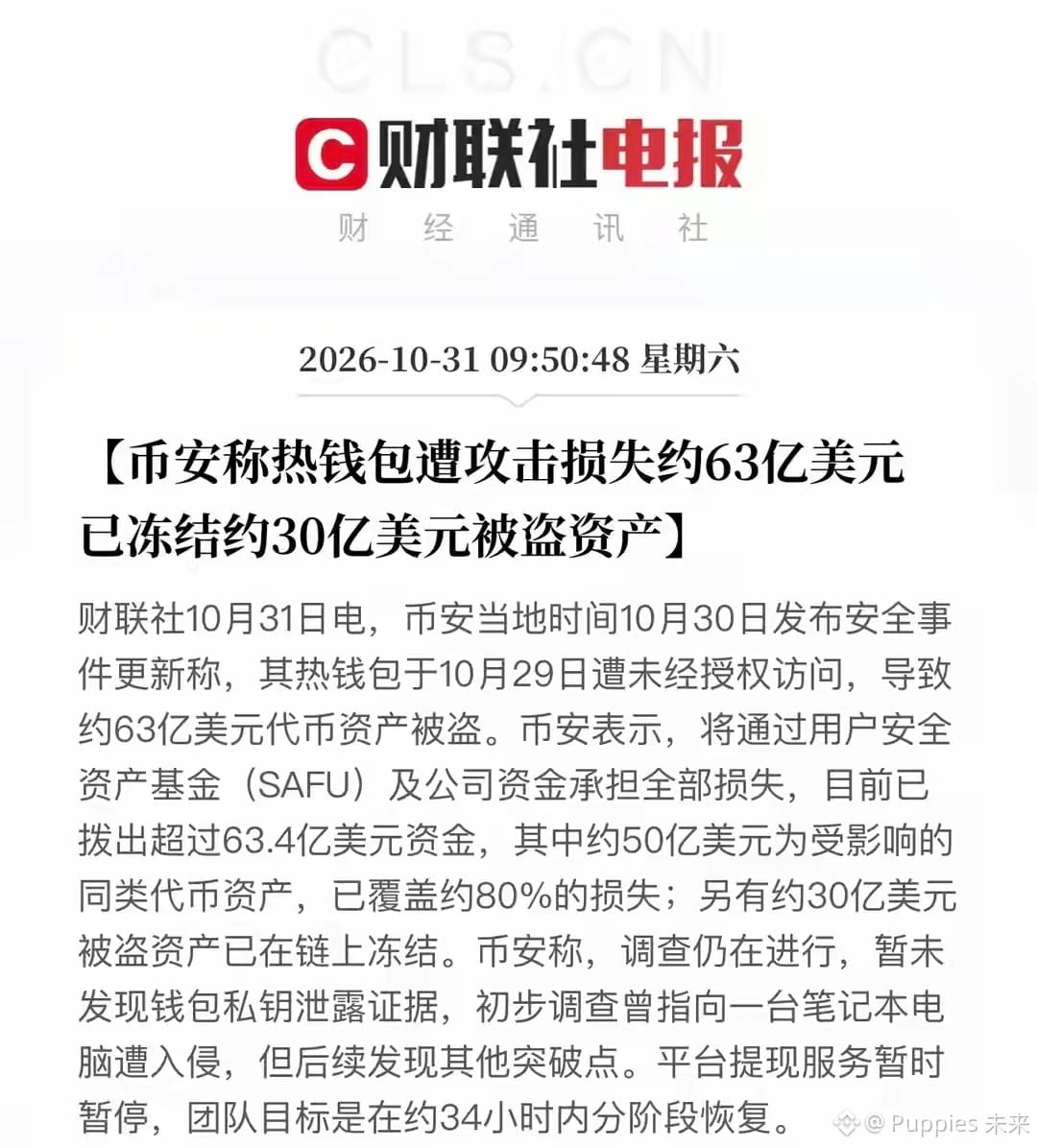
$AIN $IDOL $PEPE Binance’s hot wallet was attacked, and approximately $6.3 billion worth of token assets were stolen. Although about $3 billion has already been frozen, the figure still sets a new industry record.
After more than ten years of trading, I’ve seen countless black swan events, but this one is worth discussing in depth.
First, why a hot wallet?
Anyone who trades knows that a cold wallet is a safe, while a hot wallet is a cash register. A cash register is convenient, but it’s exposed to the outside world every day. The hot wallet was attacked this time, which suggests the problem occurred in the day-to-day transfer process, not in the core private key system. Binance itself has also said it found no evidence of private key leaks, and initial indications point to a laptop being compromised. In plain terms, it’s likely that some internal process was breached.
Second, how was over $6 billion reduced to $3 billion through freezes?
This is the most intriguing aspect of the incident. Once on-chain assets have been transferred out, recovering half of them depends on swift coordination between stablecoin issuers and blockchain analytics firms. Most of the stolen assets were traceable tokens. Once the wallet holding the stolen funds was flagged and the issuers froze the assets, the money could no longer be moved. This shows that the industry’s response mechanisms have matured considerably. It’s a completely different era from the days of Mt. Gox and FTX, when “the money was gone, and that was that.”
Third, the SAFU fund really came through this time.
Binance announced that all losses would be covered by the SAFU fund and company funds, and that $6.34 billion had been allocated. From the user’s perspective, this could be called “invisible compensation,” but it comes at a real financial cost. This is the strength of a leading exchange, and part of its competitive moat. Smaller platforms would basically shut down if something like this happened to them.
Fourth, withdrawals are suspended. How will the market react?
The news is bound to cause some panic. But note one detail: Binance says its goal is to restore withdrawals in stages within 34 hours. Historically, whenever an exchange has run into trouble, the short-term reaction is panic selling, while in the medium term the bad news is often seen as “fully priced in.” After Bitcoin fell below key support yesterday, whether it can quickly recover will depend on fund flows over the next 48 hours.
Lessons for ordinary investors like us:
1. A big platform ≠ zero risk. Diversifying where you store your assets is always a golden rule;
2. Keep long-term assets in a cold or hardware wallet. Don’t prioritize convenience;
3. When a black swan event occurs, first look at the speed of the response and the ability to compensate users, then decide whether to stay or leave.