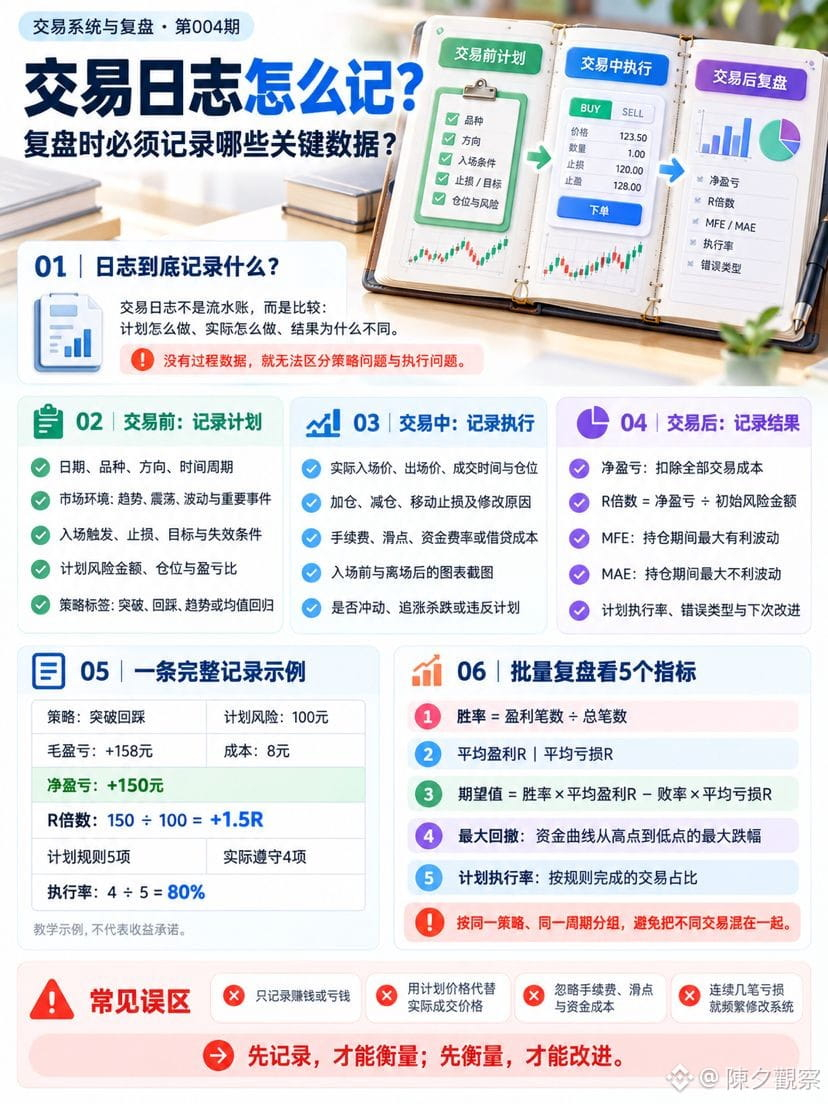
How should you keep a trading journal? What key data must you record during a review?
📒 A trading journal is more than simply noting “whether you made or lost money today.”
A genuinely useful journal should answer three questions: What was the plan? What actually happened? Why did the result differ?
Keep a complete record in three stages:
Before the trade: instrument, direction, timeframe, market conditions, entry trigger, stop-loss, target, position size, and planned risk
During the trade: actual execution price, adding to or reducing the position, stop-loss adjustments, commissions, slippage, financing costs, and whether you deviated from the plan
After the trade: net profit or loss, R-multiple, maximum favorable/adverse excursion, type of mistake, and how to improve
Consistent record-keeping helps you identify which strategies are truly effective, and whether losses come from the system or from execution errors.
Teaching example:
Initial risk: 100 yuan
Gross profit: 158 yuan
Commissions and slippage: 8 yuan
Net profit: 150 yuan
R-multiple = 150 ÷ 100 = +1.5R
Of 5 planned rules, 4 were followed
Execution rate = 4 ÷ 5 = 80%
When reviewing similar trades, focus on tracking: win rate, average winning R, average losing R, expectancy, maximum drawdown, and plan adherence rate.
Closing a position is not the end. Regularly reviewing your entries, stop-losses, exits, and adherence to the plan is how you identify your edge and recurring mistakes.
⚠️ Don’t lump together different strategies, instruments, or timeframes, and don’t overhaul your system just because you’ve had a few consecutive losses.
You must record before you can measure, and measure before you can improve.
📅 Coming next
Monday | Macro Finance Course | Episode 005
“What is the real interest rate? Why does it affect gold, the U.S. dollar, and growth stocks at the same time?”
$BTC #交易计划