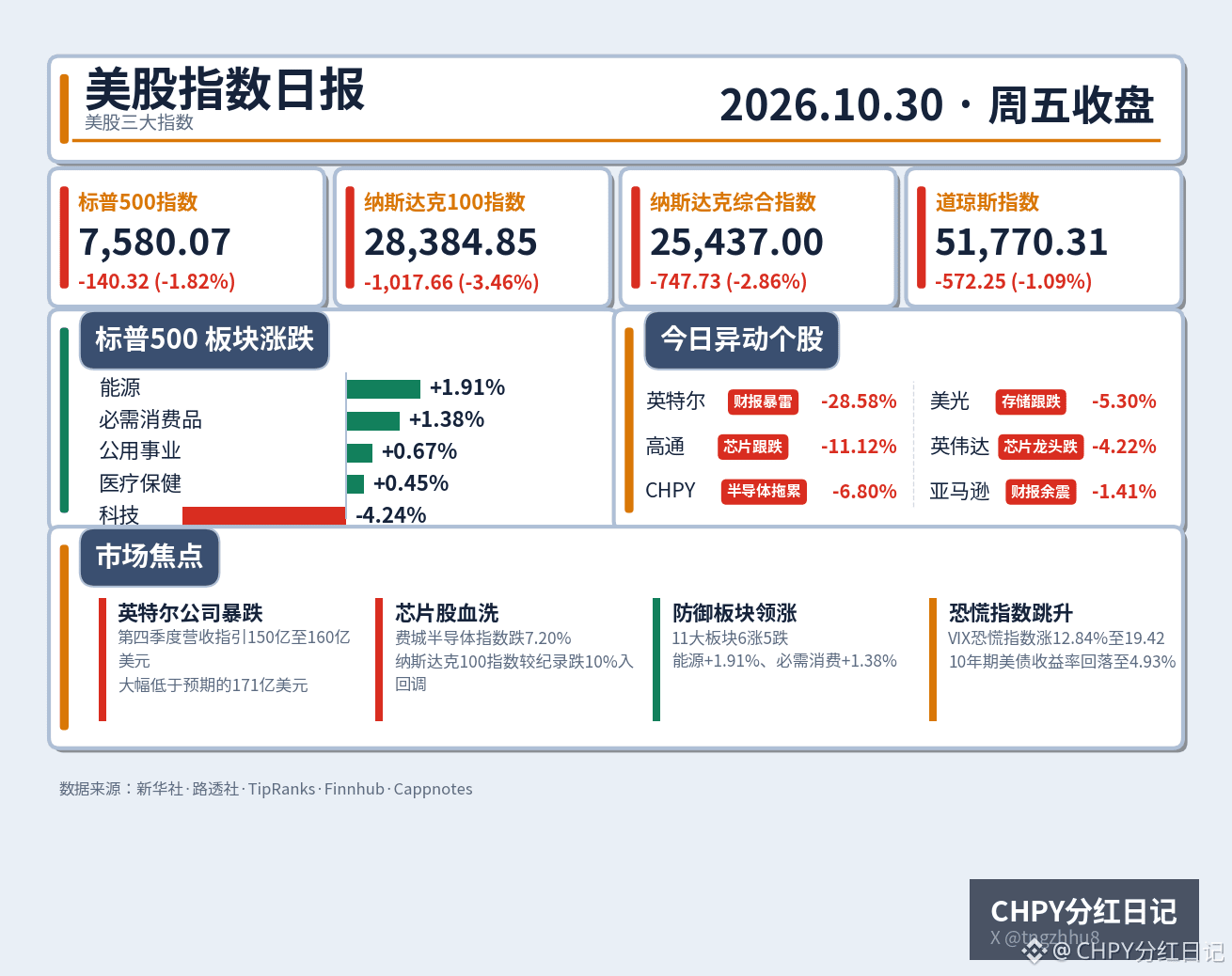
The S&P 500 fell 1.82% to 7,580.07, the Dow Jones fell 1.09% to 51,770.31, the Nasdaq Composite fell 2.86% to 25,437.00, and the Nasdaq 100 fell 3.46% to 28,384.85. All four indexes closed lower. The S&P 500 had its worst single-day performance since June, the Nasdaq Composite posted its biggest one-day drop since June 5, and the Nasdaq 100 fell 10% from its record, entering its third correction of the year.
The trigger was Intel: its fourth-quarter revenue guidance of $15 billion to $16 billion was far below expectations of $17.1 billion, and its stock plunged 28.58%, its worst single-day performance in 52 years. Chip stocks were dragged down across the board: the Philadelphia Semiconductor Index fell 7.20%, Qualcomm dropped 11.12%, Micron fell 5.30%, and Nvidia lost 4.22%. Even Amazon fell another 1.41%.
This wasn't a day's worth of nerves; it was a week's reckoning coming due on Friday. Alphabet plunged 12.64% after its earnings report on Thursday, wiping out about $500 billion in market value. Its free cash flow turned negative, at -$9.07 billion, lighting the first fuse. Intel followed on Friday, effectively telling the market that even the chipmakers themselves are starting to buckle under the cost of the AI boom. This week, the S&P 500 fell 0.58%, the Nasdaq Composite dropped 2%, and the Dow Jones declined 0.85%, with all three indexes down for a third consecutive week. In October, the S&P 500 fell 0.94% and the Nasdaq Composite lost 5.3%; only the Dow Jones rose, gaining 1.7%.
Money didn't flee altogether; it moved elsewhere. Six of the S&P 500's 11 sectors rose and five fell. Energy led with a 1.91% gain, followed by consumer staples, up 1.38%. Health care, utilities, real estate, and materials also closed higher across the board. Technology was the biggest laggard, down 4.24%, while industrials fell 1.57%. The VIX fear index rose 12.84% to 19.42, briefly spiking to 23.93 intraday, while the 10-year U.S. Treasury yield fell 6 basis points to 4.93%—a classic flight-to-safety mix: investors are worried, but not yet running for the exits.
CHPY took a hit too: semiconductor holdings weighed on it, and it closed at $56.71, down 6.80%. But it's important to distinguish two things: what fell was the valuation, not the dividend itself—the distribution arrived as usual this week, and the dividend schedule hasn't changed. What changed was the market's pricing of its semiconductor holdings.
The real test comes next Monday, when Apple reports earnings. If it, too, delivers a “high spending, slow returns” report, the Nasdaq 100's correction may not yet be over. If Apple holds steady, oversold chip stocks could see a sharp rebound at any time. The November 3 U.S. midterm elections are also approaching, and uncertainty is what markets fear most in the run-up to an election. This isn't a collapse in belief in AI; it's valuations forcing the giants to show their cash-flow results. Until they do, it's worth pausing before chasing chip stocks higher. Money rotating into defensive sectors is unlikely to rush back in the short term.
#美股 #Nasdaq 100 Index
The trigger was Intel: its fourth-quarter revenue guidance of $15 billion to $16 billion was far below expectations of $17.1 billion, and its stock plunged 28.58%, its worst single-day performance in 52 years. Chip stocks were dragged down across the board: the Philadelphia Semiconductor Index fell 7.20%, Qualcomm dropped 11.12%, Micron fell 5.30%, and Nvidia lost 4.22%. Even Amazon fell another 1.41%.
This wasn't a day's worth of nerves; it was a week's reckoning coming due on Friday. Alphabet plunged 12.64% after its earnings report on Thursday, wiping out about $500 billion in market value. Its free cash flow turned negative, at -$9.07 billion, lighting the first fuse. Intel followed on Friday, effectively telling the market that even the chipmakers themselves are starting to buckle under the cost of the AI boom. This week, the S&P 500 fell 0.58%, the Nasdaq Composite dropped 2%, and the Dow Jones declined 0.85%, with all three indexes down for a third consecutive week. In October, the S&P 500 fell 0.94% and the Nasdaq Composite lost 5.3%; only the Dow Jones rose, gaining 1.7%.
Money didn't flee altogether; it moved elsewhere. Six of the S&P 500's 11 sectors rose and five fell. Energy led with a 1.91% gain, followed by consumer staples, up 1.38%. Health care, utilities, real estate, and materials also closed higher across the board. Technology was the biggest laggard, down 4.24%, while industrials fell 1.57%. The VIX fear index rose 12.84% to 19.42, briefly spiking to 23.93 intraday, while the 10-year U.S. Treasury yield fell 6 basis points to 4.93%—a classic flight-to-safety mix: investors are worried, but not yet running for the exits.
CHPY took a hit too: semiconductor holdings weighed on it, and it closed at $56.71, down 6.80%. But it's important to distinguish two things: what fell was the valuation, not the dividend itself—the distribution arrived as usual this week, and the dividend schedule hasn't changed. What changed was the market's pricing of its semiconductor holdings.
The real test comes next Monday, when Apple reports earnings. If it, too, delivers a “high spending, slow returns” report, the Nasdaq 100's correction may not yet be over. If Apple holds steady, oversold chip stocks could see a sharp rebound at any time. The November 3 U.S. midterm elections are also approaching, and uncertainty is what markets fear most in the run-up to an election. This isn't a collapse in belief in AI; it's valuations forcing the giants to show their cash-flow results. Until they do, it's worth pausing before chasing chip stocks higher. Money rotating into defensive sectors is unlikely to rush back in the short term.
#美股 #Nasdaq 100 Index