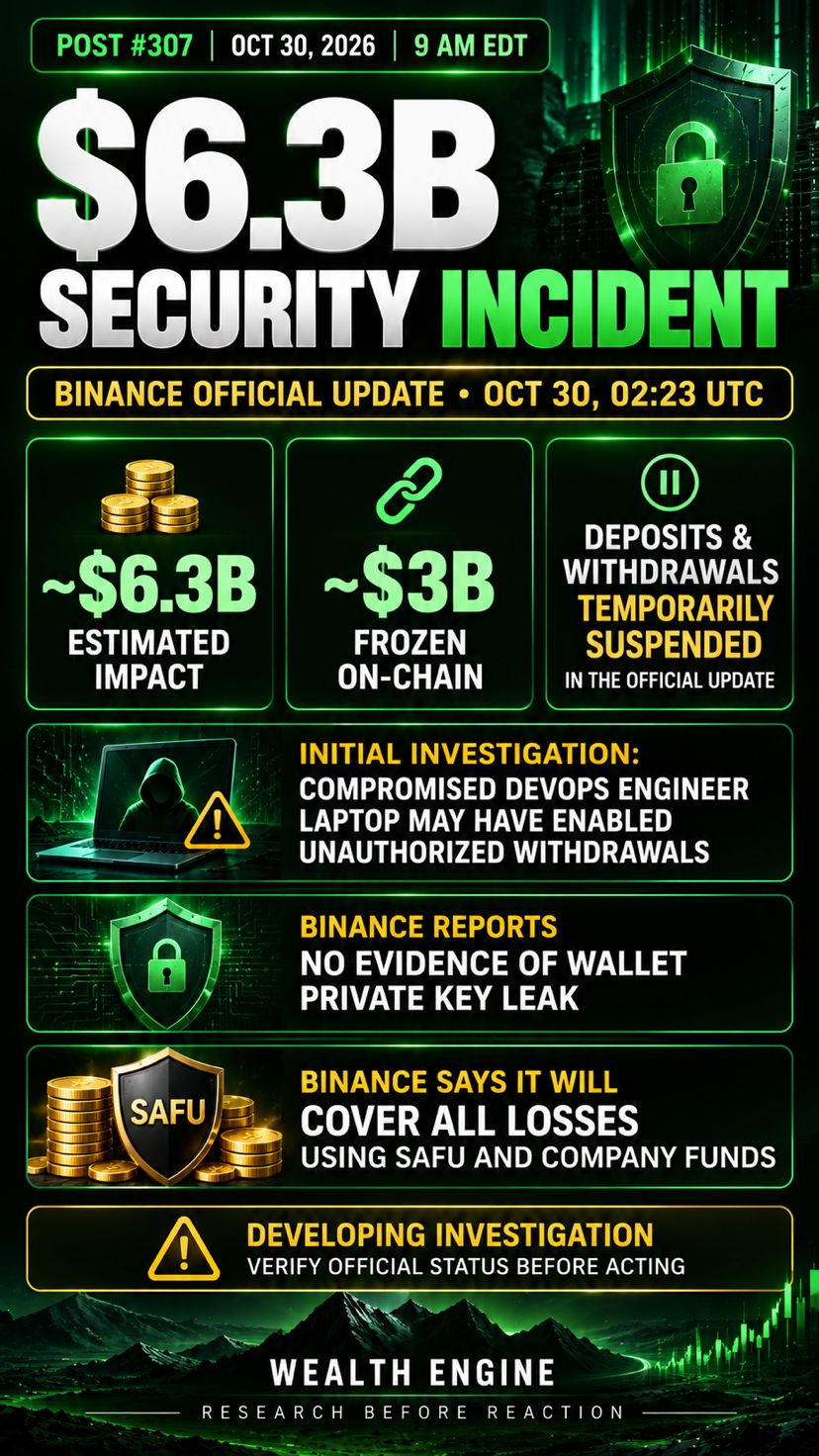
Binance's $6.3B Security Incident: Facts Before Fear
The crypto market is facing a serious operational-security event. The priority is to separate confirmed statements from preliminary findings—and market reaction from verified facts.
What Binance reported
In its official update published at 02:23 UTC on October 30 (10:23 PM EDT on October 29), Binance said:
Estimated incident impact: approximately $6.3 billion.
Assets frozen on-chain with partners: approximately $3 billion.
Initial investigation: a compromised DevOps engineer's laptop may have enabled unauthorized withdrawal transactions.
Wallet private keys: Binance reported no evidence of a private-key leak at that time.
Response: Binance said it would cover all losses using its SAFU fund and company funds. Its statement also described temporarily suspending deposits and withdrawals during security checks.
These are preliminary company statements, not a completed independent technical investigation.
$BTC — $77,845.22 · −2.50%
$ETH — $2,228.02 · −3.50%
$BNB — $704.96 · −6.10%
$XRP — $1.25 · −2.60%
$SOL — $97.24 · −2.90%
$ADA — $0.1918 · −3.20%
$DOT — $0.9385 · −3.80%
The same global dashboard showed market capitalization of approximately $2.73 trillion, 24-hour volume of $142.572 billion, Fear & Greed at 41 (Fear), BTC dominance at 57.4%, and ETH dominance at 9.95%. These global metrics also refresh separately. 
Wealth Engine perspective
A security incident is not just a price-volatility event. It raises questions about operational controls, custody, withdrawal availability and counterparty risk. A falling market does not independently establish the cause of each asset's move.
Avoid panic-driven transfers and unsolicited recovery links. Verify announcements through official channels.
Question: During an exchange security incident, which evidence matters most to you—official service status, proof of reserves, or on-chain fund movements, and why?
#Bitcoin #CryptoSecurity #Binance #MarketAnalysis #WealthEngine