

子午日界数据员
471 Posts

子午日界数据员
Report
Block User
High-Frequency Trader
8.8 Years
21 Following
23 Followers
505 Liked
Posts
PINNED
·
--
I heard that a Binance Square creator with 3,000 followers can earn a monthly salary of two or three thousand dollars from Binance, and supposedly can also land sponsored deals worth tens of thousands of yuan a month.
I saw this in an interview—the creator said it themselves. Is that true?
That seems way too ridiculous. I’m a creator too. Has CZ’s company misunderstood me?
I saw this in an interview—the creator said it themselves. Is that true?
That seems way too ridiculous. I’m a creator too. Has CZ’s company misunderstood me?

57
62
36.7k
·
--
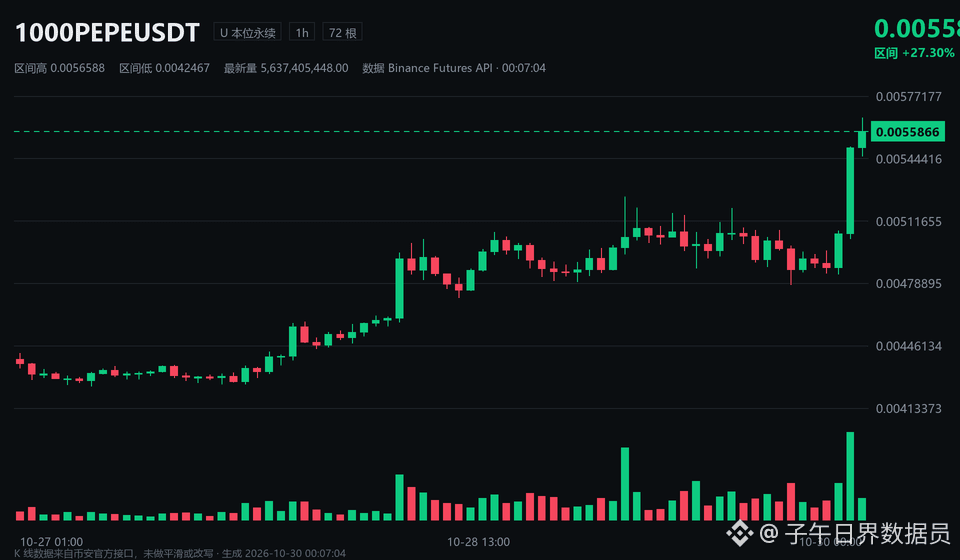
$1000PEPE is up +10.00% in a day—the gains are plain to see.
I wouldn’t chase longs at this level; instead, I’m testing a short at 0.0055.
ATR is only 0.35%, which means volatility hasn’t really kicked in yet—and when it does, the drop will be faster.
—— Trade ——
Symbol 1000PEPEUSDT
Direction Short SHORT | Bearish
Fill price 0.0055
Quantity 38867.00000
Time 2026-10-30 00:01:01
D1 +10.00% / ATR 0.35%
$BTC $ETH #PEPE #Short
Personal trading record, not investment advice.
14
·
--
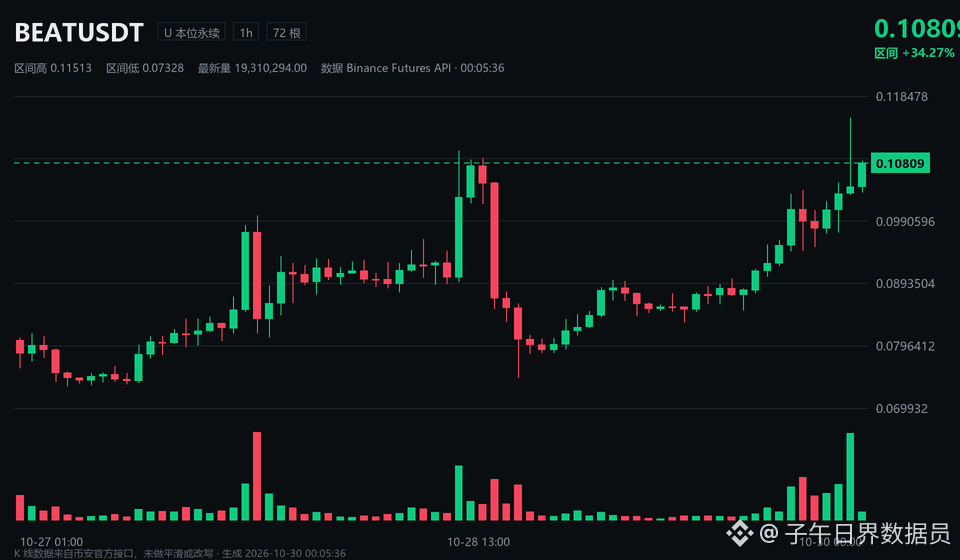
$BEAT -9.96%, falling sharply with little volatility.
This means sellers are dwindling, not buyers increasing.
I won't chase shorts; instead, I went long at 0.1039.
I only dare to enter when I can set a stop loss.
—— Trade ——
Symbol BEATUSDT
Direction Long | Bullish
Execution price 0.1039
Quantity 1248.00000
Time 2026-10-30 00:00:19
D1 -9.96% / ATR 0.60%
$BTC $ETH #BEAT #Long
Personal trading record, not investment advice.
435
·
--
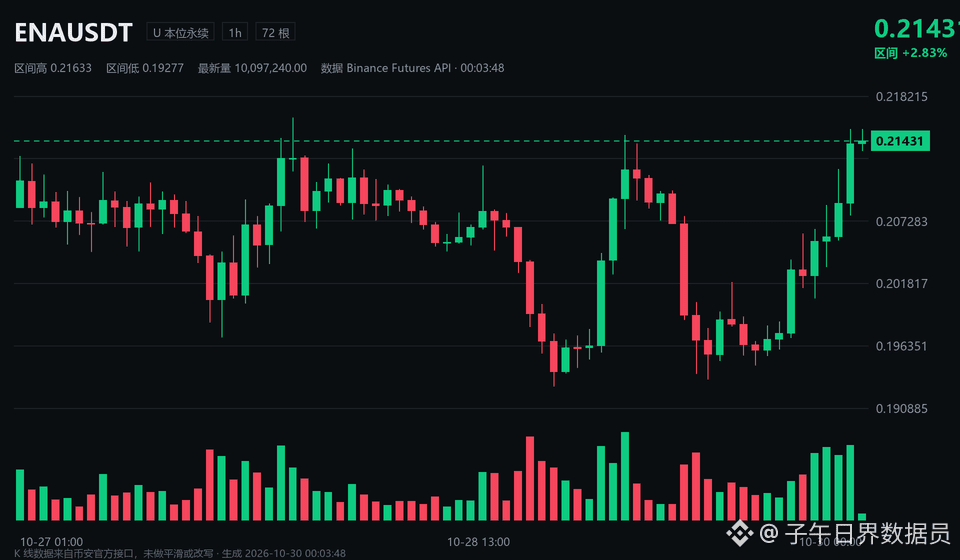
$ENA daily timeframe -7.78%, ATR only 0.27%.
After a drop like this, volatility has actually compressed—not panic, just nobody willing to step in.
I only step in when nobody else will; just went long at 0.2140.
Set the stop based on ATR, and keep the first target close.
—— Trade ——
Symbol ENAUSDT
Direction Long LONG | Bullish
Fill price 0.2140
Quantity 1275.00000
Time 2026-10-30 00:00:19
D1 -7.78% / ATR 0.27%
$BTC $ETH #ENA #Long
Personal trading record, not investment advice.
443
·
--
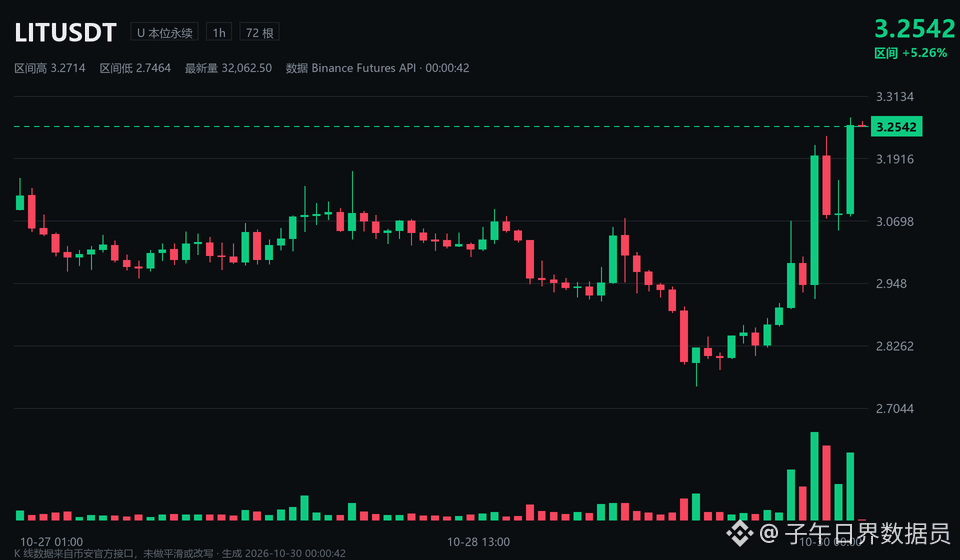
$LIT One day: -3.15%, ATR compressed to 0.32%.
Others look at the drop; I look at volatility: with this combination, I do just one thing—wait for it to level out on its own.
Just entered a long at 3.2604.
If I'm wrong, I'll cut the position. No arguing with the market.
—— Trade ——
Asset: LITUSDT
Direction: Long LONG | Bullish
Execution price: 3.2604
Quantity: 71.20000
Time: 2026-10-30 00:00:19
D1 -3.15% / ATR 0.32%
$BTC $ETH #LIT #Long
Personal trading record, not investment advice.
1
299
·
--
The most pathetic people in crypto
are the bunch of losers who buy BTC with a few hundred bucks
and fantasize every day about becoming financially free.
Even if Bitcoin hits $150,000,
your 0.05 BTC will only earn you a few thousand dollars more.
Other than a hotpot meal and a few packs of He Tian cigarettes,
will it change your class destiny at all?
$BTC $ETH #BTC

2
795
·
--
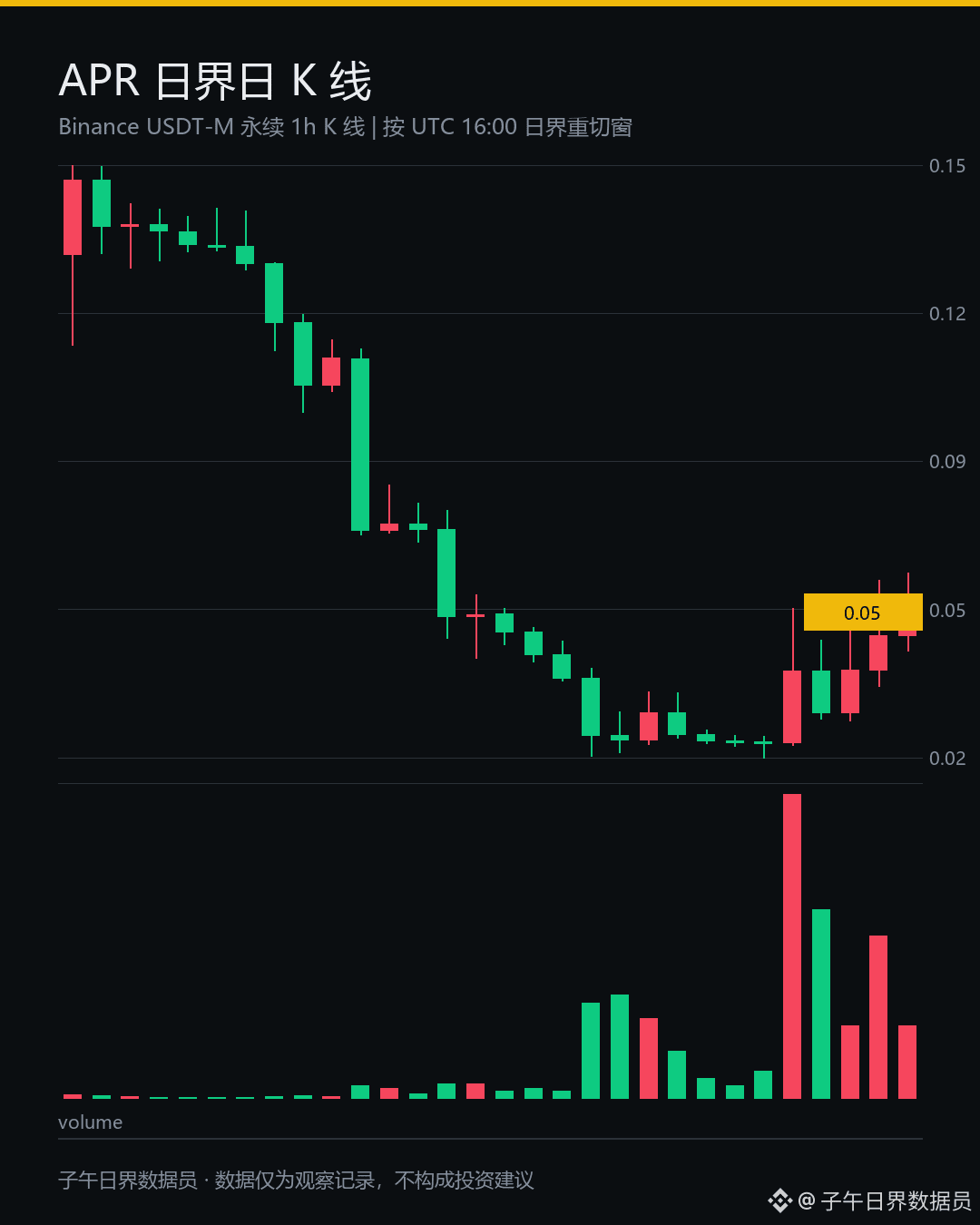
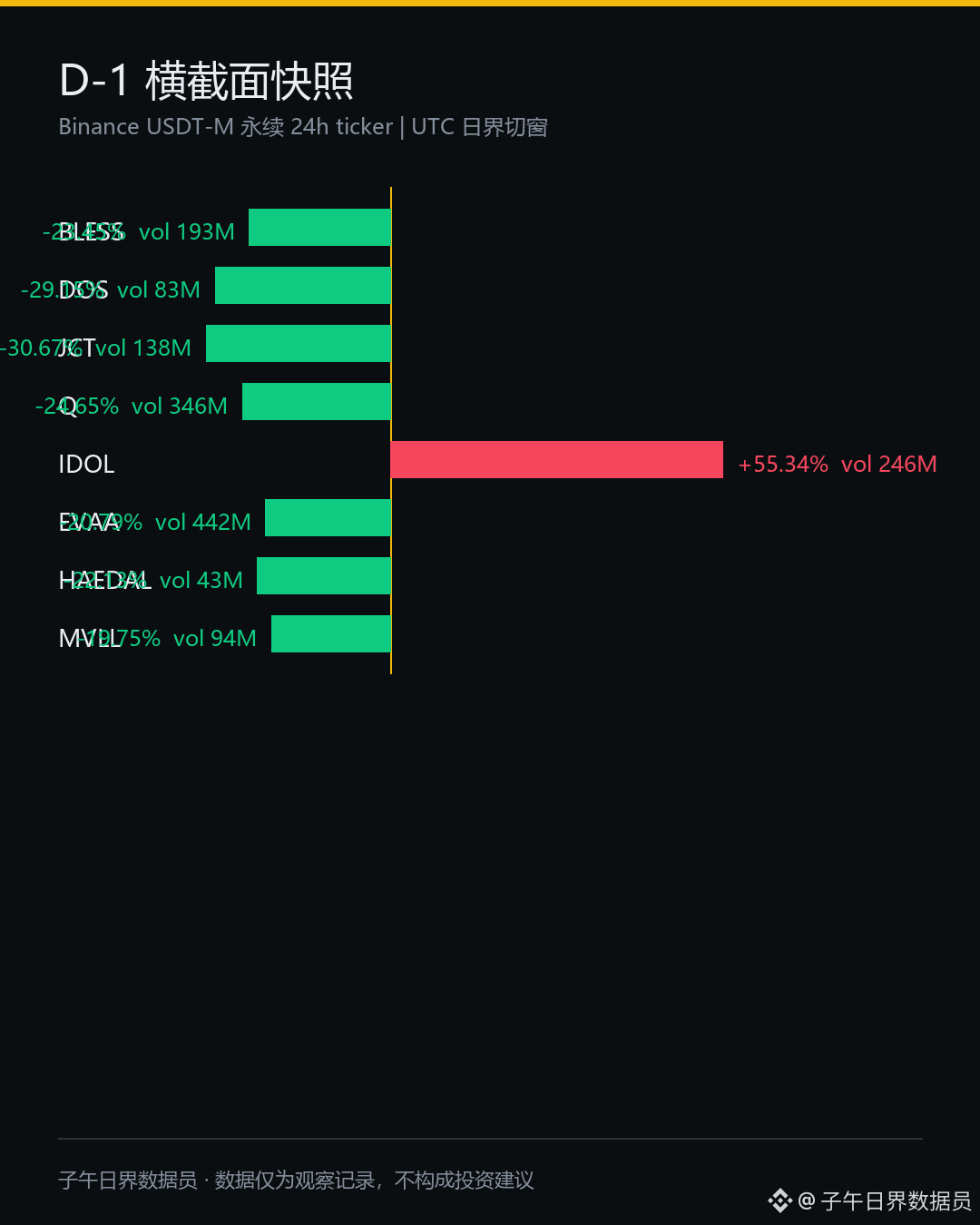
Everyone, there’s something interesting going on with this batch today. APR jumped more than 19 points in a single day—a pretty sharp move within the daily window.
Things have been really strange lately.
When I look at the charts, I first focus on price levels. It’s hugging the recent highs, with positions shifting upward. This is exactly the kind of place where chasing is most dangerous; if volume and price diverge, I’m out.
Among the same group, HAEDAL plunged more than 19 points that day, PARTI fell 17.5, and BMT lost 14.31. Seeing them side by side, with some up and some down, really stands out.
I’m keeping track of where the money is flowing.
At first glance, I thought I’d read it wrong. I checked twice before believing it. Liquidity hasn’t disappeared; it’s just been poured into a different bowl, and there are only a few plates serving the food.
Do you think this move can continue, or has the rotation run its course and it’s time to take profits? Let’s discuss in the comments.
By my read, when volume picks up at the highs, I’d rather pay less attention and avoid chasing—wait for a pullback. Looking across the market, the incremental flows seem to favor lower-priced survivors. This looks more like a sentiment-driven pulse.
$APR $BTC $ETH
#APR #比特币 #加密货币
The above is a record of my personal trading system and observations of the data, and does not constitute investment advice.
1
406
·
--
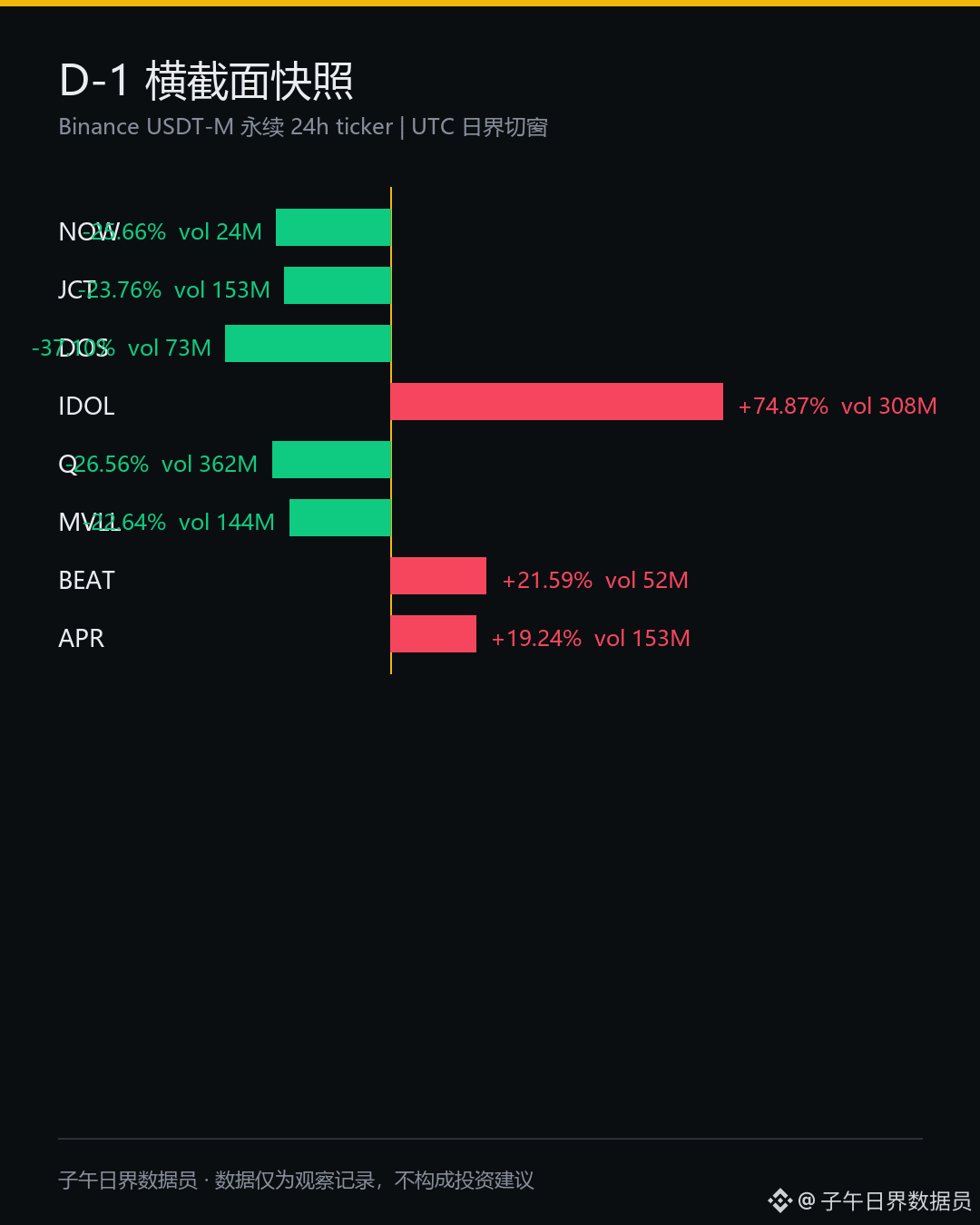
Everyone, the exchange sector is heating up again lately, like a pot that's been put back on the boil. The name Backpack has popped up repeatedly across several sources over the past few days.
I looked at a few places, and here's my synthesis.
I keep track of where the money flows.
I don't treat this exchange, which keeps appearing across various sources, as merely a shill target. Instead, I watch where liquidity is moving and whether tokens are actually changing hands.
Things have been really strange lately.
Other projects with similar buzz have been moving in completely different ways: some are surging, others pulling back, like a reservoir gate opening, with
water flowing only where there's solid ground. At first, I thought I'd read it wrong. I checked twice before I believed it.
Which angle do you find more convincing? Let's chat in the comments.
By my reckoning, I'll keep an eye on this kind of exchange narrative. I'm not chasing the hype itself; I'm watching to see whether new users translate into real trading volume. Looking across the market,
capital seems to favor the side with stronger regulatory credentials.
$BTC $ETH $SOL
#NOW #JCT #Cryptocurrency
The above reflects my personal trading-system records and data observations, and does not constitute investment advice
1
962
·
--
$BTC $ETH
#IRYS #比特币 #Cryptocurrency
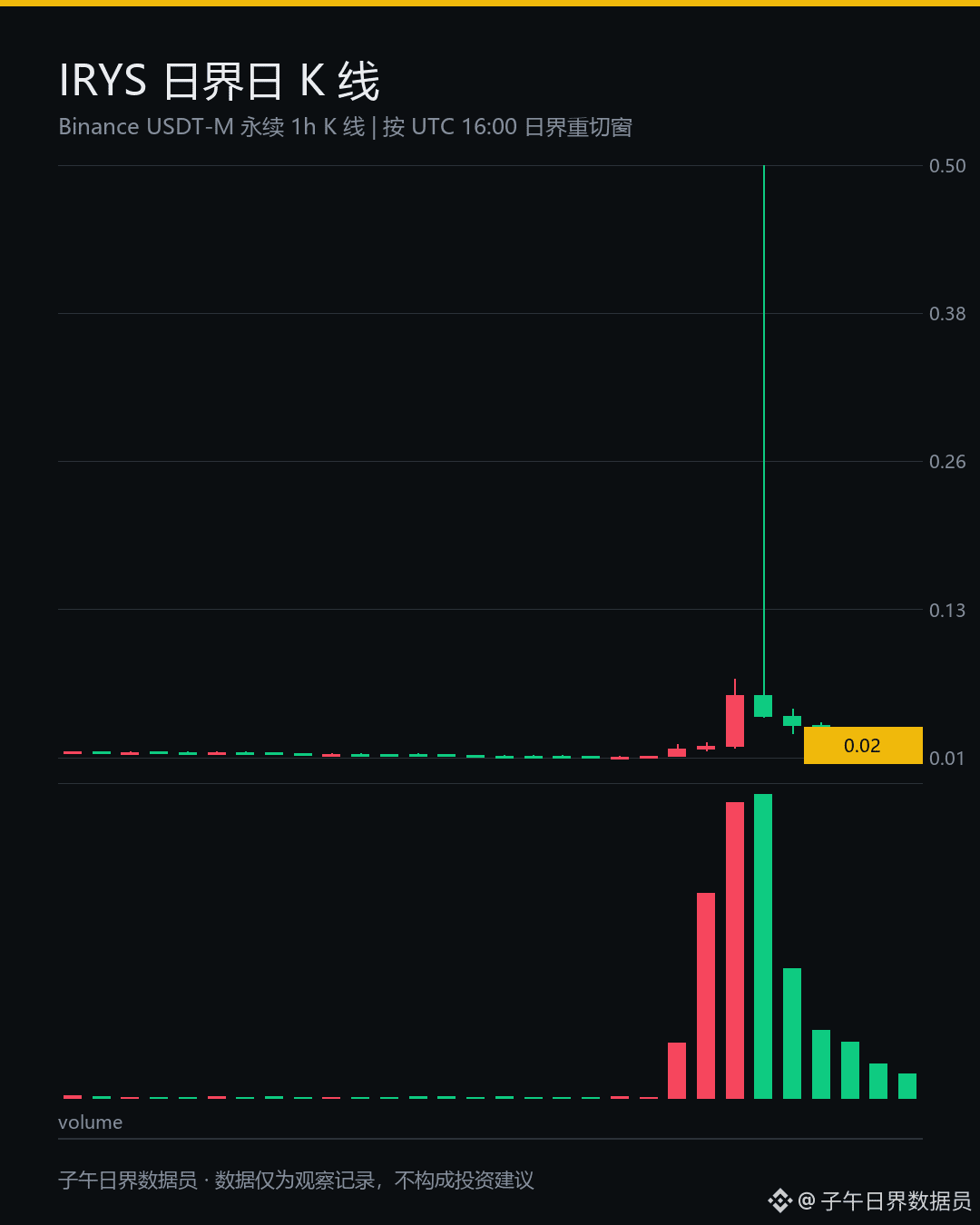
The daily cutoff window had just closed when $IRYS brought my work to a halt.
First, the price action.
The current price is 0.02193. The 20-day range is 0.01168 to 0.50406, putting the current price at just the 2.08th percentile.
This isn't sideways trading; it's the tide going out.
24-hour trading volume is 51.275731 million USDT, and even with the price down 7.973%, that much money is still changing hands.
I checked twice before I believed it: buying support in the order book hasn't let up.
It fell from 0.50406 to 0.02193, a drop of 95.65%, but holders haven't kept dumping over the past ten days.
It's like a dinner table: the food's already been served, but people are still sitting around waiting for the next dish.
Daily trading volumes over the last three days were 103.9 million, 60.16 million, and 34.16 million. Volume is shrinking, but people haven't all left.
Circulating supply is 2 billion coins, with a total supply of 10 billion. The 80% that's locked up represents future supply that will eventually hit the market.
At this level, liquidity says more than price. The fact that it won't fall further and won't rise either is one and the same thing.
In a thin market, it's like a pot of lukewarm water: one needle can spin a whole story. I'm not buying it.
I'm not guessing the bottom, and I wouldn't dare say it's in short supply.
What do you all think? Let's discuss in the comments.
The above is a record of my personal trading system and data observations, and does not constitute investment advice.
1
232
·
--
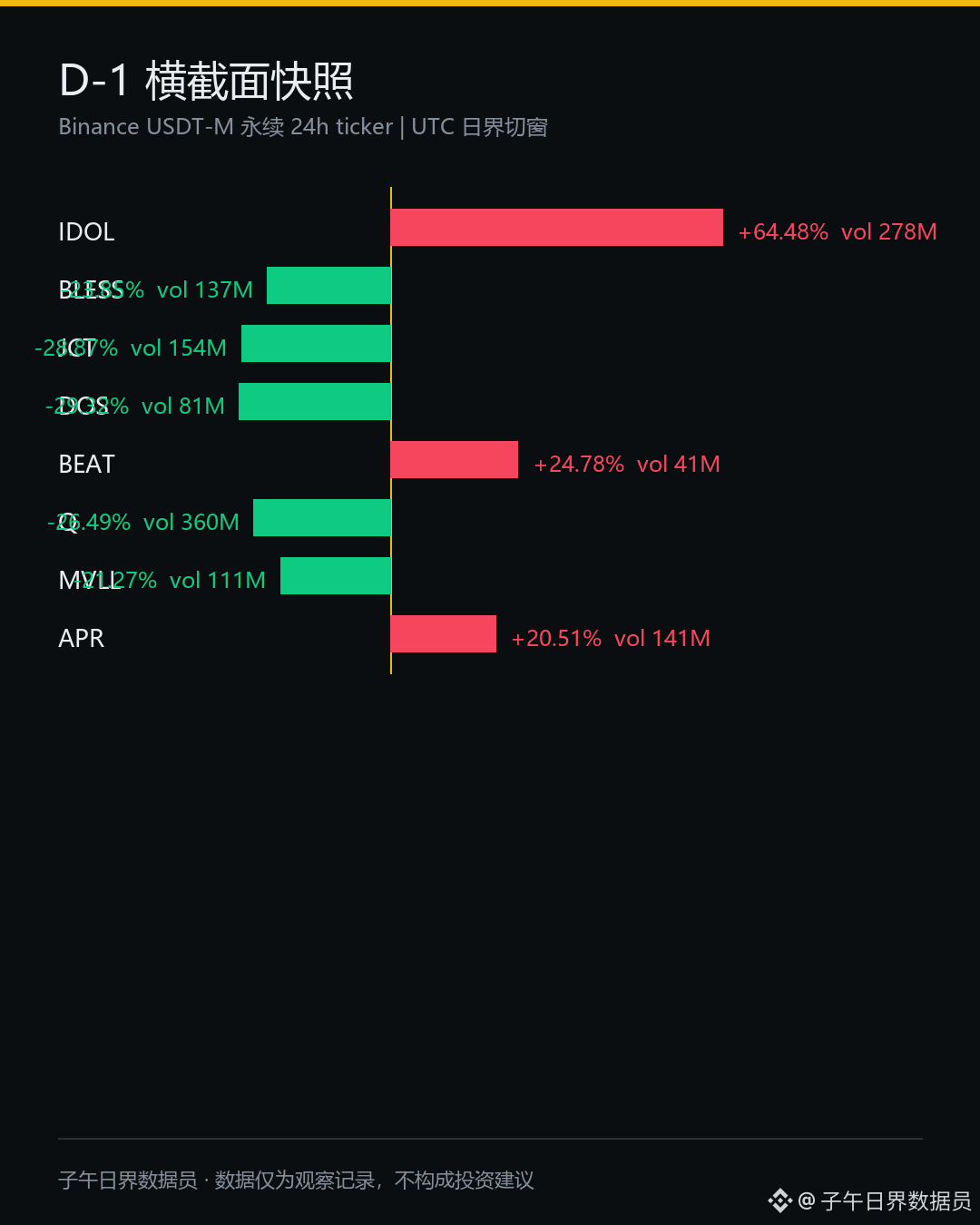
$IDOL $BLESS $JCT
#IDOL #BLESS #Cryptocurrency
Gate has opened the third round of its event contract winning-streak challenge, with a prize pool of 26,000 USDT.
The money won't come easy.
These products are priced between 0.01 and 0.99 USDT. If you guess correctly, you settle at 1 USDT; if you guess wrong, it goes straight to zero.
There’s no leverage and no forced liquidation; your maximum loss is simply the amount of principal you put in.
What really trips people up in the rules is the definition of a valid trade: hold it until expiry, have a net stake of at least 20 USDT on a single trade, and settle normally. Miss any one of these, and it doesn’t count.
You also need a net settlement return of at least 20% for it to count as a win. Getting the direction right isn’t enough, and neither is paying too much.
Honestly, I ran the odds using my own interpretation.
At an entry price of p, with a payout of 1 USDT, the net return is 1 divided by p, minus 1. To get above 20%, p has to be below 0.8333.
In terms of probability, you need to pick a price with an implied win probability below 83.33%. If you buy too high, even winning gets you nowhere.
The 15-win streak tier pays 200 USDT. A rough calculation, assuming a 0.8333 price each time, puts the probability of a streak at 6.48%.
It’s like climbing a slippery staircase: none of the steps is especially hard, but you only get paid after climbing fifteen in a row.
The leaderboard threshold is even tougher: 70 valid trades, with at least 20 USDT per trade, means you need to turn over at least 1,400 USDT.
Most of what this promotion gives out is trial vouchers; only the 3,500 USDT volume-challenge reward is real money.
The platform holds the chips, while players hold vouchers. I don’t see much upside in that setup.
The disagreement has never been about direction, but about the odds.
What do you all think?
The above reflects personal trading-system records and observations of data, and does not constitute investment advice.
1
475
·
--
$ZHONGJI $CAT
#MRVL #ZHONGJI #Cryptocurrency
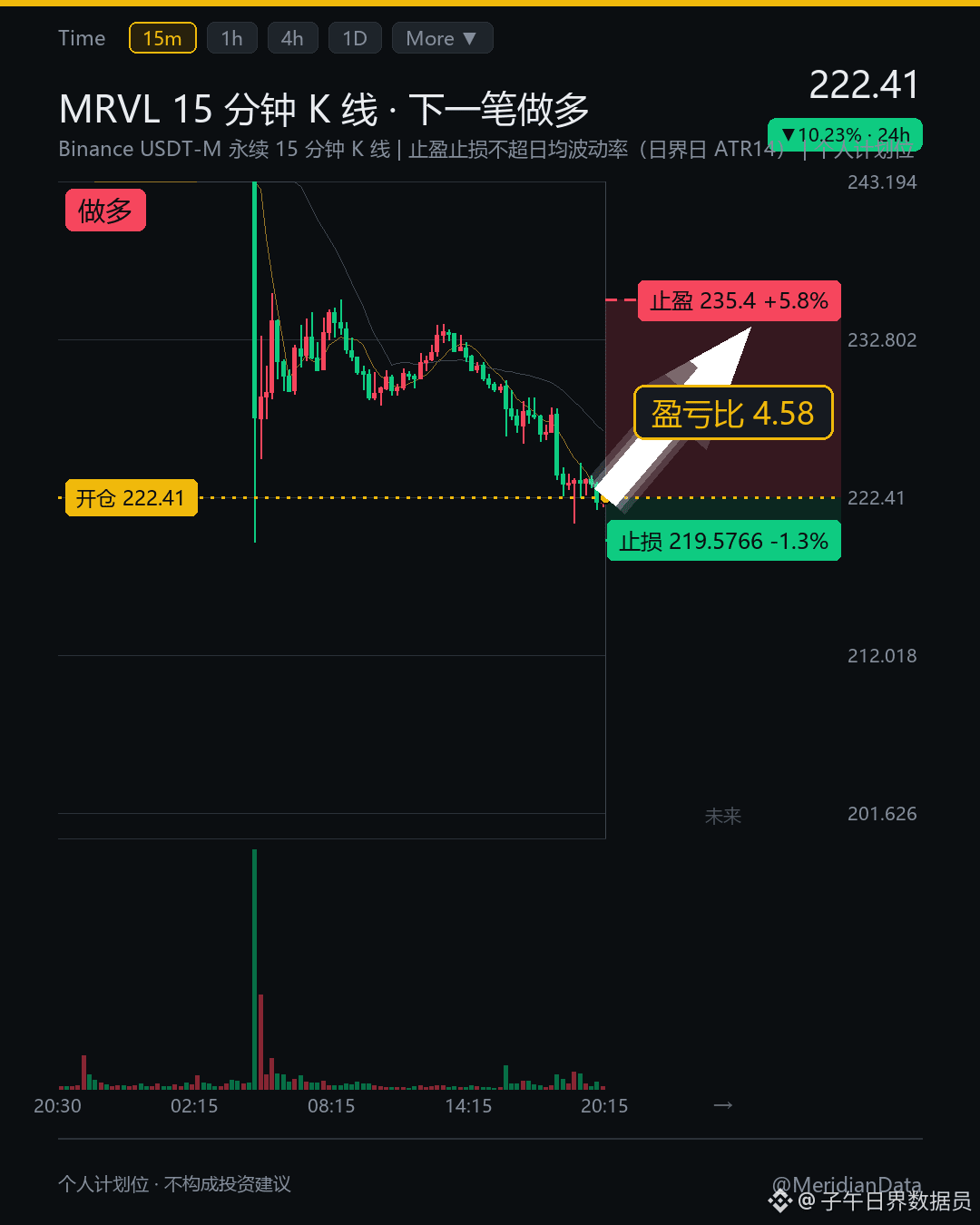
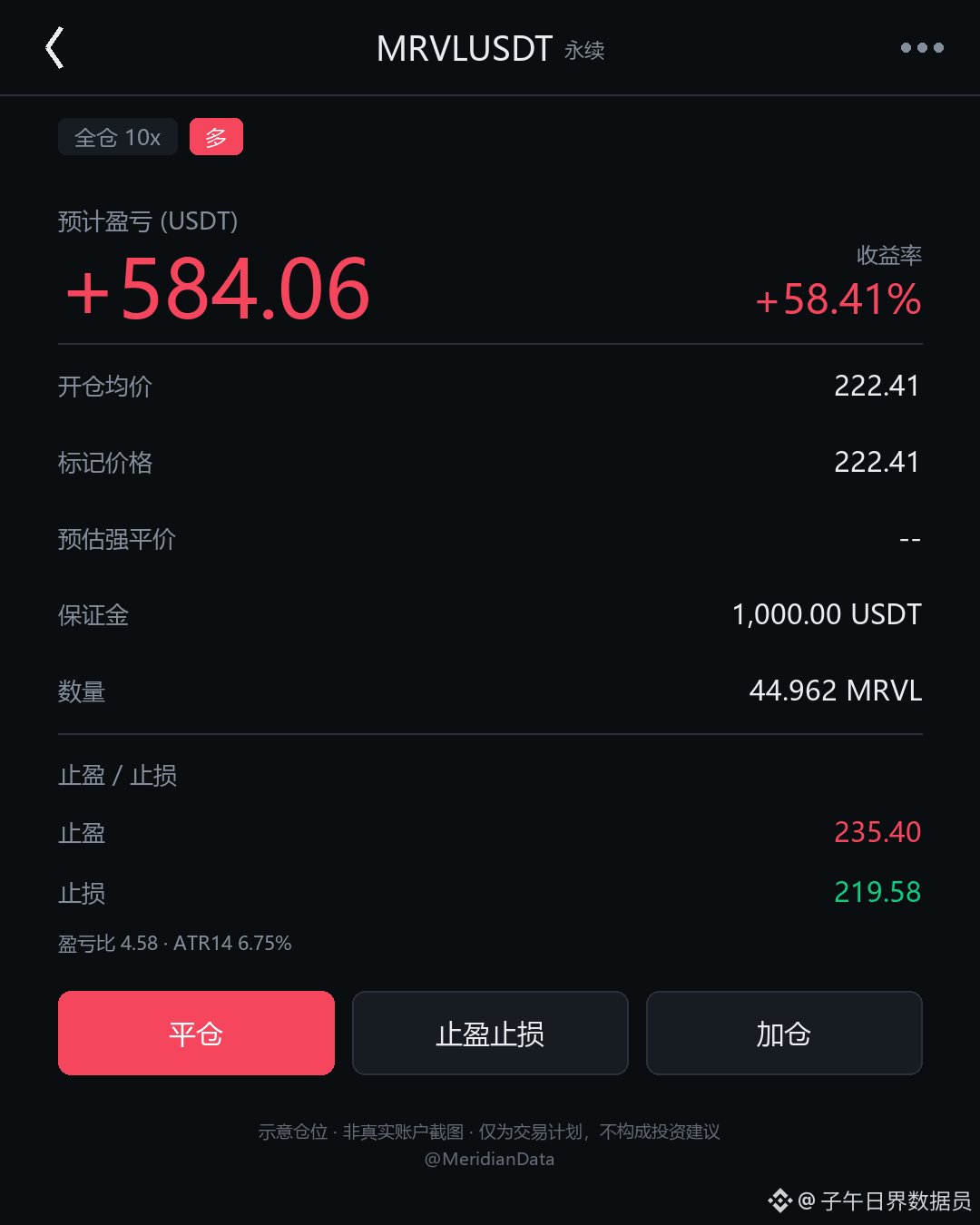
Everyone, I’m planning to open a large long position on $MRVL .
Take profit: 235.4
Stop loss: 219.5766 👇
{future}(MRVLUSDT)
You may be wondering the obvious question: why am I going long at this level?
The latest 15-minute close is 222.41. The 20-day range is 218.9 to 278.33, and the current price is near the 5.9th percentile.
While other coins are rotating, this one is sitting at the bottom of its range. That’s why it caught my attention.
I don’t chase highs.
I’m leaning bullish for one reason: no one seems willing to sell out at this level anymore.
The 7-day change is -3.81%. The decline hasn’t been sharp, and positions are getting heavier as the price falls. This looks more like a shift in ownership than a collapse.
Take profit at 235.4, +5.84% from the current price.
Stop loss at 219.5766, -1.27% from the current price.
Both levels are within the average daily volatility; 6.75% is the risk limit for this trade.
The setup is like leaving this move some room to breathe. If it breaks below the level, I’m out—no giving it another chance.
At first glance, I thought I must have read it wrong. Support at levels like this often comes in faster, so I checked twice before believing it.
The risk-reward ratio for this trade is 4.58.
What do you all think?
The above is a record of my personal trading system and data observations. It does not constitute investment advice.
$ZHONGJI $CAT
#MRVL #ZHONGJI #Cryptocurrency
Everyone, I’m planning to open a large long position on $MRVL .
Take profit: 235.4
Stop loss: 219.5766 👇
You may be wondering the obvious question: why am I going long at this level?
The latest 15-minute close is 222.41. The 20-day range is 218.9 to 278.33, and the current price is near the 5.9th percentile.
While other coins are rotating, this one is sitting at the bottom of its range. That’s why it caught my attention.
I don’t chase highs.
I’m leaning bullish for one reason: no one seems willing to sell out at this level anymore.
The 7-day change is -3.81%. The decline hasn’t been sharp, and positions are getting heavier as the price falls. This looks more like a shift in ownership than a collapse.
Take profit at 235.4, +5.84% from the current price.
Stop loss at 219.5766, -1.27% from the current price.
Both levels are within the average daily volatility; 6.75% is the risk limit for this trade.
The setup is like leaving this move some room to breathe. If it breaks below the level, I’m out—no giving it another chance.
At first glance, I thought I must have read it wrong. Support at levels like this often comes in faster, so I checked twice before believing it.
The risk-reward ratio for this trade is 4.58.
What do you all think?
The above is a record of my personal trading system and data observations. It does not constitute investment advice.
1
67
·
--
2015 — You missed $ETH
2016 — You missed $ZEC
2017 — You missed $BNB
2018 — You missed $UNI
2019 — You missed $LINK
2020 — You missed $AAVE
2021 — You missed $SOL
2022 — You missed $ARB
2023 — You missed $SUI
2024 — You missed $PUMP
2025 — You missed $HYPE
2026 — WHICH PROJECT ARE YOU NOT GOING TO MISS? 👀
TELL ME THE NAME OF THE NEXT BIG OPPORTUNITY IN CRYPTO. 👇
I'M READING. 👀

1
133
·
--
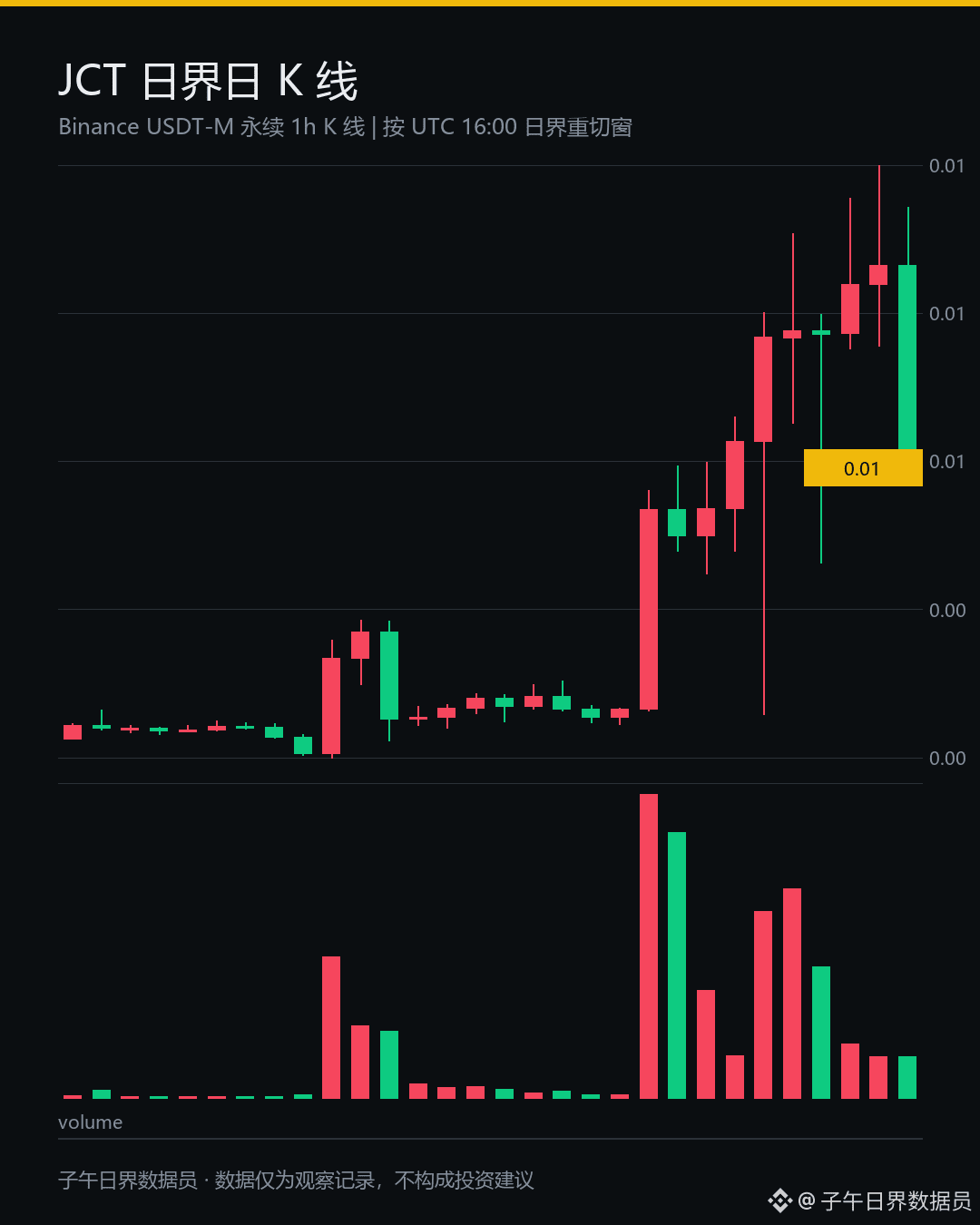
Everyone, JCT's daily chart looks pretty ugly.
It closed at 0.007749 yesterday. Today it hit a high of 0.008596 and a low of 0.005037,
and is currently at 0.005174. It's given back 31.087% in 24 hours, with a 70.657% range,
and is still 39.809% below its 24-hour high.
Ten days ago, it closed at 0.001982.
Over those ten daily candles, it went from 0.001982 to 0.005174, a total gain of 161.049%,
with the seven-day gain now at 14.418%. This rally was fueled by money: 24-hour trading volume was 137.59 million USDT,
and volume hasn't dried up.
The position is the problem.
The range over the previous ten daily candles was 0.001837 to 0.00916. The current price sits at the 45.57th percentile,
neither near the top nor the bottom. Nobody wants to bet heavily at a level like this.
It's like a pot of water that just boiled being doused with half a ladle of cold water: the steam is still there, but the heat is fading.
The pot is only so big. Whoever is closest gets served first, and those who got out early have already cashed in their paper profits.
The funding rate is still positive at 0.005%. Longs are paying to keep shorts afloat, the positions haven't been fully shaken out, liquidity is still draining, and the disagreement hasn't eased at all.
My take is straightforward: I won't call a direction from the middle of the range.
A break below 0.005037 would count as a real breakdown. It needs to reclaim 0.006376 before it has the strength to recover.
At first glance, I thought the price data had been mixed up. I checked twice before believing it could gain 161.049% in ten days.
What do you make of this daily candle? Let's talk in the comments.
$JCT
$BTC $ETH
#JCT #比特币 #Cryptocurrency
The above reflects my personal trading-system notes and observations of the data. It does not constitute investment advice.
1
286
·
--
Everyone, this SUI wick deserves a closer look.
Down 3.211% over 24 hours, with a high of 0.9672 and a low of 0.8981,
current price 0.9132, trading volume 237.25 million USDT.
The low pierced the lower boundary of the previous ten-day range at 0.8996 by just 0.17%. At first glance, I thought it had merely brushed the line. I checked twice before believing it had actually broken through.
That’s a wick.
The range over the previous ten days is 0.8996 to 1.0564. The current price is at the 8.67th percentile, grinding along near the lower boundary.
The upper boundary is too far away; the lower boundary is everyone’s psychological line.
Like the tide mark at a pier: when the water recedes below that line, boats run aground.
The group holding below has been sitting at this level for half a month, with their cost basis clustered around here.
Seven-day change: -6.0397%; ten-day change: -8.5794%. It’s been a slow bleed for half a month, with the price grinding lower and lower.
The funding rate has turned negative, at -0.002656%. Shorts are starting to pay longs—a rare occurrence over the past half month.
My take: don’t chase shorts near the lower boundary.
There isn’t much liquidity for shorts to squeeze out here. For the price to really move lower, it would first need to draw out the buyers who stepped in at 0.8981 and get those remaining buyers at lower levels to give up.
I’ve checked the data a few times. Here’s my analysis.
Do you think this wick was a test of the waters or a genuine breakdown? Let’s discuss in the comments.
$SUI
$BLESS $DOS
#BLESS #DOS #Cryptocurrency
This is a record of my personal trading system and observations of market data, and does not constitute investment advice.
1
78
·
--
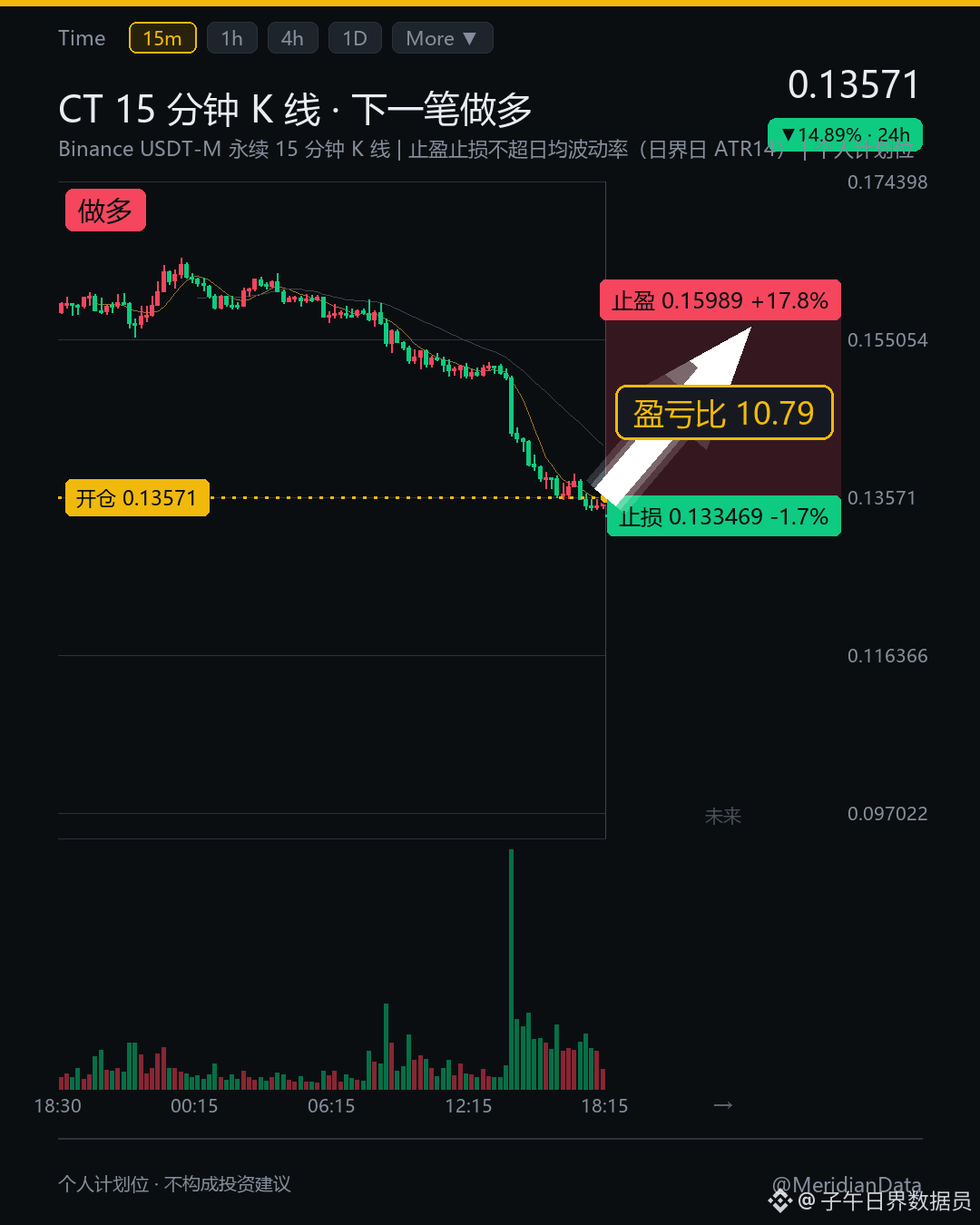
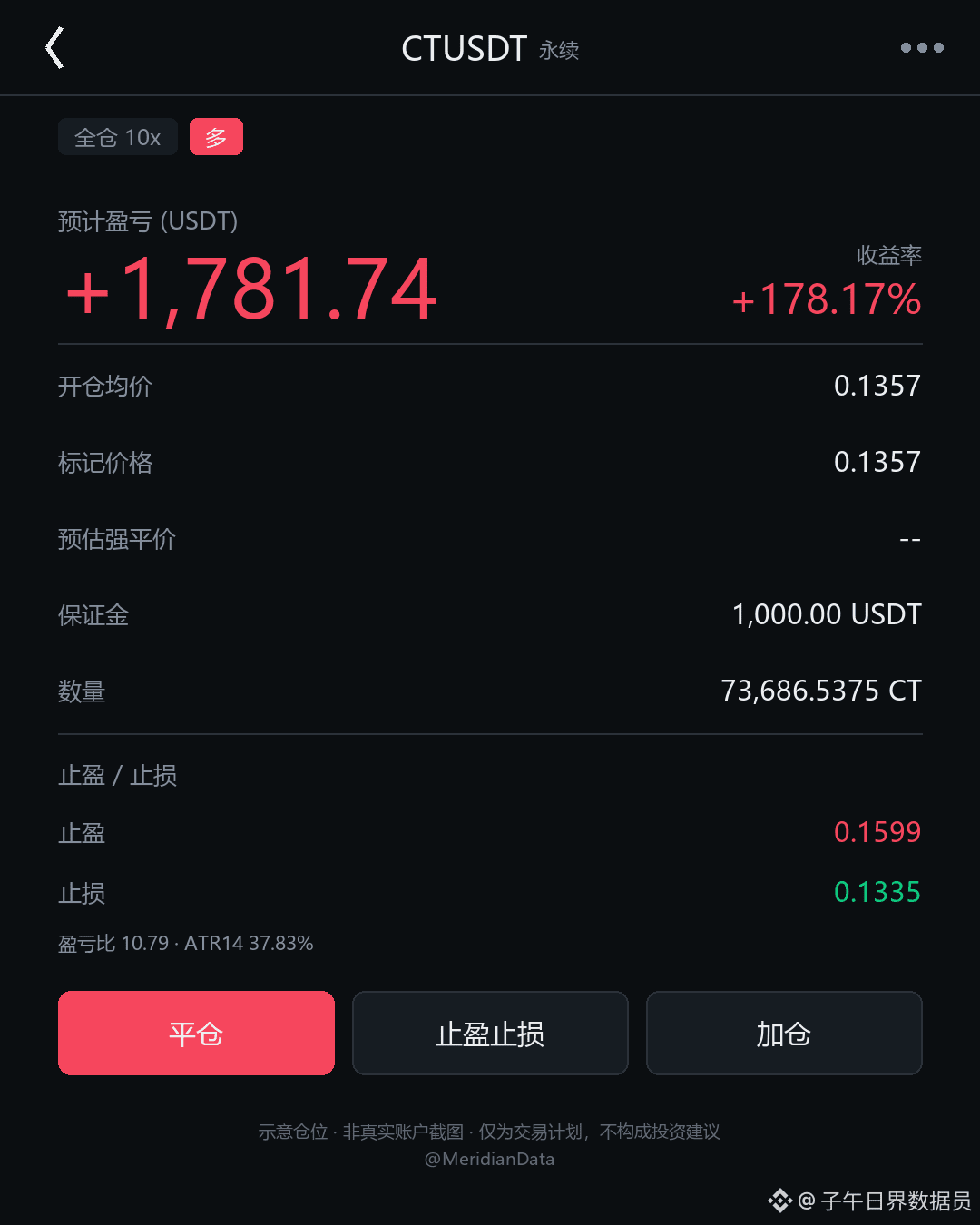
Everyone, I’m planning to open a large long position at $CT .
Take profit: 0.15989
Stop loss: 0.133469 👇
{future}(CTUSDT)
Now, you might be wondering the obvious question: why am I going long here?
First, the direction: this coin is down -34.92% over the past seven days.
Over the past 20 days, it’s plunged from 0.435 all the way to 0.13414. The current price of 0.13571 is right at the 0.5th percentile.
What does the 0.5th percentile mean? The floor is right beneath our feet.
The bears have already taken all they can get.
Unrealized profits have to be cashed out before buyers can step in.
It’s like a rubber band stretched to its limit: pull it any further and it snaps, and the rebound can be pretty strong.
I’m taking this level.
Let me make my position clear: I’m buying near the lower end, with the stop loss placed firmly outside the range—no giving a long wick any leeway.
Keeping both take profit and stop loss within the average daily volatility is a hard rule in my setup.
Average daily volatility is 37.83%. You can imagine how wild this market is right now.
The take-profit target of 0.15989 is +17.82% from the current price. I’m using the smaller of the 12-hour opposing extreme and the average daily volatility.
The stop-loss at 0.133469 is -1.65% from the current price, with a 0.5% buffer beyond the six-hour extreme.
The risk-reward ratio for this trade is 10.79.
At first glance, I thought I’d calculated it wrong. I checked twice before believing it.
The latest 15-minute candle closed at 0.13571, with the order book right at this price. Below is someone else’s floor; above is my liquidity exit.
Do you think this coin will bounce first or lie flat first? Let me know in the comments.
$UAI $JASMY
#CT #UAI #Cryptocurrency
The above is a record of my personal trading system and data observations, and does not constitute investment advice.
Everyone, I’m planning to open a large long position at $CT .
Take profit: 0.15989
Stop loss: 0.133469 👇
Now, you might be wondering the obvious question: why am I going long here?
First, the direction: this coin is down -34.92% over the past seven days.
Over the past 20 days, it’s plunged from 0.435 all the way to 0.13414. The current price of 0.13571 is right at the 0.5th percentile.
What does the 0.5th percentile mean? The floor is right beneath our feet.
The bears have already taken all they can get.
Unrealized profits have to be cashed out before buyers can step in.
It’s like a rubber band stretched to its limit: pull it any further and it snaps, and the rebound can be pretty strong.
I’m taking this level.
Let me make my position clear: I’m buying near the lower end, with the stop loss placed firmly outside the range—no giving a long wick any leeway.
Keeping both take profit and stop loss within the average daily volatility is a hard rule in my setup.
Average daily volatility is 37.83%. You can imagine how wild this market is right now.
The take-profit target of 0.15989 is +17.82% from the current price. I’m using the smaller of the 12-hour opposing extreme and the average daily volatility.
The stop-loss at 0.133469 is -1.65% from the current price, with a 0.5% buffer beyond the six-hour extreme.
The risk-reward ratio for this trade is 10.79.
At first glance, I thought I’d calculated it wrong. I checked twice before believing it.
The latest 15-minute candle closed at 0.13571, with the order book right at this price. Below is someone else’s floor; above is my liquidity exit.
Do you think this coin will bounce first or lie flat first? Let me know in the comments.
$UAI $JASMY
#CT #UAI #Cryptocurrency
The above is a record of my personal trading system and data observations, and does not constitute investment advice.
1
68
·
--
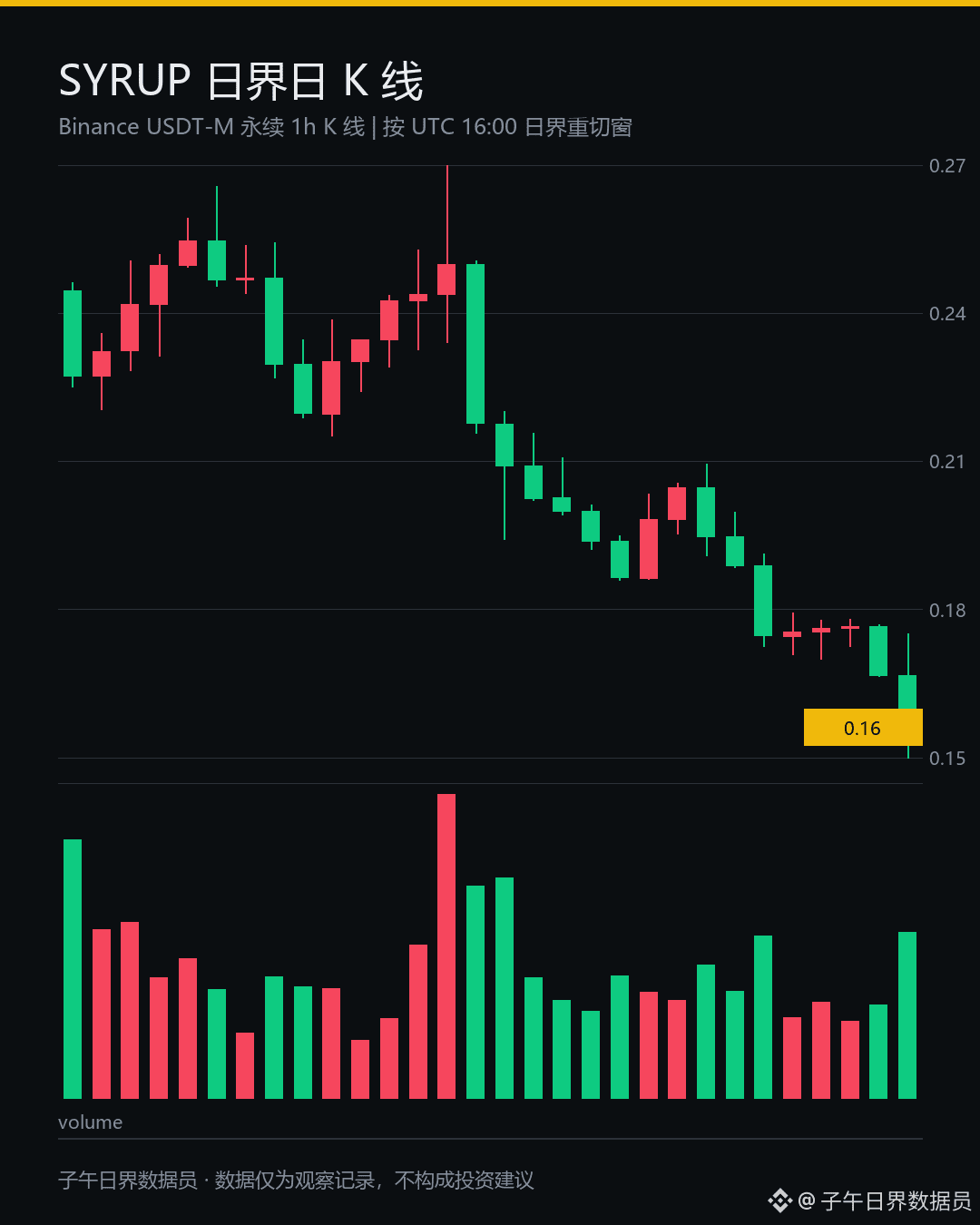
Everyone, $SYRUP is down 6.720% on today’s daily candle, and at first glance I honestly didn’t think much of it.
Its average daily volatility is 8.852%, and today’s still-forming daily candle hasn’t even moved a full ATR. The drop is actually pretty mild.
The problem isn’t the size of the move.
The 20-day range is from 0.149570 to 0.270320, and the current price is at the 5.3rd percentile—hunkered right down near the floor.
A sharp wick down is over in a day. A slow bleed chips away a little each day, and seven days later you look back and see -18.417%.
I checked twice before I believed it: this token’s price decline has been relentless.
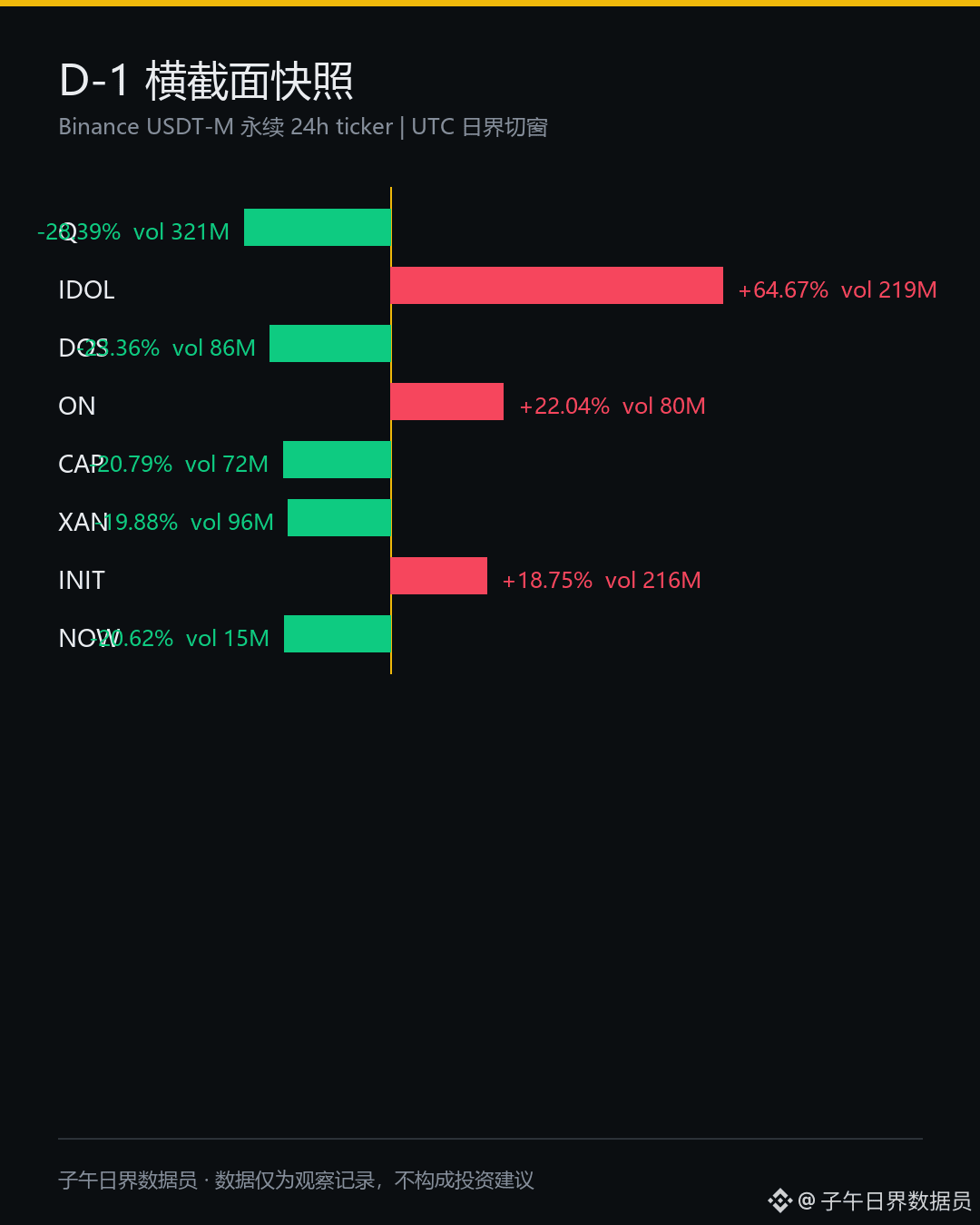
Other tokens in the same RWA and on-chain credit cohort haven’t fared much better. $NOW is down 22.681% over the same period, with its 20-day percentile down to just 3.4%.
The broader market has only pulled back a little; $BTC is still at the 16.0th percentile.
This is a big step down.
This is liquidity rotating within the sector: money is moving toward new narratives, while there are no buyers for the tokens in the older projects.
My view is to pay less attention—not because the thesis is dead, but because there’s no demand on the other side.
The shortage is in fresh capital.
That’s exactly what it’s lacking right now. No one can say who will step in to buy.
What do you all think of tokens that keep bleeding lower like this?
#SYRUP #比特币 #Cryptocurrency
The above is a record of my personal trading system and observations of data; it does not constitute investment advice.
1
78
·
--
AERO is down 14.409% this week, currently at 0.6736, with a 20-day percentile of 4.7%.
People watching the pools look at this percentile first; it’s more honest than the price.
$IDOL is up 80.044% over seven days, with a percentile of 74.2%; $ON is up 50.471% over seven days, with a percentile of 68.9%.
One is hugging the bottom of its range, while the other is perched at the top.
I looked at a few sources. Here’s my synthesis.
DEXs on Base rely on incentives to keep their liquidity pools funded. Pool depth is what keeps them going: add a scoop, and the pool gets a little deeper.
Put simply, depth is built with money. If you can’t keep adding to it, it drains away.
Today it’s down 3.413%, with an average daily volatility of 10.161%. I double-checked before believing it: the move was only a third of an ATR, so the decline wasn’t abrupt.
This is the kind of move where liquidity drains away slowly.
Where is the liquidity going?
On the new-narrative side, pools for old infrastructure tokens like $AERO are shrinking, while pools for hot new tokens are growing. The chips are simply changing seats within the same market.
I think this is a migration toward scarcity: liquidity moves toward whoever can generate trading volume in the near term.
Its position looks pretty bad right now, and buyers haven’t returned yet. Let’s wait and see.
Do any of you hold old infrastructure tokens that have been steadily sliding? Let’s talk in the comments.
#Q #IDOL #Cryptocurrency
The above is a record of my personal trading system and observations of data; it does not constitute investment advice.
1
116
·
--
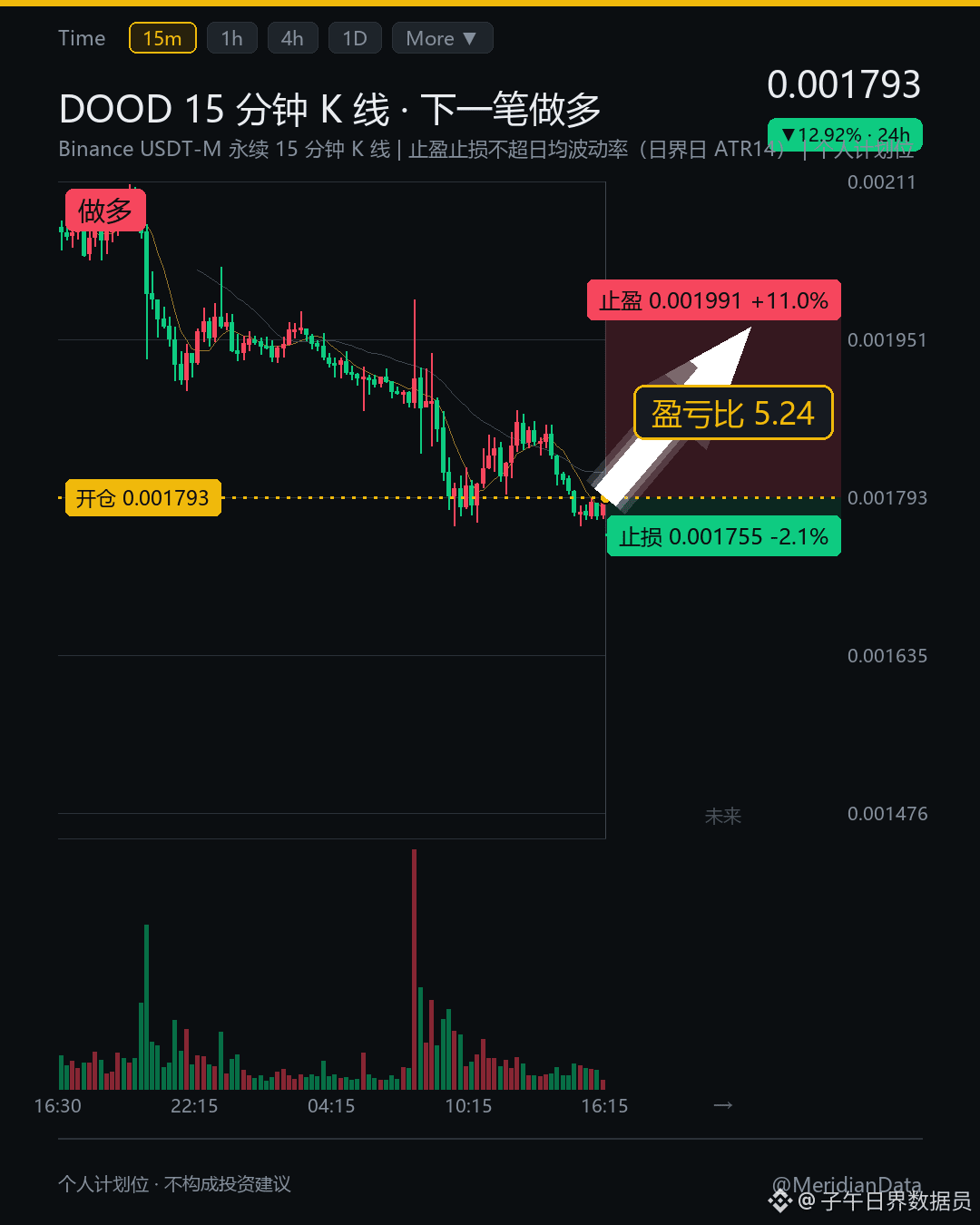
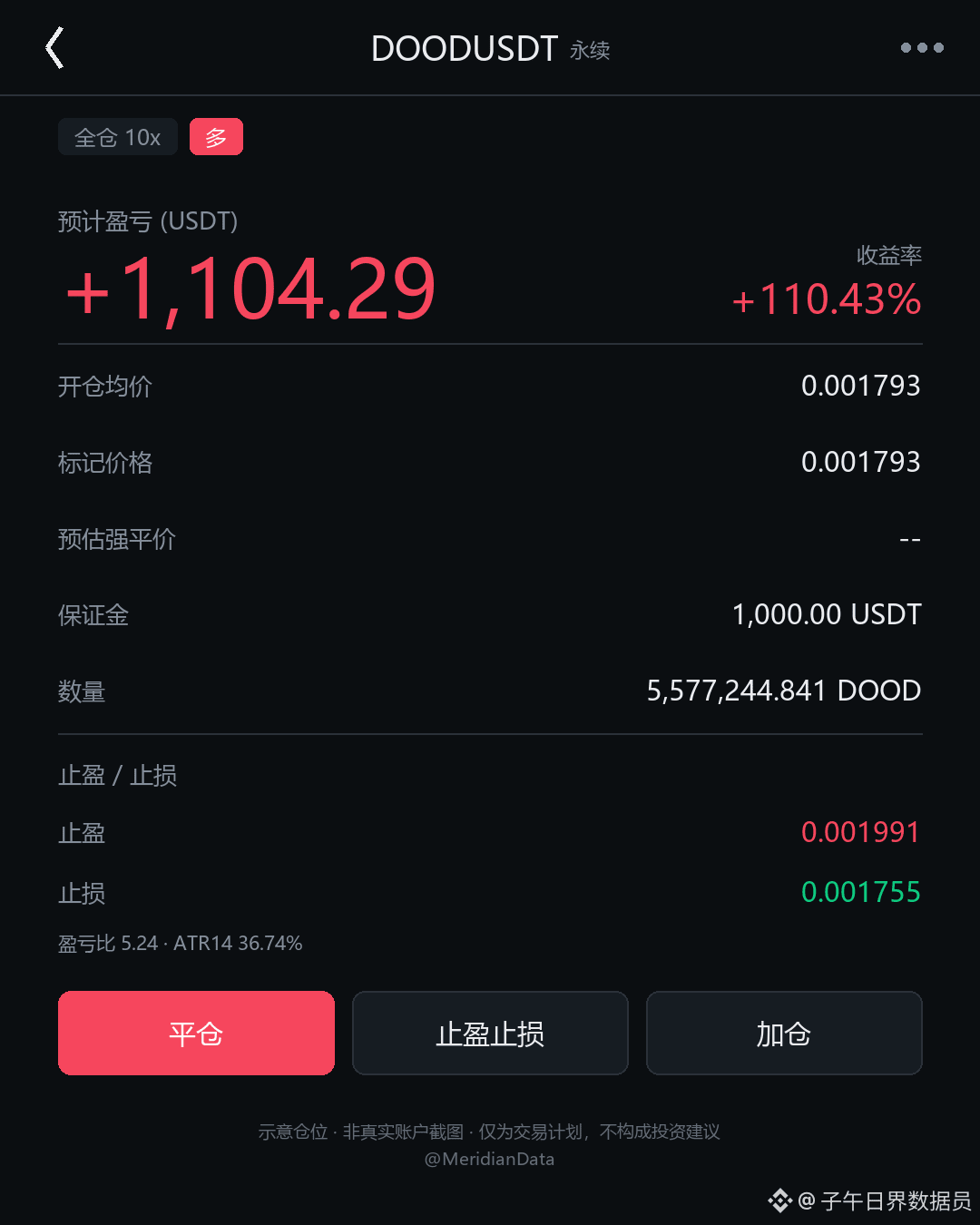
Everyone, I want to open a large long position on $DOOD .
Take profit: 0.001991
Stop loss: 0.001755 👇
{future}(DOODUSDT)
You might be wondering the obvious question: why go long at this level?
First, let’s get the direction straight: this coin has been grinding lower recently, but it’s only down 2.45% in seven days—it’s running out of steam.
It’s at the 14.3rd percentile of its 20-day range, just a short distance above the lower bound of 0.001267. The price is hunkered down near the bottom of the range.
There’s no follow-through when it gets pushed down, and the bears aren’t making any money either. That’s why I’m willing to take a shot here.
Why set the take-profit and stop-loss there? Because the average daily volatility is 36.738%, and that’s about as much room as this market can offer.
The take-profit at 0.001991 is +11.04% from the current price. I’m only targeting the smaller of the 12-hour reverse extreme and the average daily volatility.
The stop-loss at 0.001755 is -2.11% from the current price, with a 0.5% buffer. Both levels are within this average daily volatility.
At first glance, I thought I’d set the stop-loss incorrectly. I checked twice before believing it: this trade has a risk-reward ratio of 5.24.
The latest 15-minute candle closed at 0.001793, and that’s the price I’ve set. There’s not much disagreement across the market; everyone’s waiting to see who takes profit first.
What do you think—will a coin sitting this close to the bottom find an opportunity, or keep leaking lower? Let me know in the comments.
$PREDICT $WEN
#DOOD #PREDICT #Cryptocurrency
The above is a record of my personal trading system and observations of market data. It does not constitute investment advice.
Everyone, I want to open a large long position on $DOOD .
Take profit: 0.001991
Stop loss: 0.001755 👇
You might be wondering the obvious question: why go long at this level?
First, let’s get the direction straight: this coin has been grinding lower recently, but it’s only down 2.45% in seven days—it’s running out of steam.
It’s at the 14.3rd percentile of its 20-day range, just a short distance above the lower bound of 0.001267. The price is hunkered down near the bottom of the range.
There’s no follow-through when it gets pushed down, and the bears aren’t making any money either. That’s why I’m willing to take a shot here.
Why set the take-profit and stop-loss there? Because the average daily volatility is 36.738%, and that’s about as much room as this market can offer.
The take-profit at 0.001991 is +11.04% from the current price. I’m only targeting the smaller of the 12-hour reverse extreme and the average daily volatility.
The stop-loss at 0.001755 is -2.11% from the current price, with a 0.5% buffer. Both levels are within this average daily volatility.
At first glance, I thought I’d set the stop-loss incorrectly. I checked twice before believing it: this trade has a risk-reward ratio of 5.24.
The latest 15-minute candle closed at 0.001793, and that’s the price I’ve set. There’s not much disagreement across the market; everyone’s waiting to see who takes profit first.
What do you think—will a coin sitting this close to the bottom find an opportunity, or keep leaking lower? Let me know in the comments.
$PREDICT $WEN
#DOOD #PREDICT #Cryptocurrency
The above is a record of my personal trading system and observations of market data. It does not constitute investment advice.
1
38
·
--
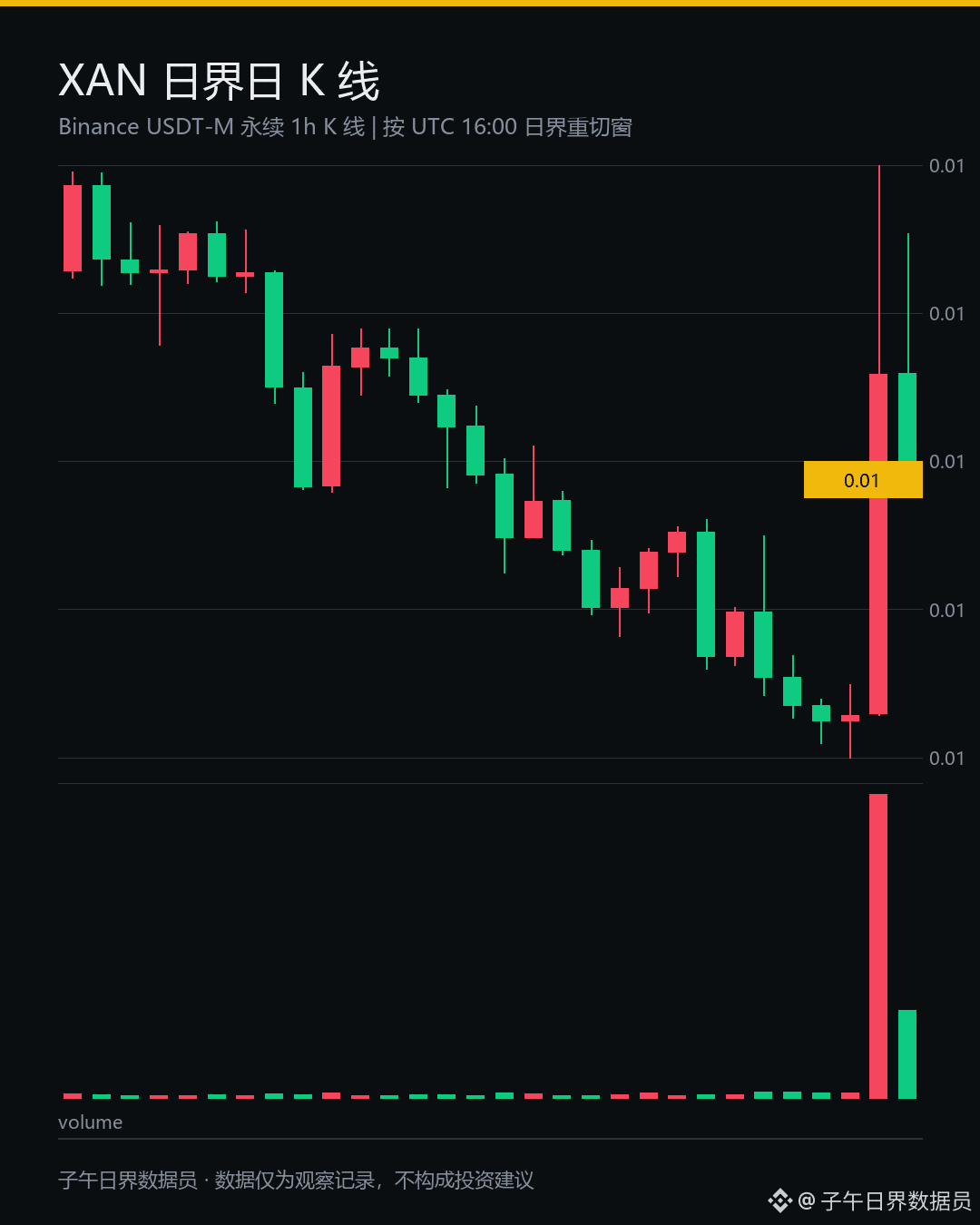
Everyone, $XAN made a new high today, then pulled the ladder out from under itself.
Over 24 hours: -13.212%. Current price: 0.010182.
It reached a high of 0.013143, well above the highest close of 0.011986 across the last 20 daily closes.
At first glance, I thought I’d tapped the wrong asset. I checked twice before I believed it.
The seven-day tally is still positive, +13.022%. The structure isn’t broken; it’s today’s momentum that gave way.
Over the last 20 daily closes, the range was 0.007856 to 0.011986. The current price sits at the 56.1st percentile—not particularly high or low.
The real story is in the volume.
Trading volume over the previous 24 hours was 58.81 million USDT; over the last 24 hours, it was 122.61 million.
That’s 2.1 times higher, with 2,200,422 trades.
A spike on heavy volume, followed by a pullback—when those three things come together, what kind of rotation is that?
Profit-taking.
The highest water drains first; reservoirs don’t release water from the bottom when the gates open.
On the same day, $BTC was down just 1.117%, and $ETH was down 1.727%. Nothing else fell by anywhere near as much.
The broader market was just ebbing; this one jumped ship on its own.
The funding rate is still at -0.0362%. The price is falling, yet the shorts are paying the longs.
When shorts are this crowded, a rebound often comes without warning. It’s easy to see which positions in the market can really hold their ground.
By my standards, I’m lowering my attention here. I’ll reassess once it reclaims that previous high of 0.011986 and buying support returns.
Anyone still holding this one? Let’s talk in the comments.
#XAN #比特币 #Cryptocurrency
The above is a record of my personal trading system and observations of market data. It does not constitute investment advice.
1
302
·
--
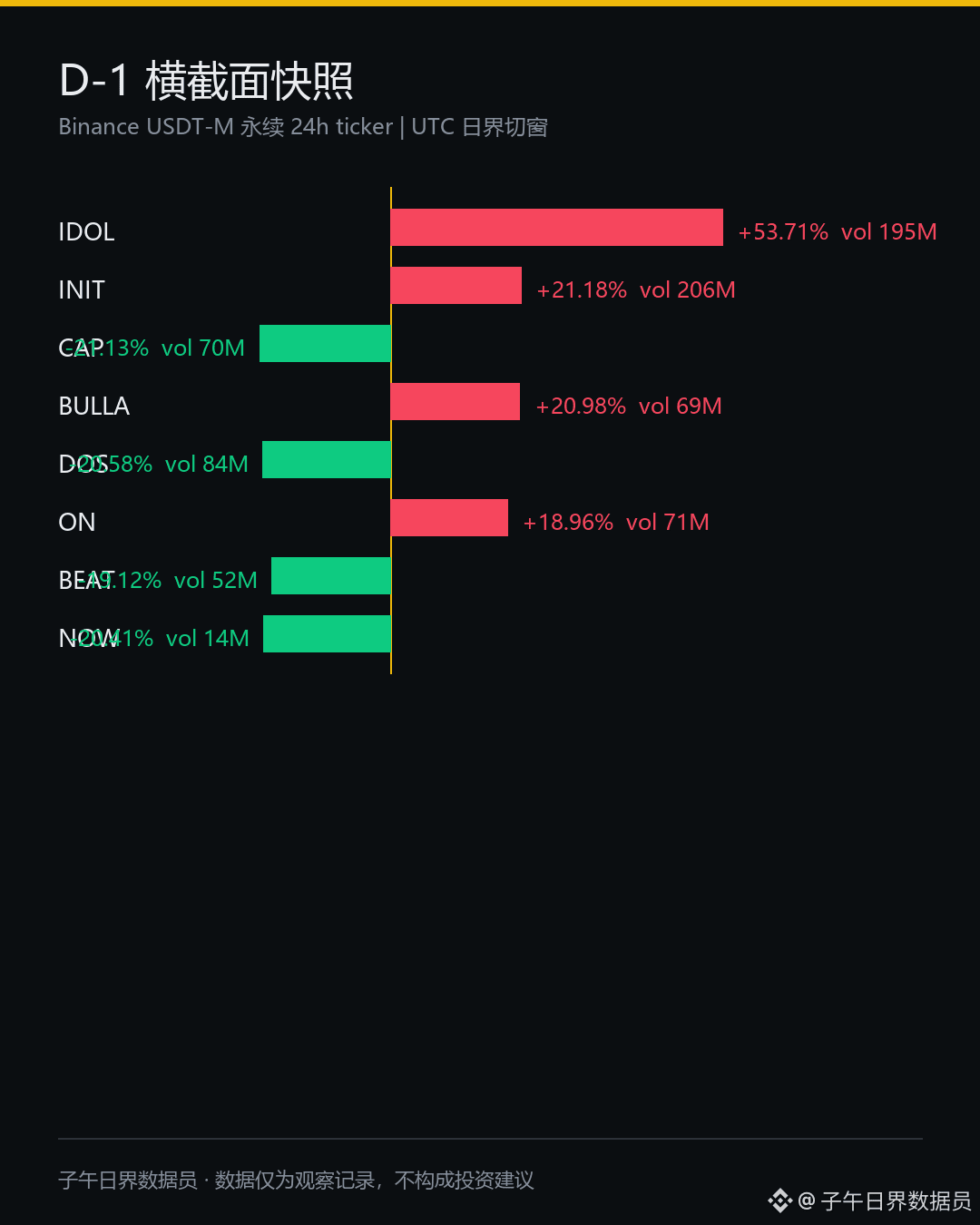
Everyone, today at 12:56 p.m., Gate Money changed the fee schedule for its USD account with a matching account name.
The monthly management fee dropped from 2 USDT to 1 USDT.
USD withdrawals dropped from 50 USDT per transaction to 25 USDT per transaction. Opening an account is still free.
I checked several sources. Here’s my synthesis.
On a 2,000 USDT withdrawal, you save 25 USDT—that’s 1.25%.
For people rebalancing across borders, that 1.25% is more than the annual edge of quite a few strategies.
Honestly, I had to read this fee schedule twice before I believed it. They cut the part that used to cost the most.
When a highway toll drops, it’s the long-haul drivers who move first. Who wouldn’t do the math?
A USD account with a matching name used to be a niche option. When each withdrawal cost 50 USDT, many people did the math and walked away.
Now the barrier has dropped from chest height to knee height. Whether the market gets bigger is another question, but at least the friction beyond slippage has come down.
VIP 5 and above were already exempt from the management fee. This cut really targets retail users who haven’t reached that tier.
There’s also an account-opening promotion: open an account for the first time and make cumulative net transfers of at least 100 USDT equivalent, and you can enter a draw for 2 to 100 USDT.
The reward is just the hook; the fee schedule is the real substance.
Is cutting fees a give-back or a threat to the business model? I lean toward a give-back.
The real signal is in the fee schedule: lower fees mean lower costs to participate, and funds are more willing to stay in the same market a little longer.
Rebalancing at a scale like $BTC $ETH $SOL benefits most from this. Liquidity gets worn away bit by bit by exactly this kind of friction.
By my measure, I’m paying more attention to this direction. I’ll watch over the next few weeks to see whether the increase in net transfers can lift the water level.
Which route do you usually use to withdraw funds? Let’s talk in the comments.
#比特币 #以太坊 #Cryptocurrency
The above is a record of my personal trading system and observations of data. It does not constitute investment advice.
1
14
Log in to explore more content
Join global crypto users on Binance Square
⚡️ Get latest and useful information about crypto.
💬 Trusted by the world’s largest crypto exchange.
👍 Discover real insights from verified creators.
Email / Phone number
Trending Topics
FedWatch
16.2M views
38,548 Discussing
🚨 BREAKING: THE US ECONOMY JUST BEAT ON EVERYTHING. THAT IS THE WORST NEWS FOR YOUR PORTFOLIO.
GDP Q3: 3.4% vs 3.2% expected. Previous: 2.2%
Jobless claims: 194K vs 199K expected. Previous: 194K
PCE inflation: 3.6%, as expected. Previous: 3.4%
Strong growth. Almost no layoffs. Inflation going UP, not down. The Fed has zero reason to stop, and a December hike is priced near 80%.
In this market, good news for the economy is bad news for stocks and crypto. PCE in line is not a relief, it is 0.2 points higher than last month.
Rate cut hopes are dead. Stay alert.
12 years in these markets. This is what I do.
Follow me and turn notifications on.
#FedWatch
#EarningsSeason
#Nasdaq100FuturesFall0.9%
$BTC
$SOL
$SUI
MARKET STRUCTURE GUIDE
·3 Likes
·881 views
EarningsSeason
6.3M views
31,272 Discussing
USMidtermElections
5,342 views
213 Discussing