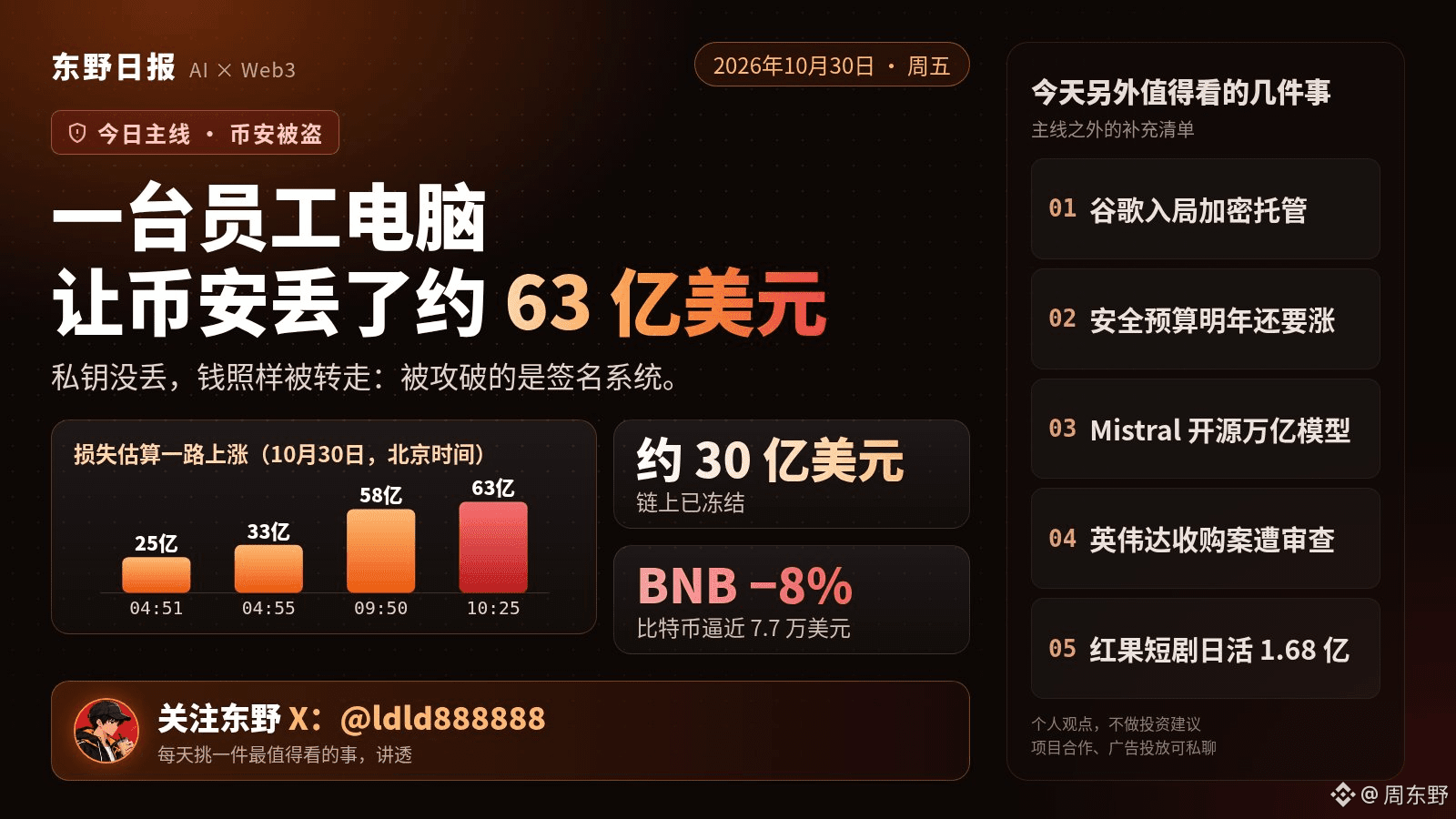
One employee’s computer cost Binance about $6.3 billion.
In the early hours of October 30, assets were transferred out of Binance’s hot wallet in large batches. The exchange’s preliminary investigation pointed to a DevOps engineer’s computer being compromised.
Security firm Blockaid believes the signing system was tampered with, rather than private keys being leaked. About $3 billion has been frozen on-chain so far.
Why does this matter?
Not a single private key was lost, yet the funds were still transferred—because the attackers compromised the system that signs transactions for the exchange. Even the most secure cold wallet can be undone by one office computer. More ironically, the funds were stopped thanks to centralized issuers like Tether and Circle stepping in to freeze them.
Security isn’t about how thick the vault walls are; it’s about how weak the weakest person is.
Four other stories worth checking out today:
🔹
Google Cloud is testing institutional-grade MPC asset custody, with plans to launch commercially in early 2027
→ Binance just lost out to a compromised signing system, and now Google is selling signing security. The timing is chilling.
🔹
a16z surveyed 100 security leaders: 87% expect net growth in security budgets for fiscal year 2027
→ If your company cuts its budget again next year, it’ll be hard to make those cuts in the security department.
🔹
Mistral releases the weights of a trillion-parameter model focused on cybersecurity defense
→ Both attackers and defenders can now download the same large model. The question is who puts it to use first.
🔹
The U.S. Department of Justice reviews Nvidia’s $12.93 billion acquisition of Hugging Face
→ The open-source community’s biggest fear isn’t having no models; it’s having only one place to access them.
If you still keep your coins on an exchange, will this make you move them to your own wallet?
Every day, we break down one story worth your attention. Follow Dongye, and see you tomorrow.
#币安将上线PREDICT现货交易