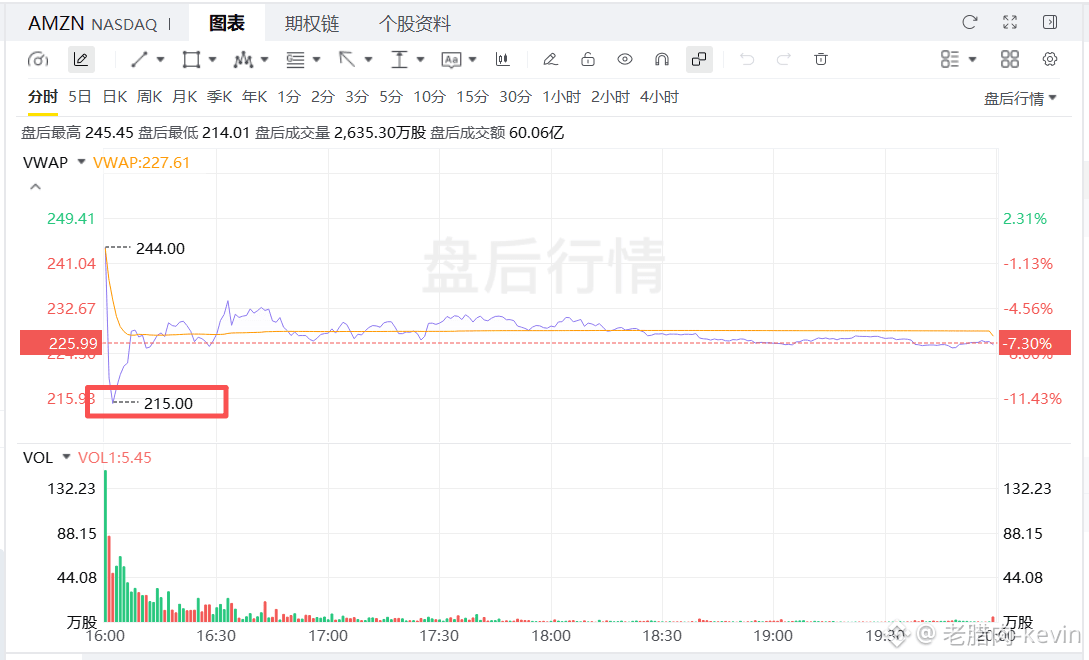

#亚马逊盘前下跌约7% Profits are strong, cash flow is on its knees: How should we read Amazon’s earnings?
Amazon’s Q3 looked decent on the surface. Revenue was 201.9 billion, slightly below expectations; EPS was 1.89, also not a beat. But operating income hit 28.1 billion, up 61% year over year, with a 13.9% margin—a record high. AWS was even stronger: 45.98 billion, up 39.3%, accelerating for the sixth consecutive quarter and growing at its fastest pace in five years.
So why did the stock plunge more than 12% after hours at one point, before narrowing its losses to around 7%, with after-hours trading near 226?
Cash flow is getting torched. Capital expenditure was 77.2 billion in the quarter, and trailing-12-month free cash flow went from +14.8 billion last year straight to -42.4 billion. The market isn’t questioning demand for AWS; it’s questioning when this spending spree will start bringing in returns.
There were plenty of highlights on the earnings call: Jassy projected AWS growth above 40% in both 2027 and 2028, and said it could reach a trillion dollars in 5 to 10 years; backlog hit 578 billion, up by triple digits year over year; revenue commitments for Trainium and Graviton were up 20-fold year over year, with chips to be sold externally by the end of 2027; and Bedrock’s token volume was up 17-fold year over year. Retail was also called “undervalued.” Excluding the Prime Day timing mismatch, North America and International still grew 6% and 8%, respectively.
Is money flowing back into AI? It’s being selective, not going wild. Money is rotating into semiconductors, but when megacap earnings come out, the market first cuts stocks with holes in their cash flow. Amazon’s profits are strong enough, and AWS’s outlook is aggressive enough, but until the free-cash-flow wound heals, investors will only take structural positions, not trend-following ones. $AMZN $SOXL $KORU