

The sharp after-hours drop in U.S. semiconductor and memory stocks was mainly triggered by Intel’s disastrous earnings guidance, which spread negative sentiment across the sector. This was compounded by concerns about cash flow following the massive AI capital expenditure plans announced by Amazon and Alphabet, as well as the steep gains memory stocks had already made.
But there is one key distinction:
There is currently no evidence that actual demand for AI chips or HBM memory has suddenly collapsed. The market appears to be reassessing earnings expectations and valuations.
1. The immediate trigger: Intel’s Q4 guidance came in far below expectations
After the U.S. stock market closed on October 29, Intel released its earnings report.
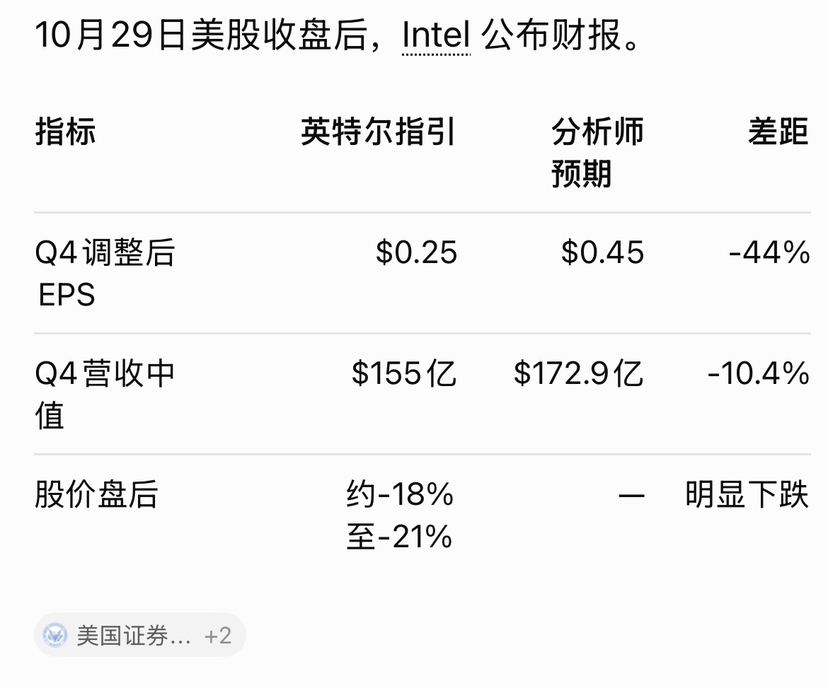
Intel pointed to two main problems:
Weakness in the PC industry: Higher memory prices are weighing on the PC market, and the weakness may persist through the first half of 2027.
Disruption to factory operations: The explosion and shutdown at an Israeli factory are expected to result in a combined revenue loss of about $600 million over two quarters.
After the news broke, AMD fell about 4% and AVGO about 2% after hours, while a 3x leveraged semiconductor ETF briefly dropped about 9%.
Citing trader analysis, Reuters reported that the after-hours semiconductor sell-off was driven mainly by sentiment spillover from Intel’s weak guidance, rather than simultaneous deterioration in the performance of all chip companies. Reuters +1
II. Why are memory stocks falling too?
There are three reasons behind the decline in memory stocks.
First, returns on AI capital spending are being questioned.
Alphabet shares sold off after its earnings report amid concerns about free cash flow and capital spending. On October 29, Amazon also announced a full-year capital spending plan of about $220 billion. Its results did not fully meet market expectations, and the stock fell about 7% after hours. AWS growth remains strong, but investors are beginning to worry about when massive AI investments will generate cash returns. AP News
Second, rising memory prices have different effects upstream and downstream.
For memory suppliers such as Micron and SK Hynix, higher DRAM/HBM prices generally support revenue and profits. But for Intel and PC makers, excessively high memory prices raise the cost of complete systems and weigh on end-market demand.
This means:
Rising memory prices can boost memory manufacturers’ profits while simultaneously hurting PC shipments.
If PC demand remains weak, investors may question the durability of demand for consumer DRAM. But that does not mean demand for HBM in AI servers is weakening in the same way.
Third, elevated expectations had set the stage for profit-taking.
On October 28, SK Hynix’s strong earnings report briefly lifted Micron by about 4.8%. But on October 29, Micron fell about 3.5% intraday, while SanDisk dropped about 2.7%; Samsung’s earlier decline also added pressure to the memory sector. Fidelity +1
The market is now noticeably less tolerant of high-growth stocks falling short of expectations.
III. Latest after-hours performance: The declines are spreading
After the U.S. market closed on October 29, prices were quoted at different times for different stocks. The ranges below are from Reuters reports and do not represent a single, unified real-time snapshot.
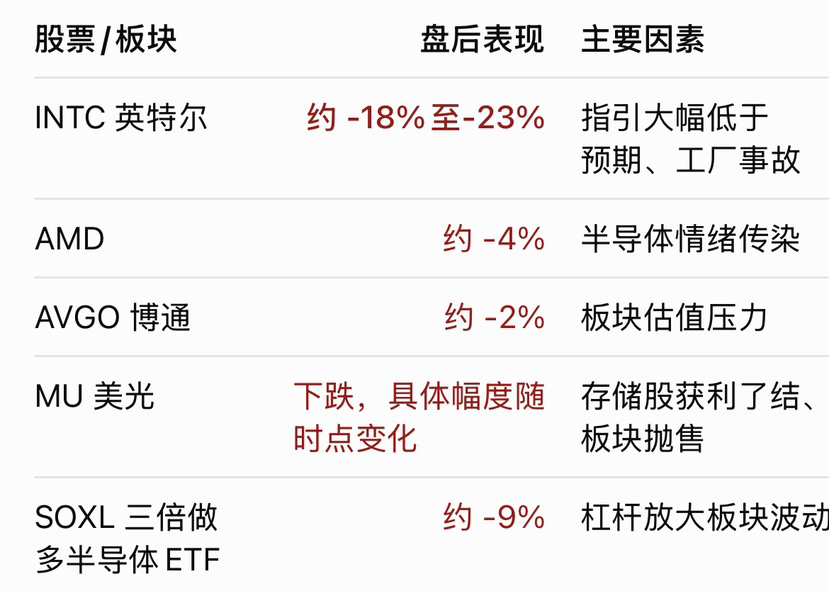
Follow-up Reuters reports confirmed that Intel briefly fell more than 20% after hours, while NVDA, AMD, AVGO, MU and other chip stocks fell roughly 1%–6%. Reuters +2
IV. Is this a short-term correction, or has the memory cycle peaked?
I think we should distinguish among three areas:
Area | Fundamental outlook | Main current risks
HBM (AI high-bandwidth memory) | Demand remains strongly supported | Future capacity expansion; excessive valuations
Server DRAM | Supported by AI server demand | Supply-demand dynamics; price sustainability
Consumer DRAM / NAND | Memory prices are rising, but end-market demand may come under pressure | Declining PC sales; higher prices dampening demand
Especially in Micron’s (MU) case: Intel’s weak PC business alone is not enough to conclude that the growth thesis for Micron’s HBM has been undermined.
On the contrary, Intel’s disclosure that high memory costs are weakening PC demand is precisely evidence that memory supplies remain tight. But whether high prices can be sustained over the long term depends on new capacity, demand elasticity and corporate inventories.
For now, this looks more like:
A sell-off driven by a combination of negative surprises in Intel’s fundamentals, concerns about returns on AI capital spending, and profit-taking in a highly valued memory sector.
Rather than a confirmed reversal in demand across the entire semiconductor and memory industries.
V. What should you watch next?
If you’re following the AI hardware supply chain—including MU, AVGO, COHR and LITE—I recommend keeping a close eye on:
The decline after the U.S. market officially opens tonight: After-hours liquidity is lower and may magnify price moves. Watch whether MU, AVGO and NVDA continue to fall, rather than focusing only on INTC.
Whether analysts lower their future earnings forecasts: If share prices fall but EPS forecasts remain stable, it points more to a valuation adjustment; if EPS expectations also start to come down, the risk is greater.
HBM/DRAM prices and orders: These are central to determining whether the memory cycle has truly reversed—not Intel’s share price.
Whether cloud providers cut capital spending: Amazon still plans to invest heavily, and demand for Microsoft Azure also remains strong. For now, this does not support the conclusion that demand for AI hardware is collapsing across the board.
My current view: This sharp semiconductor sell-off had a clear earnings-related catalyst, but the declines in memory stocks reflect, to a greater extent, reduced risk appetite for highly anticipated assets.
Unless cloud providers cut AI orders, HBM prices weaken, or analysts sharply lower their memory earnings forecasts in the coming days, it would be premature to conclude that the memory cycle is over based solely on this after-hours sell-off.