



Date: October 29, 2026
Introduction
In recent hours, the global crypto asset market has been shaken by one of the largest operational and security incidents in its history. A series of unusual, massive transfers from hot wallets attributed to Binance—the world’s largest exchange by trading volume—immediately raised suspicions of a major cyberattack.
Within minutes, the movement of billions of dollars in stablecoins and other crypto assets triggered a chain reaction: record freezes by the sector’s largest digital dollar issuers, a severe wave of liquidations in the derivatives market, and intense discussions about the sources of vulnerability in the Web3 ecosystem.
On-Chain Flows and the Event Timeline
On-chain tracking data (Etherscan and analytics aggregators) revealed that more than US$3.3 billion in assets were abruptly transferred to a recently created address on the network.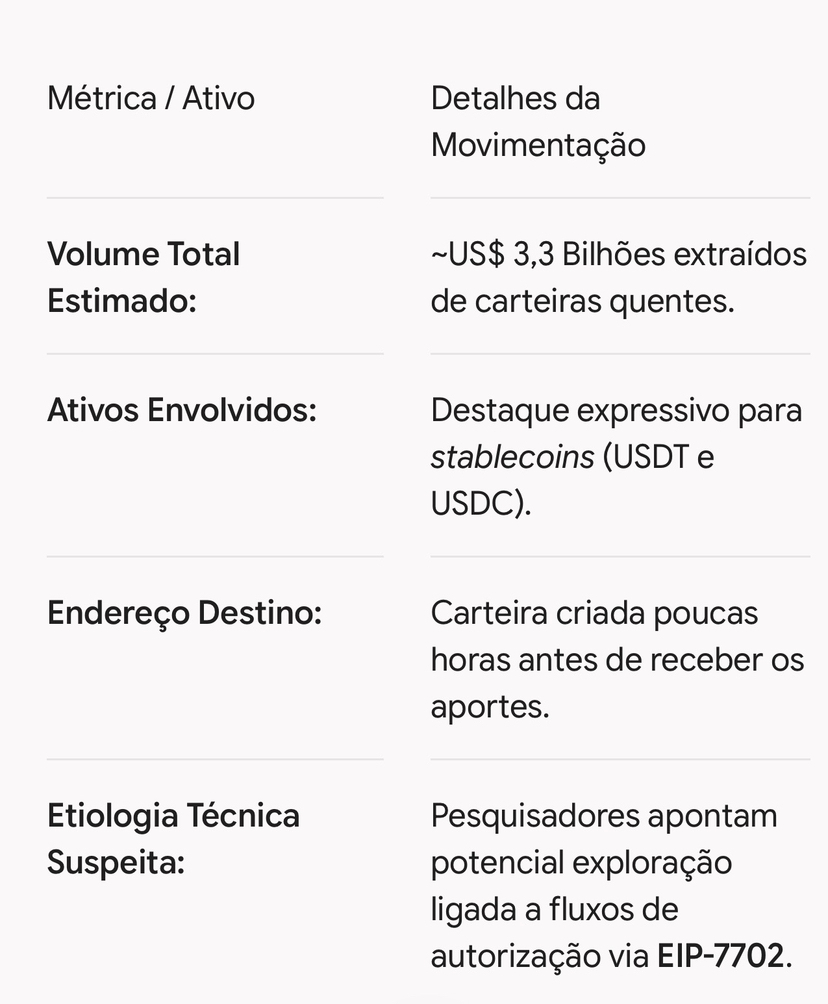
The scale of the amount and the atypical pattern of the transaction signatures led block explorers to preliminarily label the destination addresses as suspected exploiters.
The Infrastructure Response: Freezing in Record Time
The stablecoin infrastructure’s response was unprecedented in speed and scale:
Tether and Circle’s Actions: The issuers activated emergency protocols, jointly blocking approximately US$1.8 billion to US$2.3 billion in USDT and USDC directly in the smart contracts linked to the suspicious addresses.
Damage Control: The ability of centralized issuers to freeze addresses prevented the immediate conversion and dispersal of these reserves through decentralized exchanges (DEXs) or cross-chain aggregators.
Technical Note: Although the ability of centralized issuers to freeze assets sparks recurring debates about network neutrality, in the current situation, the mechanism acted as a crucial emergency brake against the permanent outflow of capital.
Immediate Impact on Financial and Derivatives Markets
Uncertainty about the extent of the problem and the operation’s immediate solvency triggered panic in order books:
Mass Liquidations: More than US$600 million in leveraged positions were liquidated in less than an hour in the crypto futures market.
Pressure on Bitcoin and Altcoins: Bitcoin saw sharp downward volatility, falling to the lower end of the US$79,000 range during periods of greatest uncertainty.
Discounts and Volatility: Traders operated with wider spreads amid fears of withdrawal restrictions or processing delays on major networks.
Next Steps and Monitoring
While internal security audit teams and independent experts investigate the transaction records to determine whether there was a human infrastructure failure, an operational key leak, or smart contract manipulation, the market remains on red alert:
Forensic Audit: Confirming whether the movements resulted from an external cyber breach, a protocol exploit, or a poorly coordinated internal restructuring of cold/hot wallets.
Protection Mechanisms: The existence of the exchange’s guarantee fund (SAFU) and the rapid response from stablecoin issuers remain the main safeguards against systemic impact.
The episode reinforces a fundamental rule for decentralized and centralized financial markets: the constant need for security architectures with multiple layers of custody, automated contingency measures, and strict isolation of hot wallet access.#Alert🔴 #URGENTE #Binance #Hacker #bitcoin $BTC
