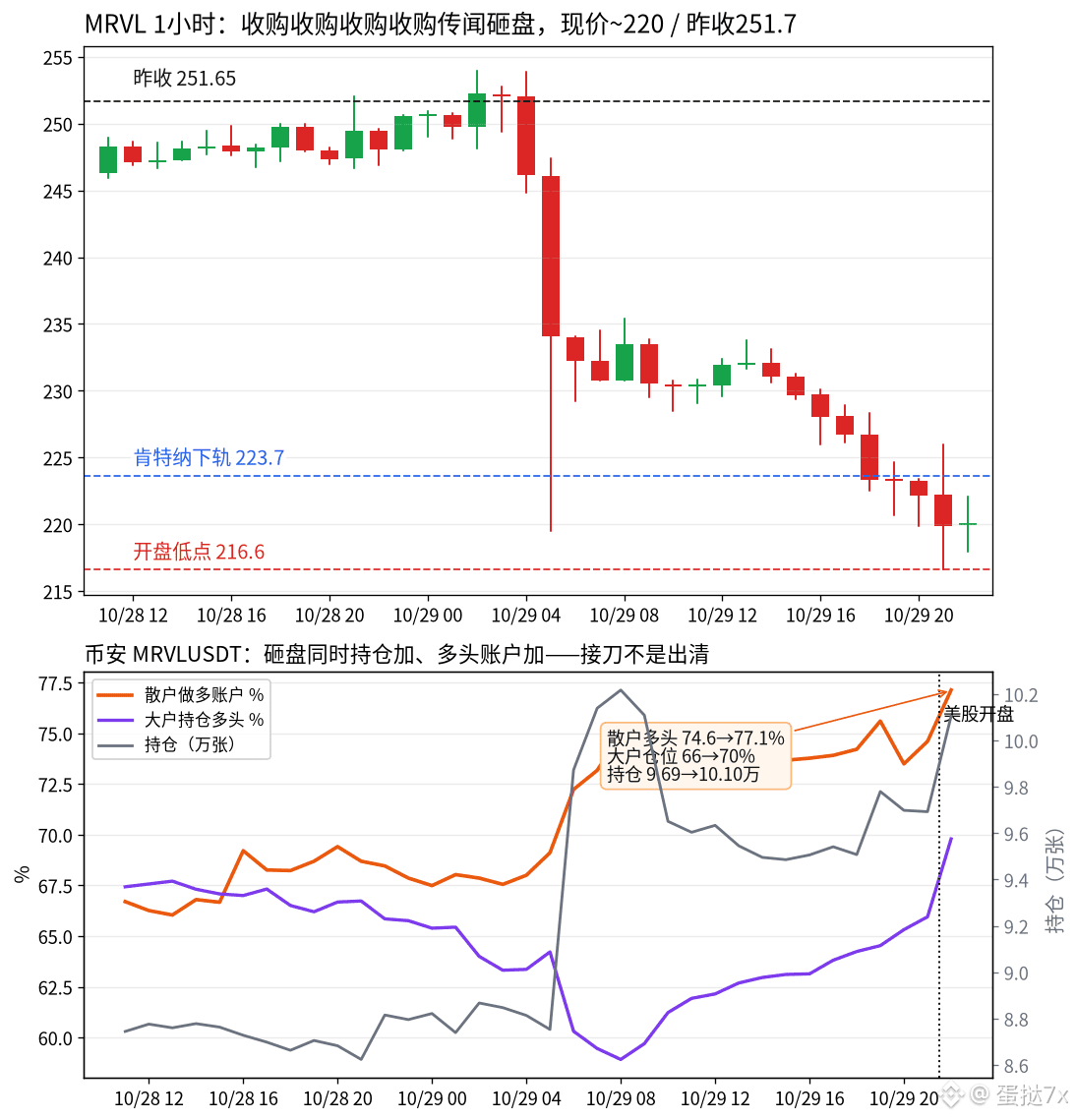
In the first hour after the open, futures open interest climbed from 96,900 contracts to 101,000, retail accounts holding long positions rose from 74.6% to 77%, and large holders’ long positions increased from 66% to 70%. $MRVL plunged from yesterday’s close of 251.7 to around 220, down roughly 12%. On Binance, the futures price was down about 11% over 24 hours, with roughly $237 million in trading volume. The market’s easiest story to tell is acquisition, merger, financing fears, and a flush-out—but the positioning tells a different story.
The catalyst was a report that Marvell was in talks to acquire optical-module maker Lumentum. The market valued the deal at roughly the $80-billion-plus level. Financing pressure sent Marvell lower, while the acquisition target, $LITE , rose about 5%. The first five-minute candle after the U.S. market opened climbed from 222.5 to 225.7, then plunged to 220; the session low was 216.6. Futures trading volume during that first hour was about $37.4 million.
Yet as the price made new lows, both sides added to their long positions: open interest rose by more than 4,000 contracts, and the share of retail and large-account longs increased in tandem. Who is being forced to do what? Accounts still adding longs on the way down face stop-losses or margin calls with every further drop. Not many people are actually unwinding positions, so the low looks like someone is stepping in to buy, when in fact there’s a queue of falling-knife catchers. During this morning’s $GOOGL earnings-driven selloff, large accounts were reducing positions while retail was buying; the price is still hovering around 286, so the falling-knife-catching thesis has not yet been disproven. On Marvell, both sides are catching the knife, making the structure more tangled. The funding rate is still slightly positive, near zero; nobody is paying up to aggressively short.
Technically: the 1-hour RSI is around 20.5, and the Keltner lower band at 223.7 has been breached. The 12-period moving average at 226 and the 50-period moving average at 235 are both overhead. The Bollinger lower band, around 215, is close to the intraday low. ATR is about 2%. The 216.6 level is the hard low from the open; above it, the Keltner lower band at 223.7 is the first test for a rebound.
I’m treating the 216–220 range as falling-knife catching amid merger-financing fears, not as a panic bottom. Until open interest falls back below 97,000 contracts and the share of retail accounts holding longs drops back to 75%, the first rebound level to watch is 223.7, the Keltner lower band—whether it can turn into support. If it can’t, it’s still just a price on the way through. I have no position in this move in MRVL.
$MRVL #美股 #Semiconductors