A lot of people haven’t quite got this straight.
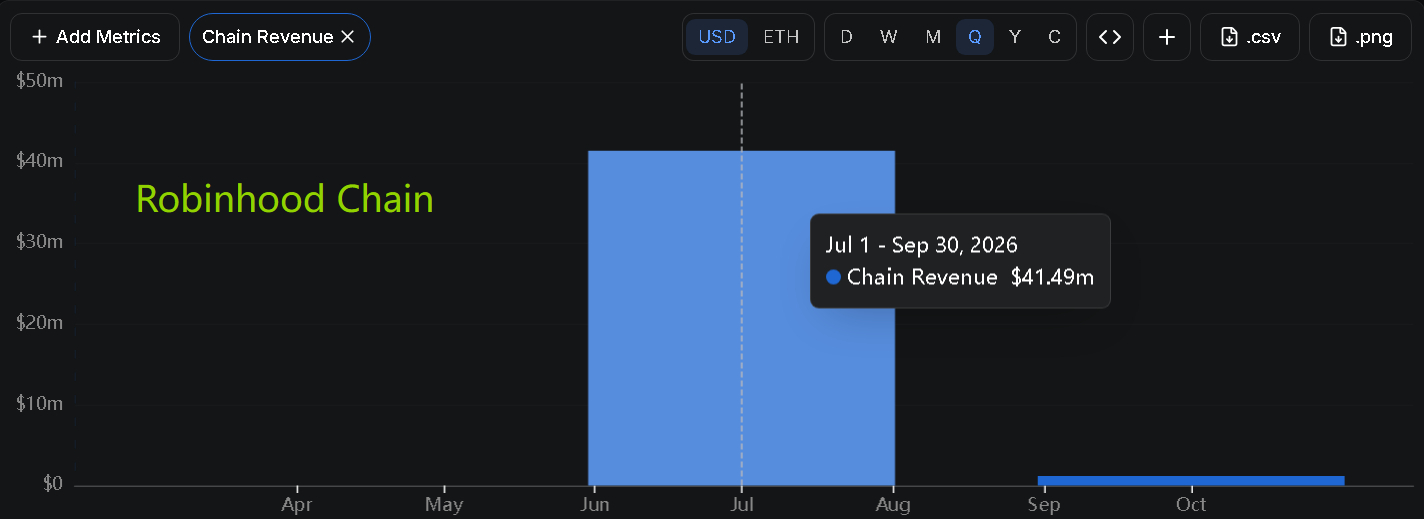
How much did Robinhood Chain actually earn in Q3?
According to DefiLlama, it was $41.49 million.
But $HOOD ’s financial report confirmed only $26 million.
To understand why, we need to break down the different ways revenue from a single gas fee is distributed:
1. Ethereum: Charges settlement and data fees required to run the chain. This isn’t the biggest expense.
2. 10% of net revenue goes to Arbitrum.
3. A share goes to other launch partners.
The chain revenue reported by DefiLlama has already been adjusted for the first two items above.
The additional item disclosed in the financial report is the final one: the share paid to “launch partners.”
These “launch partners” are partners who helped Robinhood build the chain and provided foundational services when it launched.
The full list hasn’t been disclosed. Arbitrum and Ethereum, mentioned above, could both be included.
According to the company, Robinhood initially retained only about 50% of its sequencer revenue.
That’s why management said on the earnings call that RHC actually generated about $50 million in gross revenue this quarter, with around $25 million left after revenue sharing.
DefiLlama’s $41.49 million figure reflects revenue after deducting some known fees. The difference arises because the company uses different accounting rules and includes a different scope of items.
To sum up:
1) About $50 million reflects the chain’s revenue-generating capacity.
2) $26 million is the revenue the company actually gets to keep.
3) $41.49 million is revenue calculated according to DefiLlama’s methodology.
Use DefiLlama to research the chain; to calculate its contribution to $HOOD ’s revenue, use the financial report.