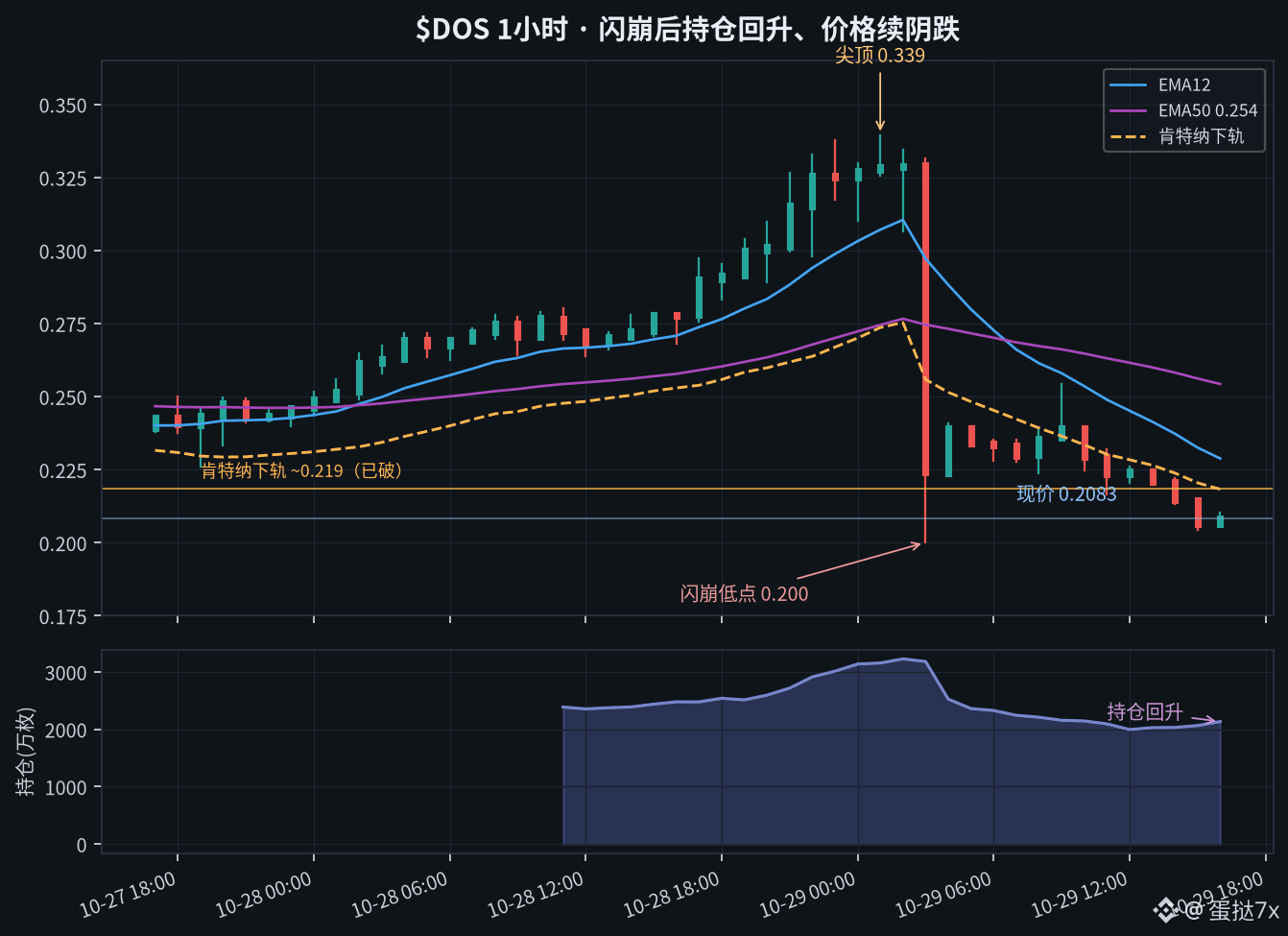
During the hour of the flash crash, open interest was slashed from 32.3 million to 25.3 million tokens, making it look like the positions had been fully flushed out. But after $DOS plunged from its peak of 0.339 to 0.208, open interest actually climbed back from around 20 million tokens at noon to 21.3 million—the slow grind lower was shorts adding to their positions, not bulls buying the dip.
The perpetual contract is down about 23% in 24 hours, with roughly $85.6 million in volume. The intraday high was 0.339 and the low was 0.200. The 3 a.m. hourly candle this morning plunged straight from 0.329 to 0.200, with a single-hour range of over 30%; RSI fell from around 86 to 29. The current price of 0.208 is still below the lower Keltner band at 0.219. The 1-hour RSI is around 30, KDJ's J has dropped to around negative territory, and the MACD histogram remains negative. The 12-period MA at 0.229 and the 50-period MA at 0.254 are both overhead resistance. In terms of price structure, the flash-crash low of 0.200 is the nearest firm support, while the lower Keltner band at 0.219 and the 12-period MA at 0.229 are the first hurdles for a rebound.
The positioning data is even more telling: retail accounts holding longs have only fallen from around 66% near the peak to around 60%, while large traders' long/short positioning is nearly evenly split. The funding rate has flipped from around positive 0.037% at the peak to slightly negative now, suggesting that the fuel for longs hasn't been exhausted—this isn't a panic sell-off that's already fully played out. Who's being forced to do what? Retail longs still in the market have to choose between taking further stop losses or adding margin each time the price edges lower.
In my $Q post at noon, I said the short-covering bounce wasn't a trend reversal. After that, it plunged again from around 0.07 to near 0.04. My read on that move hasn't changed; I'm applying the same positioning logic to this slow decline after the flash crash.
I'm treating this stretch around 0.208 as a slow post-flash-crash decline driven by shorts adding to their positions, and I'm not adding longs myself. Until open interest falls back below 20 million tokens and the share of retail accounts holding longs drops below 55%, I'll first watch whether the lower Keltner band at 0.219 can turn into support on a rebound. If it can't hold, the next level to watch is the flash-crash low at 0.200. I have no position in $DOS here.
#DOS #合约数据 #MarketAnalysis