Oracle has laid out a cash flow timeline; the transition period is what really matters
At Oracle’s investor day, I was most interested in how it plans to get through the peak in capital expenditures. Long-term revenue targets can be ambitious, but the funding gap between building projects and collecting cash determines how long shareholders have to wait—and what that waiting costs them.
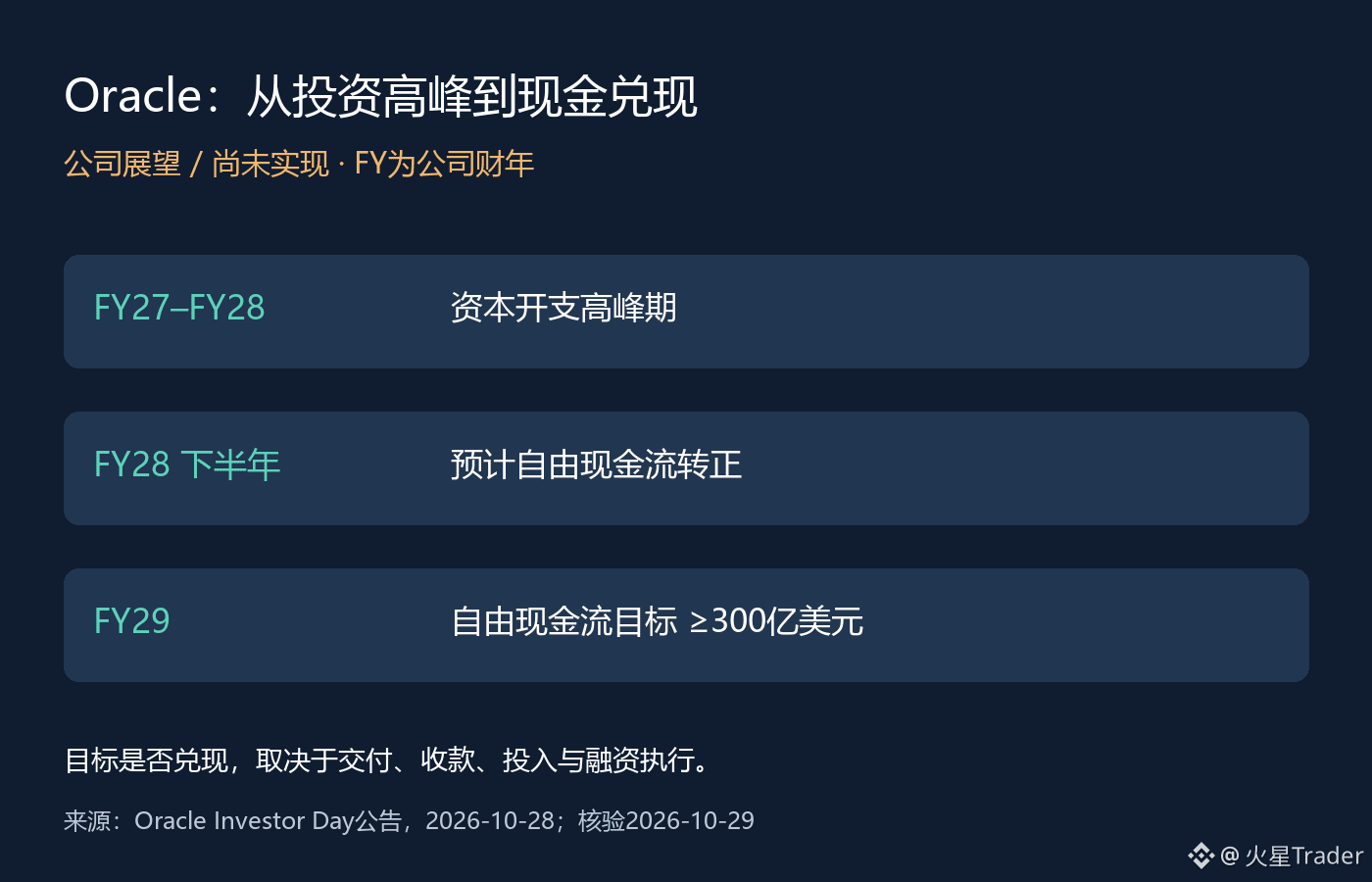
The official announcement on October 28 laid out a clear path: capital expenditures are expected to peak in FY27–FY28, free cash flow is expected to turn positive in the second half of FY28, and the FY29 free cash flow target is at least $30 billion. The company also expects to fund growth with its own resources starting in FY29. These are management’s outlooks, not financial results already achieved.
The company also said it intends to limit additional capital market financing before FY30 to $20 billion, split equally between equity and total debt. There are two easy-to-miss caveats: this excludes refinancing of existing debt, and it is in addition to the $20 billion ATM equity financing completed in the first quarter of FY27. “An additional $20 billion” should not be taken to mean that the entire expansion cycle will require only $20 billion.
My takeaway is that this timeline shifts the discussion from “How large is AI demand?” to “Who pays first?” The company lists supplier financing, customer-provided hardware, and customer prepayments as ways to reduce upfront cash needs. But changing when payments are made does not mean the equipment and funding come at no cost; the impact of each arrangement on debt, future obligations, and profits needs to be checked individually.
The main risk for shareholders is treating a future return to positive cash flow as if the company were already funding itself today. As long as construction spending comes before customer payments, delivery delays or changes in customer payment timing could alter financing needs during the transition. On the other hand, if prepayments and deliveries proceed as planned, the cash strain could be less severe than capital expenditure figures alone suggest. Both scenarios need to be tested against future disclosures.
I’ll be tracking three things: whether capital expenditures peak as planned, whether operating cash flow keeps pace, and whether additional financing stays within the limits the company has set. If the return to positive free cash flow is pushed back or financing grows, the cost of this growth path will need to be reassessed. If the plan is delivered, the long-term targets can gradually become verifiable operating capabilities.
Source: Oracle’s October 28, 2026 Investor Day announcement, verified on October 29 Beijing time. The accompanying image summarizes the company’s outlook and does not represent cash flow already achieved; FY refers to the company’s fiscal year.
https://investor.oracle.com/investor-news/news-details/2026/Oracle-Investor-Day-2026-Accelerating-Value-Creation/default.aspx
At Oracle’s investor day, I was most interested in how it plans to get through the peak in capital expenditures. Long-term revenue targets can be ambitious, but the funding gap between building projects and collecting cash determines how long shareholders have to wait—and what that waiting costs them.
The official announcement on October 28 laid out a clear path: capital expenditures are expected to peak in FY27–FY28, free cash flow is expected to turn positive in the second half of FY28, and the FY29 free cash flow target is at least $30 billion. The company also expects to fund growth with its own resources starting in FY29. These are management’s outlooks, not financial results already achieved.
The company also said it intends to limit additional capital market financing before FY30 to $20 billion, split equally between equity and total debt. There are two easy-to-miss caveats: this excludes refinancing of existing debt, and it is in addition to the $20 billion ATM equity financing completed in the first quarter of FY27. “An additional $20 billion” should not be taken to mean that the entire expansion cycle will require only $20 billion.
My takeaway is that this timeline shifts the discussion from “How large is AI demand?” to “Who pays first?” The company lists supplier financing, customer-provided hardware, and customer prepayments as ways to reduce upfront cash needs. But changing when payments are made does not mean the equipment and funding come at no cost; the impact of each arrangement on debt, future obligations, and profits needs to be checked individually.
The main risk for shareholders is treating a future return to positive cash flow as if the company were already funding itself today. As long as construction spending comes before customer payments, delivery delays or changes in customer payment timing could alter financing needs during the transition. On the other hand, if prepayments and deliveries proceed as planned, the cash strain could be less severe than capital expenditure figures alone suggest. Both scenarios need to be tested against future disclosures.
I’ll be tracking three things: whether capital expenditures peak as planned, whether operating cash flow keeps pace, and whether additional financing stays within the limits the company has set. If the return to positive free cash flow is pushed back or financing grows, the cost of this growth path will need to be reassessed. If the plan is delivered, the long-term targets can gradually become verifiable operating capabilities.
Source: Oracle’s October 28, 2026 Investor Day announcement, verified on October 29 Beijing time. The accompanying image summarizes the company’s outlook and does not represent cash flow already achieved; FY refers to the company’s fiscal year.
https://investor.oracle.com/investor-news/news-details/2026/Oracle-Investor-Day-2026-Accelerating-Value-Creation/default.aspx