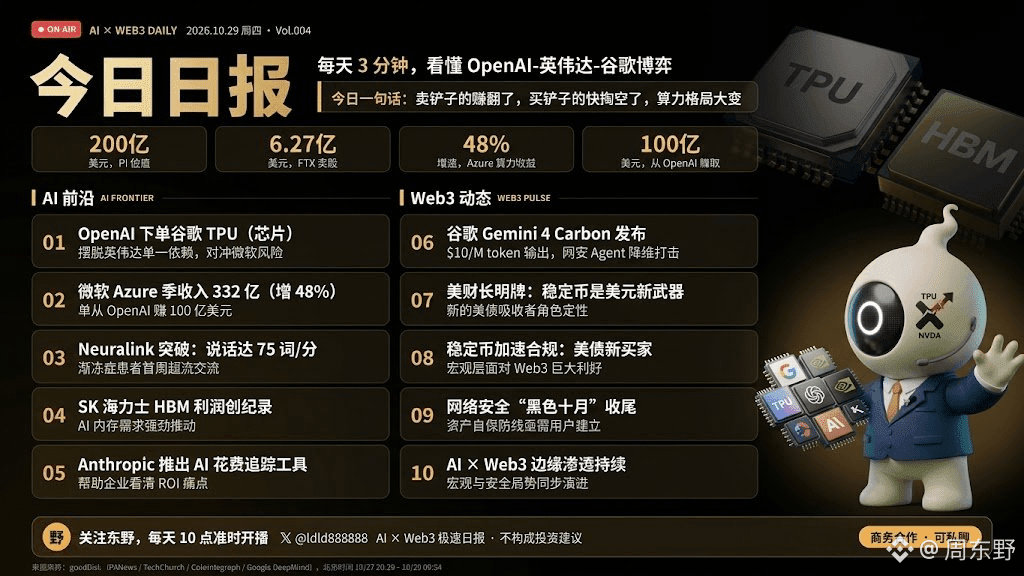
OpenAI has started buying Google TPUs. Nvidia’s most profitable business is being pried open from the back door by its biggest customer—Microsoft made $10 billion from OpenAI in a quarter, and then OpenAI placed an order with Google.
--Dongye Daily 10.29 | AI × Web3
1. A crack in the computing-power monopoly
OpenAI plans to purchase Google TPUs (Google’s in-house AI chips).
👉
Dongye’s take: This isn’t about saving money; it’s about “hedging in reverse.” Betting everything on Nvidia and Microsoft makes the risk of being cut off from computing power scarier than the competition itself.
2. Google Gemini 4 Carbon: API output at $10/M tokens—nearly twice as expensive as GPT-4o, but built for the tough work of cybersecurity
It’s not just expensive; for now, it’s only available to professional security organizations.
👉
Dongye’s take: It addresses the pain point of companies that “can’t afford top hackers to find bugs.” An AI assistant that can spend days searching for vulnerabilities in a complex codebase is comparable to a cybersecurity team earning millions a year. At this price, it directly replaces traditional outsourced cybersecurity services.
3. Web3 macro signal: The US Treasury Secretary calls stablecoins “new buyers of US Treasuries”
Bessent stated publicly that stablecoins are an extension of the US dollar—and buyers of US Treasuries.
👉
Dongye’s take: For the first time, regulators have positioned stablecoins as an extension of the US dollar. The case for bringing them into the regulatory fold is moving forward.
(There’s also an AI-related story: SK Hynix’s AI memory profits hit a record. It has nothing to do with Web3, so we won’t force it in.)
💡
The lower the cost of computing power, the faster AI adoption will be.
Let’s discuss in the comments: Now that OpenAI is buying chips from Google, how many more years can Nvidia’s computing-power monopoly last?
#谷歌财报能否守住基本盘 #股票财报季