

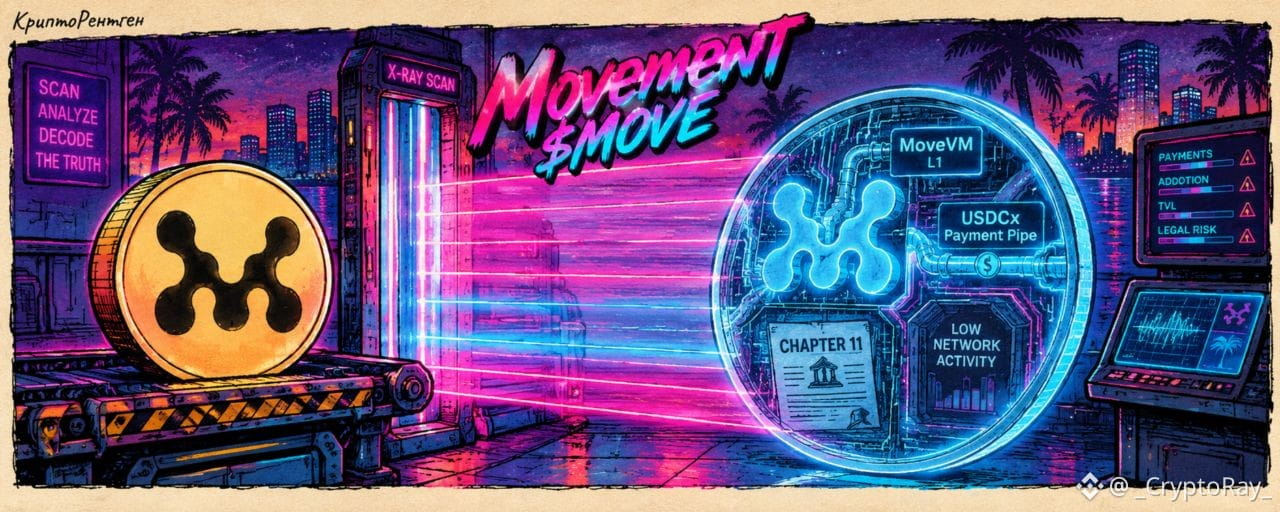
Movement ($MOVE ) started as a Layer 2 on Ethereum with the MoveVM virtual machine. Today it is an independent Layer 1 that focuses on stablecoin payments and cross-border transfers.
Snapshot as of October 29, 2026 (aggregator figures differ):
price: $0,0064–0,0068;
market cap: $29,8–31,6 million;
FDV: $64–68 million;
down from the all-time high (~$1.45, December 2024): about −99.5%.
The central tension: the strategy promises payments, while measurable network activity remains modest. This piece is for readers who want to distinguish the project's claims from verifiable figures.
Technology
Architecture: independent Layer 1 with its own infrastructure and validators. Move Industries announced the launch of M1 as an L1 in December 2025.
Virtual machine: MoveVM, with development tools for the Move language.
Positioning: in June 2026, the project was repositioned around stablecoin payments, transfers, and financial products for emerging markets. This was more than a technical transition: the business focus also changed, and the project is trying to rebuild trust after the market-maker scandal.
USDCx: Circle announced the availability of USDCx on Movement via xReserve on March 25, 2026. The token is backed by USDC and enables interoperability with supported networks.
What this means in practice: the integration confirms technical capability, but does not prove widespread use for payments. This should be assessed by looking at actual transfers, active users, and revenue.
Tokenomics
Maximum supply: 10 billion MOVE.
Circulating supply: about 4.66 billion (46.6%).
Outside the reported circulating supply: about 5.34 billion (53.4%). This does not mean that all of it is locked under the same terms or will unlock at the same time.
Token functions: fees, staking, governance.
Burns: no automatic system-wide burn with a sustained deflationary effect has been confirmed.
Move Alliance. According to Move Industries, alliance members will direct 50–100% of their revenue toward buying MOVE and holding the tokens in treasury. This is the stated model. The scale of actual buybacks cannot be verified; doing so would require treasury addresses, transaction histories, and transparent revenue reporting.
Unlocks. We were unable to independently verify a detailed schedule after September 2026, so the article does not include specific monthly amounts. Assessing the pressure requires vesting details, recipient categories, and unlock terms.
Investors
Series A: $38 million in April 2024, led by Polychain Capital.
Funding tracked by DefiLlama: $41.4 million, including Series A.
The $141.4 million figure cited by some sources has not been reliably confirmed, so it is not included in the article.
On-chain activity
DefiLlama snapshot as of October 28, 2026:
DeFi TVL: about $2.53 million;
stablecoins on the network: about $37.17 million;
24-hour DEX volume: about $5,700;
24-hour network fees: about $0.04.
How to interpret this: measurable DeFi activity remains modest for now. But TVL, DEX volume, stablecoin market capitalization, and payment turnover are different metrics. Low DEX volume does not prove that payments are not happening, and stablecoin market capitalization does not prove that stablecoins are being actively used. The report contains no data on DAU/MAU, the number of actual payments, or cross-border transfer volume, so it is not possible to draw confident conclusions about widespread use.
Trading volume. Figures vary widely across aggregators: about $33 million on CoinMarketCap versus about $4 million on CoinGecko. The differences may be due to exchange coverage and methodology. For a micro-cap, high aggregated volume does not guarantee that a large position can be opened without slippage.
The inside story
Facts:
M1 launched as an independent L1 in December 2025. June 2026 marked a repositioning.
USDCx via Circle xReserve — March 25, 2026.
MVMT Labs filed for Chapter 11 protection in Delaware state court on July 15, 2026. The case documents list assets of around $100,000–$500,000 and liabilities of $1–10 million.
In October 2026, the court approved a settlement in the bankruptcy case.
The bankruptcy concerns MVMT Labs, not the MOVE token. Move Industries stated that it is not affiliated with MVMT Labs and continues to work on the network.
The settlement does not mean that all legal questions surrounding the project have been resolved.
A scandal erupted in 2025 over a market maker's sale of approximately 66 million MOVE. Reports cited an amount of about $38 million. This should be read in the context of reports about an investigation, not as an estimate of losses to holders.
In May 2025, one of the major platforms suspended MOVE trading. This is a historical fact; its current status should be checked separately.
Rumors and insider claims:
“$141.4 million in funding” — unconfirmed.
“The DOJ grand jury investigation is ongoing” — unconfirmed: its current status could not be established.
“Move Alliance is already generating sustained demand” — unconfirmed.
“Low DEX volume means there are no payments” — unconfirmed.
Strengths and weaknesses
Pros:
Independent L1 with its own validator set.
A more specific strategy: payments, stablecoins, and cross-border transfers.
USDCx integration via Circle xReserve.
MoveVM and Move-language development tools.
$38 million Series A with participation from Polychain Capital.
Cons:
Micro-capitalization and wide variation in volume across aggregators.
53.4% of the supply is not in circulation.
Price down about 99.5% from its all-time high.
Market-maker scandal and bankruptcy of original developer MVMT Labs.
TVL of about $2.53 million and 24-hour DEX volume of about $5,700.
The scale of Move Alliance buybacks and payment use of the network have not been confirmed.
Sources
DefiLlama: TVL, stablecoins, DEX volume, fees, tracked funding.
CoinMarketCap and CoinGecko: price, market capitalization, FDV, supply.
Circle's official announcement dated March 25, 2026 (USDCx) and Move Industries' press release announcing the launch of M1.
