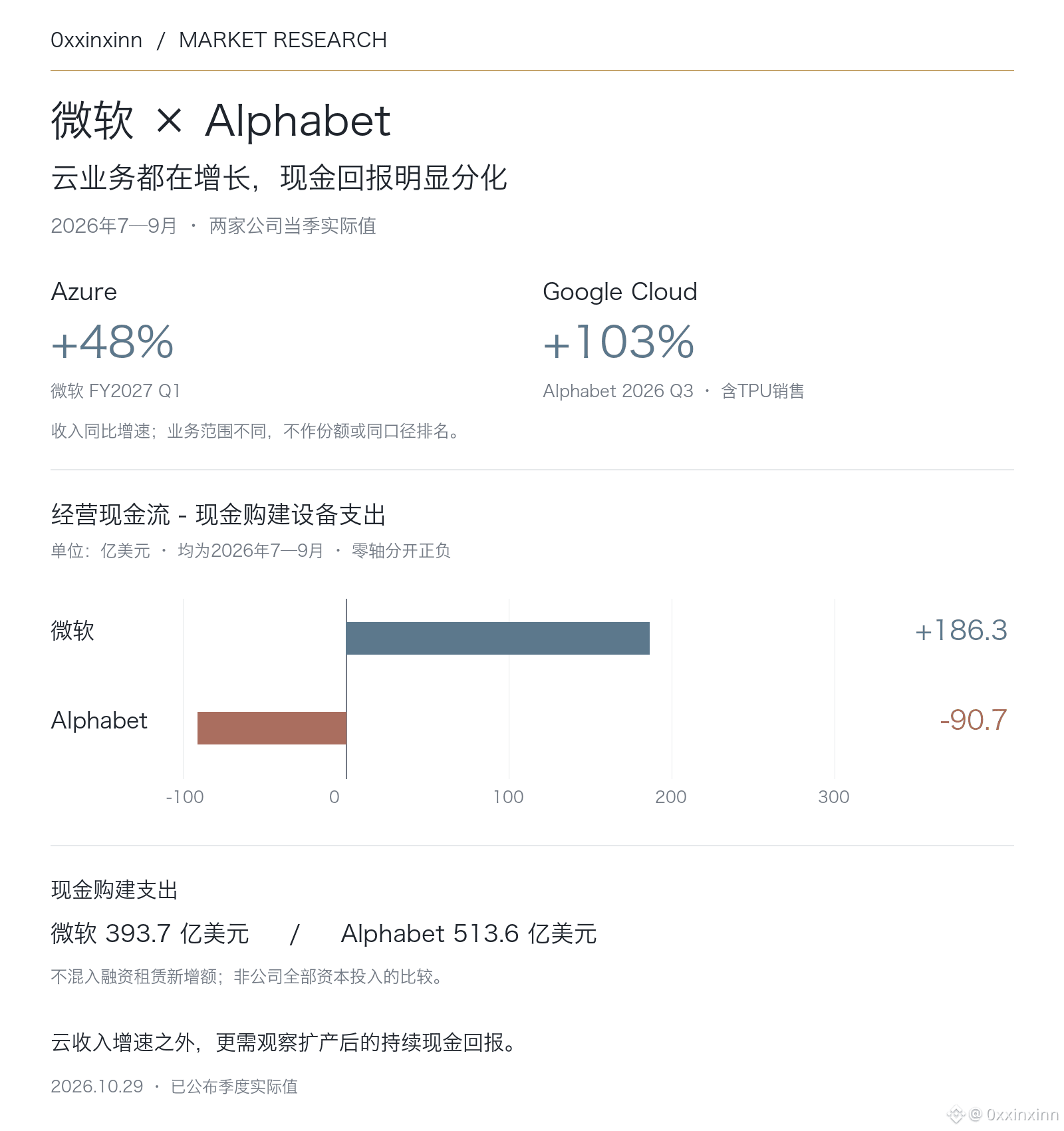
Microsoft and Alphabet’s cloud businesses are both growing, but their cash returns after capital investment have diverged.
Both earnings reports cover July–September 2026: Microsoft reported FY2027 first-quarter revenue of $92.28 billion, with Azure revenue up 48%; Alphabet reported third-quarter revenue of $127.58 billion, with Google Cloud up 103%, including sales of TPU systems. The two growth rates should not be treated as a direct measure of changes in cloud-services market share.
Using the same measure—operating cash flow minus purchases of property and equipment on the cash flow statement—Microsoft had $18.63 billion left over for the quarter, while Alphabet was $9.07 billion in the red. The latter spent $51.36 billion on purchases of property and equipment, exceeding its $42.29 billion in operating cash flow. Doubling cloud revenue does not mean expansion is already self-funding.
Earnings also need to be compared on a consistent basis. Microsoft’s GAAP earnings per share rose 32%, or 18% excluding the impact of its OpenAI investment; Alphabet’s equity-securities losses reduced earnings per share by $0.55. Investment gains and losses should not be mistaken for underlying business trends.
Going forward, equipment deployment, depreciation, and collections are worth watching more closely: if cash spending continues to outpace operating cash flow after deliveries accelerate, revenue growth may not be enough to support the valuation. This comparison uses reported cash figures and does not conflate cash purchases of property and equipment with total capital investment that includes finance leases.
Both earnings reports cover July–September 2026: Microsoft reported FY2027 first-quarter revenue of $92.28 billion, with Azure revenue up 48%; Alphabet reported third-quarter revenue of $127.58 billion, with Google Cloud up 103%, including sales of TPU systems. The two growth rates should not be treated as a direct measure of changes in cloud-services market share.
Using the same measure—operating cash flow minus purchases of property and equipment on the cash flow statement—Microsoft had $18.63 billion left over for the quarter, while Alphabet was $9.07 billion in the red. The latter spent $51.36 billion on purchases of property and equipment, exceeding its $42.29 billion in operating cash flow. Doubling cloud revenue does not mean expansion is already self-funding.
Earnings also need to be compared on a consistent basis. Microsoft’s GAAP earnings per share rose 32%, or 18% excluding the impact of its OpenAI investment; Alphabet’s equity-securities losses reduced earnings per share by $0.55. Investment gains and losses should not be mistaken for underlying business trends.
Going forward, equipment deployment, depreciation, and collections are worth watching more closely: if cash spending continues to outpace operating cash flow after deliveries accelerate, revenue growth may not be enough to support the valuation. This comparison uses reported cash figures and does not conflate cash purchases of property and equipment with total capital investment that includes finance leases.