Google Cloud revenue doubled—but first, let’s clarify what it sold
Google Cloud’s growth was strong this time, but I’d first look at the revenue mix. Cloud services and hardware system deliveries are not equally predictable sources of revenue for the next quarter.
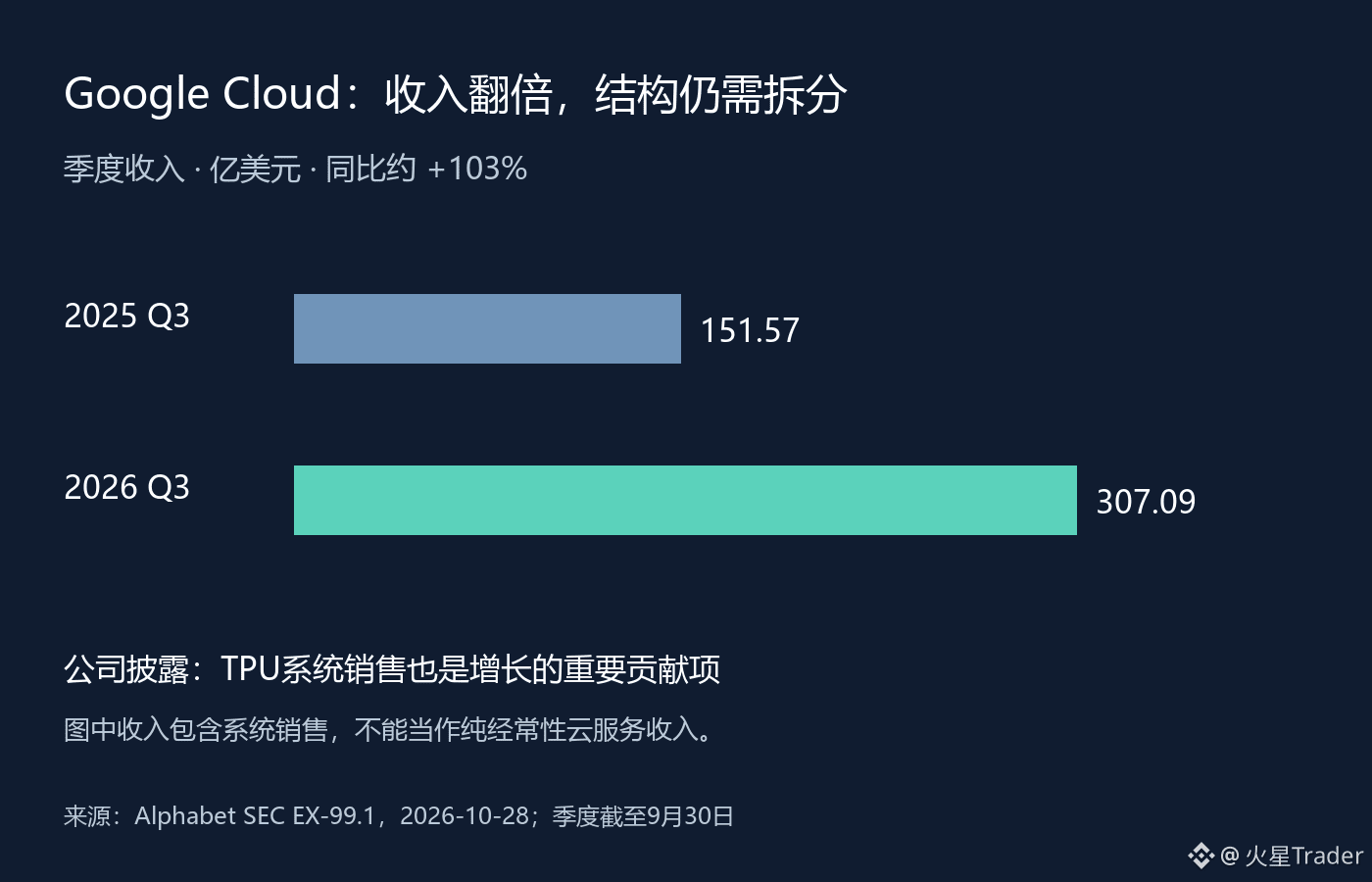
In its third-quarter earnings release published on October 28, Alphabet reported that Google Cloud revenue rose from $15.157 billion in the same period last year to $30.709 billion, up about 103% year over year. The company also explicitly said that sales of TPU systems were a significant contributor to revenue growth, alongside growth in enterprise AI infrastructure, AI solutions, and core GCP services.
That means interpreting the 103% figure as a doubling in ongoing cloud usage across all customers would overlook an important variable. System sales can generate real revenue and help build customer relationships, but the timing of revenue recognition may depend on delivery schedules. Recurring service usage, by contrast, depends more on continued consumption and renewals. Both types of business can be valuable, but their growth should not be extrapolated in the same way without first separating them.
The release does not provide enough detail for me to isolate TPU system sales and calculate a so-called “pure cloud services growth rate.” So I can’t make up a figure excluding hardware, nor can I claim that hardware accounted for all of this quarter’s strong growth. What we can confirm is that the company disclosed several sources of growth; their relative contributions still need to be verified.
In my view, the most important thing to watch next is whether this revenue mix translates into sustained demand. After a large-scale delivery, will customers continue buying services? Will their computing usage continue? Can growth hold up in the coming quarters? These signals are more useful for assessing long-term revenue quality than a single quarter’s doubling. If hardware deliveries fluctuate significantly, changes in quarterly growth do not necessarily mean customer demand has suddenly shifted.
For valuation, the key question is not just how much revenue was added this quarter, but how much of it can recur and how much additional investment will be needed to make it recur. In the next earnings release and management commentary, I’ll be looking closely at the contribution from TPU system sales, trends in service usage, and the related profit performance. First understand where the growth came from; then consider how long it can last.
Data as of 2026-09-30; earnings release dated 2026-10-28, verified on October 29 Beijing time. Chart originally created from earnings data; it includes system sales and should not be treated as purely recurring revenue.
Source: https://www.sec.gov/Archives/edgar/data/1652044/000165204426000080/googexhibit991q32026.htm
Google Cloud’s growth was strong this time, but I’d first look at the revenue mix. Cloud services and hardware system deliveries are not equally predictable sources of revenue for the next quarter.
In its third-quarter earnings release published on October 28, Alphabet reported that Google Cloud revenue rose from $15.157 billion in the same period last year to $30.709 billion, up about 103% year over year. The company also explicitly said that sales of TPU systems were a significant contributor to revenue growth, alongside growth in enterprise AI infrastructure, AI solutions, and core GCP services.
That means interpreting the 103% figure as a doubling in ongoing cloud usage across all customers would overlook an important variable. System sales can generate real revenue and help build customer relationships, but the timing of revenue recognition may depend on delivery schedules. Recurring service usage, by contrast, depends more on continued consumption and renewals. Both types of business can be valuable, but their growth should not be extrapolated in the same way without first separating them.
The release does not provide enough detail for me to isolate TPU system sales and calculate a so-called “pure cloud services growth rate.” So I can’t make up a figure excluding hardware, nor can I claim that hardware accounted for all of this quarter’s strong growth. What we can confirm is that the company disclosed several sources of growth; their relative contributions still need to be verified.
In my view, the most important thing to watch next is whether this revenue mix translates into sustained demand. After a large-scale delivery, will customers continue buying services? Will their computing usage continue? Can growth hold up in the coming quarters? These signals are more useful for assessing long-term revenue quality than a single quarter’s doubling. If hardware deliveries fluctuate significantly, changes in quarterly growth do not necessarily mean customer demand has suddenly shifted.
For valuation, the key question is not just how much revenue was added this quarter, but how much of it can recur and how much additional investment will be needed to make it recur. In the next earnings release and management commentary, I’ll be looking closely at the contribution from TPU system sales, trends in service usage, and the related profit performance. First understand where the growth came from; then consider how long it can last.
Data as of 2026-09-30; earnings release dated 2026-10-28, verified on October 29 Beijing time. Chart originally created from earnings data; it includes system sales and should not be treated as purely recurring revenue.
Source: https://www.sec.gov/Archives/edgar/data/1652044/000165204426000080/googexhibit991q32026.htm