Microsoft’s profit grew 32%—why was the adjusted growth rate only 18%?
The easiest thing to misread in Microsoft’s latest earnings report is its profit growth. Both 32% and 18% come from the company’s announcement, but when assessing the growth trend, you can’t simply choose the more flattering figure and extrapolate from it.
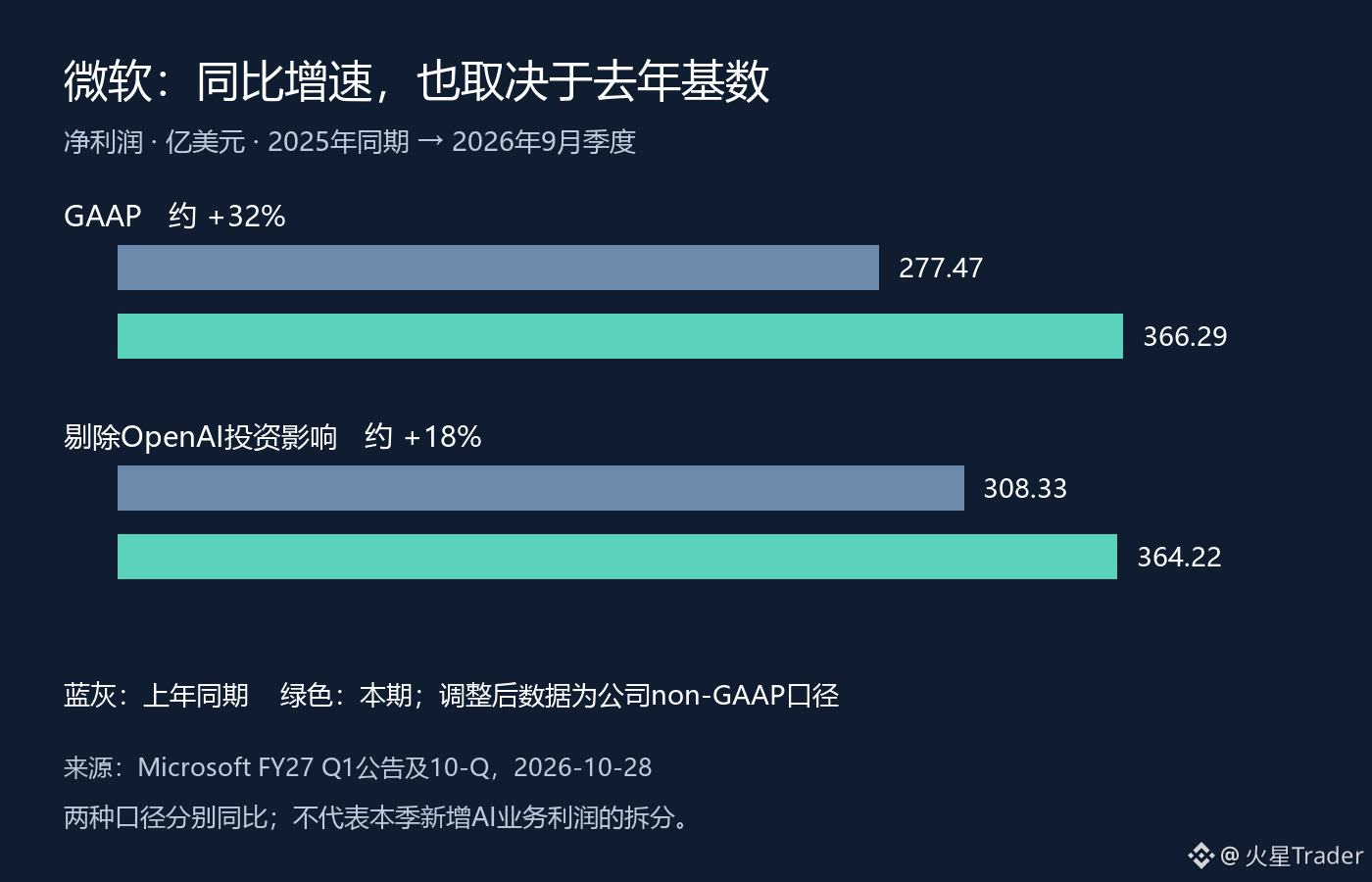
For the first quarter of FY2027, ended September 30, Microsoft reported GAAP net income of $36.629 billion, up from $27.747 billion in the same period last year. Excluding the impact of its OpenAI investment, adjusted net income was $36.422 billion, compared with $30.833 billion a year earlier. Those figures represent year-over-year growth of approximately 32% and 18%, respectively.
The two measures differed by just $207 million this quarter, yet their growth rates differed by 14 percentage points. The key is last year’s comparison base. Subtracting the reported figures, last year’s GAAP net income was $3.086 billion lower than adjusted net income. Starting from a lower base makes this year’s growth look more pronounced. The entire gap between the growth rates cannot be explained as a sudden surge in AI-related profit this quarter.
That doesn’t mean Microsoft’s business isn’t growing. Revenue rose 19% year over year, and operating income increased 21%. My reading is that the business is indeed expanding, but the impact of investment accounting and operating performance should be assessed separately. Gains on OpenAI-related investments are not direct evidence that customers are paying for cloud services.
When reading AI earnings reports, it’s especially important to resist this leap: going straight from rising net income to concluding that investments in computing capacity have fully proved their returns. The income statement, cash flows, and capital investments have different timelines for translating into results, and one quarter’s profit growth cannot answer every question. Conversely, the lower adjusted growth rate alone doesn’t prove that demand is weakening.
Next, I’ll look at operating income, operating cash flow, and capital expenditures together, then check what the company says about future demand and supply. There will be stronger grounds for discussing the quality of returns on AI investment only when profit growth consistently converts into cash and the returns on new investment become clearer. For now, understanding the year-over-year comparison base is more useful than using 32% to value the future.
Data as of 2026-09-30; earnings announcement dated 2026-10-28, verified on October 29 Beijing time. The accompanying illustration is an original rendering of earnings data, not a stock-price chart.
Source: https://www.microsoft.com/en-us/Investor/earnings/FY-2027-Q1/press-release-webcast
https://www.sec.gov/Archives/edgar/data/789019/000119312526436133/msft-20260930.htm
The easiest thing to misread in Microsoft’s latest earnings report is its profit growth. Both 32% and 18% come from the company’s announcement, but when assessing the growth trend, you can’t simply choose the more flattering figure and extrapolate from it.
For the first quarter of FY2027, ended September 30, Microsoft reported GAAP net income of $36.629 billion, up from $27.747 billion in the same period last year. Excluding the impact of its OpenAI investment, adjusted net income was $36.422 billion, compared with $30.833 billion a year earlier. Those figures represent year-over-year growth of approximately 32% and 18%, respectively.
The two measures differed by just $207 million this quarter, yet their growth rates differed by 14 percentage points. The key is last year’s comparison base. Subtracting the reported figures, last year’s GAAP net income was $3.086 billion lower than adjusted net income. Starting from a lower base makes this year’s growth look more pronounced. The entire gap between the growth rates cannot be explained as a sudden surge in AI-related profit this quarter.
That doesn’t mean Microsoft’s business isn’t growing. Revenue rose 19% year over year, and operating income increased 21%. My reading is that the business is indeed expanding, but the impact of investment accounting and operating performance should be assessed separately. Gains on OpenAI-related investments are not direct evidence that customers are paying for cloud services.
When reading AI earnings reports, it’s especially important to resist this leap: going straight from rising net income to concluding that investments in computing capacity have fully proved their returns. The income statement, cash flows, and capital investments have different timelines for translating into results, and one quarter’s profit growth cannot answer every question. Conversely, the lower adjusted growth rate alone doesn’t prove that demand is weakening.
Next, I’ll look at operating income, operating cash flow, and capital expenditures together, then check what the company says about future demand and supply. There will be stronger grounds for discussing the quality of returns on AI investment only when profit growth consistently converts into cash and the returns on new investment become clearer. For now, understanding the year-over-year comparison base is more useful than using 32% to value the future.
Data as of 2026-09-30; earnings announcement dated 2026-10-28, verified on October 29 Beijing time. The accompanying illustration is an original rendering of earnings data, not a stock-price chart.
Source: https://www.microsoft.com/en-us/Investor/earnings/FY-2027-Q1/press-release-webcast
https://www.sec.gov/Archives/edgar/data/789019/000119312526436133/msft-20260930.htm