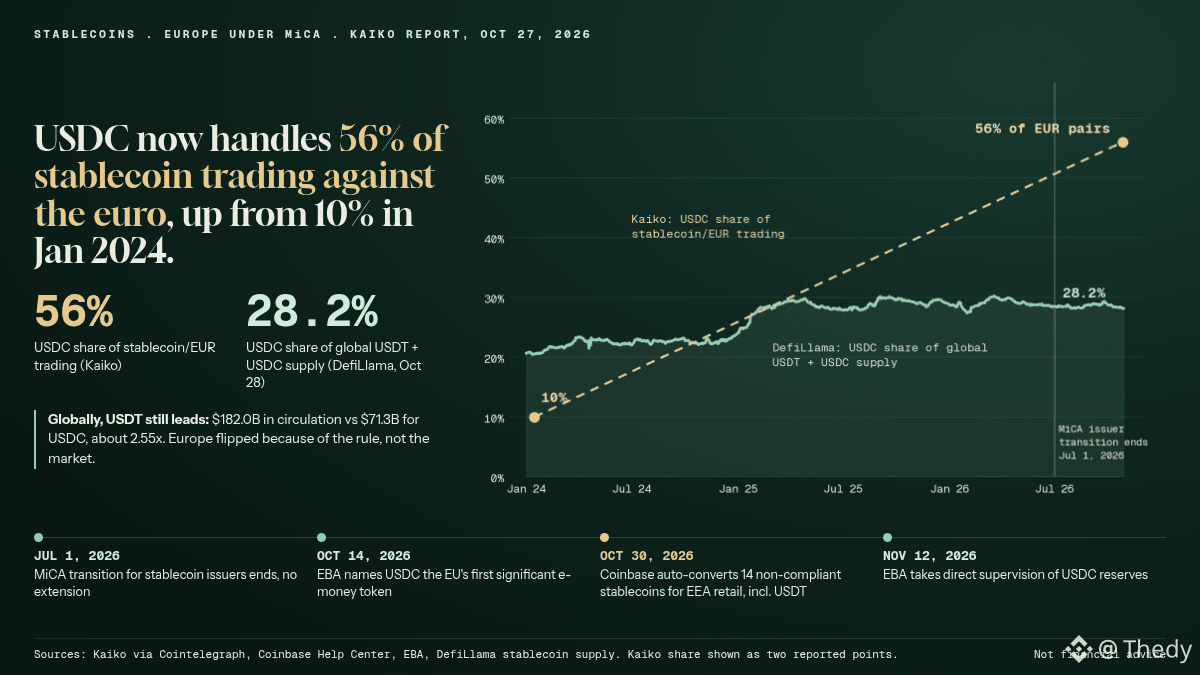
According to a Kaiko report published on 27/10, Circle's $USDC now accounts for 56% of euro stablecoin trading, up from 10% in January 2024. In Europe, $USDT is no longer the default stablecoin.
If you trade from the European Economic Area, two dates matter. On Friday 30/10, Coinbase will convert the remaining balances of 14 MiCA-non-compliant stablecoins held by its EEA retail customers—including USDT, DAI, and PYUSD—into USDC at the market price (Coinbase help page). To keep your USDT, you need to withdraw it beforehand, and the conversion may be taxable depending on the country. Then, on 12/11, the European Banking Authority will take direct supervision of USDC reserves, after it was classified on 14/10 as the EU's first “significant” e-money token.
Here's how it works: the MiCA transition period for issuers ended on 01/07/2026 without an extension. USDT is not licensed, so regulated platforms are dropping its trading pairs in Europe. Kaiko also notes that USDC/EUR order books are around 40% deeper.
The most telling point is that nothing has shifted globally. According to DefiLlama on 28/10, USDT has a circulating supply of $182.0 billion versus $71.3 billion for USDC (2.55 times more), and USDC's share of the pair has only risen from 20.7% to 28.2% since January 2024. My take: Europe's shift is driven by regulation, not traders' choices.
Two possible outcomes. Either the same pattern repeats in the United States with the GENIUS Act (the OCC rule on reserves takes effect on 18/01/2027, with restrictions on unlicensed issuers from July 2028), and USDC's global share finally rises. Or USDT liquidity simply moves offshore and into DeFi, leaving the global gap unchanged.
Do you keep your stablecoins on a MiCA-licensed platform, or in a wallet you control?
#Stablecoins #MiCA