SK Hynix’s net profit misses badly, yet its stock surges? Let’s break down the earnings report
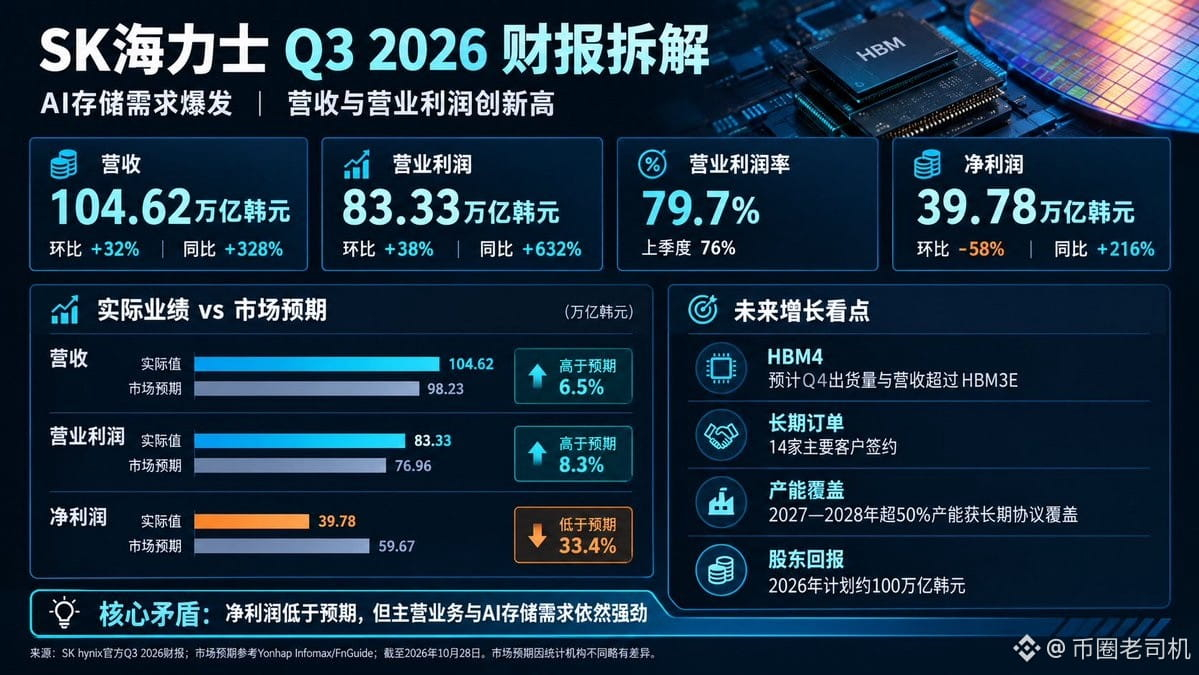
Third-quarter net profit came in at 39.78 trillion won, below market expectations of 61.29 trillion won—a shortfall of nearly 35%.
Normally, you’d expect a stock to come under pressure when profits miss expectations, right?
But the market didn’t follow that script. SK Hynix shares surged as much as 9.4% intraday, and South Korea’s KOSPI index also gained.
So what exactly are investors betting on?
1. Net profit did miss expectations, but the core business was exceptionally strong.
SK Hynix reported third-quarter revenue of 104.62 trillion won, up 32% quarter over quarter and 328% year over year. Operating profit was 83.33 trillion won, up 38% quarter over quarter and 632% year over year.
Its operating margin reached 79.7%, nearly 80%.
What does that mean in practical terms?
Operating profit was just 11.38 trillion won in the same quarter last year. Now it has climbed to 83.33 trillion won—about 7.3 times higher.
This was also the first time in SK Hynix’s history that quarterly revenue topped 100 trillion won.
So, looking just at the core business, this earnings report wasn’t merely decent—it was explosive.
The real concern was net profit: 39.78 trillion won, down 57.7% quarter over quarter and below market expectations.
It’s important to note that net profit and operating profit are calculated differently. SK Hynix’s net profit reached 93.92 trillion won last quarter, partly due to investment gains and other factors. So the sharp quarter-over-quarter decline this quarter shouldn’t be taken to mean that its core business suddenly deteriorated.
2. What the market really wants to know is whether HBM can keep generating profits.
Many investors following this AI rally are still focused on Nvidia, but the memory supply chain deserves attention too.
AI servers need more than GPUs; they also require large amounts of high-performance memory. HBM’s technical complexity, yield requirements, and advanced packaging capabilities make it difficult to replace with ordinary memory chips.
SK Hynix said in its earnings report that shipments of HBM4 are now ramping up in full. It expects HBM4 shipments and revenue to both exceed HBM3E in the fourth quarter, making HBM4 its main product.
Demand for server-oriented DDR5 is also growing, while enterprise SSD sales are benefiting from data center construction.
This means SK Hynix isn’t relying on price increases for just one product. Demand is growing across multiple high-value memory products used in AI data centers.
Of course, strong demand doesn’t mean prices will rise forever. Future supply growth and the competitive landscape will still matter.
3. The really significant data point is the orders for 2027–2028.
SK Hynix has already signed long-term supply agreements with 14 major customers, covering more than 50% of its total capacity for 2027 and 2028.
The company also believes tight supply and demand in the memory market could persist until 2030.
Taken together, these two pieces of information carry real weight.
Until now, the market has worried that demand for AI memory might be no more than a short-lived boom.
SK Hynix is now signaling that long-term agreements already support part of its capacity for the next two years, giving investors better visibility into demand than a look at one quarter’s orders alone.
Of course, signing long-term agreements doesn’t lock in future profits. Product prices, contract terms, and actual deliveries will all affect the eventual earnings.
But for the market, this should help ease concerns that demand could suddenly disappear in the short term.
4. There’s another catalyst that’s easy to overlook: 100 trillion won in shareholder returns.
SK Hynix announced plans to deliver about 100 trillion won in shareholder returns in 2026. This includes more than 30 trillion won in cash dividends and over 60 trillion won in share buybacks and cancellations.
That’s no small figure.
During the AI investment boom, the market is concerned both that companies will expand capacity too aggressively and that rising capital expenditure will drain their cash flow.
SK Hynix is preparing to expand capacity while also announcing a large-scale shareholder return. At the very least, this shows that the company is currently generating substantial cash.
However, this figure includes share buybacks, cancellations, and cash dividends. It shouldn’t be interpreted as 100 trillion won being paid out entirely in cash.
Here’s my take.
Three things are behind SK Hynix’s rebound: its core business outperformed expectations, HBM4 is entering the volume-production phase, and there’s greater visibility into capacity orders for the next two years.
On top of that, the stock may be benefiting from a recovery in expectations after earlier market concerns about AI valuations and capital spending.
But don’t rush to treat one big rally as the start of a new bull market.
The key things to watch next are HBM4 shipments and revenue in the fourth quarter, DRAM contract prices, and the capital spending of AI giants such as Nvidia, Google, and Microsoft.
If earnings estimates keep moving higher, the rally will have fundamental support. But if the stock keeps climbing while profit expectations start to peak, beware: the market may be pricing in growth too far ahead of time.
Seasoned investors don’t look only at which figures missed expectations. They ask where the money is actually being made—and whether the company can keep making it.
The biggest question for SK Hynix isn’t how much less net profit it made this quarter. It’s how long the AI memory business can sustain its current boom.
That’s what will determine the stock’s upside from here.
Sources: SK Hynix’s official third-quarter 2026 earnings report, Yonhap News Agency, and Reuters.
Trade U.S. stocks on msx @MSX_CN
Third-quarter net profit came in at 39.78 trillion won, below market expectations of 61.29 trillion won—a shortfall of nearly 35%.
Normally, you’d expect a stock to come under pressure when profits miss expectations, right?
But the market didn’t follow that script. SK Hynix shares surged as much as 9.4% intraday, and South Korea’s KOSPI index also gained.
So what exactly are investors betting on?
1. Net profit did miss expectations, but the core business was exceptionally strong.
SK Hynix reported third-quarter revenue of 104.62 trillion won, up 32% quarter over quarter and 328% year over year. Operating profit was 83.33 trillion won, up 38% quarter over quarter and 632% year over year.
Its operating margin reached 79.7%, nearly 80%.
What does that mean in practical terms?
Operating profit was just 11.38 trillion won in the same quarter last year. Now it has climbed to 83.33 trillion won—about 7.3 times higher.
This was also the first time in SK Hynix’s history that quarterly revenue topped 100 trillion won.
So, looking just at the core business, this earnings report wasn’t merely decent—it was explosive.
The real concern was net profit: 39.78 trillion won, down 57.7% quarter over quarter and below market expectations.
It’s important to note that net profit and operating profit are calculated differently. SK Hynix’s net profit reached 93.92 trillion won last quarter, partly due to investment gains and other factors. So the sharp quarter-over-quarter decline this quarter shouldn’t be taken to mean that its core business suddenly deteriorated.
2. What the market really wants to know is whether HBM can keep generating profits.
Many investors following this AI rally are still focused on Nvidia, but the memory supply chain deserves attention too.
AI servers need more than GPUs; they also require large amounts of high-performance memory. HBM’s technical complexity, yield requirements, and advanced packaging capabilities make it difficult to replace with ordinary memory chips.
SK Hynix said in its earnings report that shipments of HBM4 are now ramping up in full. It expects HBM4 shipments and revenue to both exceed HBM3E in the fourth quarter, making HBM4 its main product.
Demand for server-oriented DDR5 is also growing, while enterprise SSD sales are benefiting from data center construction.
This means SK Hynix isn’t relying on price increases for just one product. Demand is growing across multiple high-value memory products used in AI data centers.
Of course, strong demand doesn’t mean prices will rise forever. Future supply growth and the competitive landscape will still matter.
3. The really significant data point is the orders for 2027–2028.
SK Hynix has already signed long-term supply agreements with 14 major customers, covering more than 50% of its total capacity for 2027 and 2028.
The company also believes tight supply and demand in the memory market could persist until 2030.
Taken together, these two pieces of information carry real weight.
Until now, the market has worried that demand for AI memory might be no more than a short-lived boom.
SK Hynix is now signaling that long-term agreements already support part of its capacity for the next two years, giving investors better visibility into demand than a look at one quarter’s orders alone.
Of course, signing long-term agreements doesn’t lock in future profits. Product prices, contract terms, and actual deliveries will all affect the eventual earnings.
But for the market, this should help ease concerns that demand could suddenly disappear in the short term.
4. There’s another catalyst that’s easy to overlook: 100 trillion won in shareholder returns.
SK Hynix announced plans to deliver about 100 trillion won in shareholder returns in 2026. This includes more than 30 trillion won in cash dividends and over 60 trillion won in share buybacks and cancellations.
That’s no small figure.
During the AI investment boom, the market is concerned both that companies will expand capacity too aggressively and that rising capital expenditure will drain their cash flow.
SK Hynix is preparing to expand capacity while also announcing a large-scale shareholder return. At the very least, this shows that the company is currently generating substantial cash.
However, this figure includes share buybacks, cancellations, and cash dividends. It shouldn’t be interpreted as 100 trillion won being paid out entirely in cash.
Here’s my take.
Three things are behind SK Hynix’s rebound: its core business outperformed expectations, HBM4 is entering the volume-production phase, and there’s greater visibility into capacity orders for the next two years.
On top of that, the stock may be benefiting from a recovery in expectations after earlier market concerns about AI valuations and capital spending.
But don’t rush to treat one big rally as the start of a new bull market.
The key things to watch next are HBM4 shipments and revenue in the fourth quarter, DRAM contract prices, and the capital spending of AI giants such as Nvidia, Google, and Microsoft.
If earnings estimates keep moving higher, the rally will have fundamental support. But if the stock keeps climbing while profit expectations start to peak, beware: the market may be pricing in growth too far ahead of time.
Seasoned investors don’t look only at which figures missed expectations. They ask where the money is actually being made—and whether the company can keep making it.
The biggest question for SK Hynix isn’t how much less net profit it made this quarter. It’s how long the AI memory business can sustain its current boom.
That’s what will determine the stock’s upside from here.
Sources: SK Hynix’s official third-quarter 2026 earnings report, Yonhap News Agency, and Reuters.
Trade U.S. stocks on msx @MSX_CN