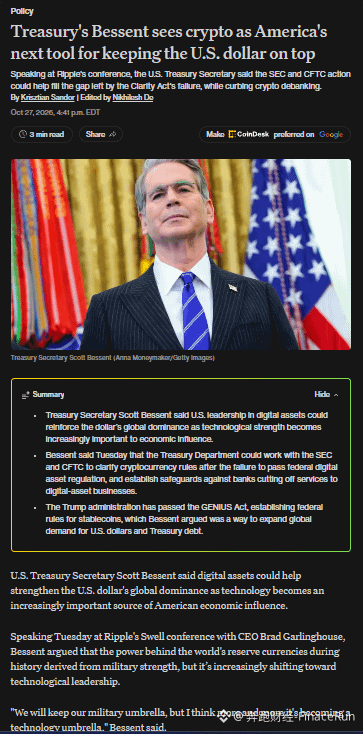
U.S. Treasury Secretary: Digital assets are a new tool for safeguarding dollar dominance; after the CLARITY Act hit a roadblock, the SEC and CFTC can coordinate on oversight
On Tuesday local time, U.S. Treasury Secretary Scott Bessent spoke at a Ripple conference, saying that the focus of great-power competition is shifting from military confrontation to technological rivalry, and that digital assets have become an important part of this contest.
Only by firmly maintaining its leading edge in digital assets can the United States continue to consolidate the dollar’s status as the world’s reserve currency. Stablecoins, meanwhile, could become a key tool for strengthening the dollar’s global reserve status.
Bessent acknowledged that the failure to pass the CLARITY Act was a major setback for advancing regulation. Nevertheless, the Treasury will work with the two major regulatory agencies, the SEC and CFTC, to fill gaps in the rules through administrative action and put effective oversight of the industry in place.
Addressing widespread industry concerns about “debanking,” Bessent said that even without legislation, regulators can issue industry best practices and risk-control safeguards to prevent banks from broadly cutting off financial services to crypto businesses.
He also reiterated that the GENIUS Act, which has already been enacted, establishes a federal regulatory framework for stablecoins. Dollar-backed stablecoins can sustain global demand for the dollar and U.S. Treasuries, further broadening financing channels for U.S. government debt.
Taken together, Bessent’s remarks mark a fundamental shift in U.S. digital currency policy from “risk prevention” to “strategic weaponization.” This is not merely an adjustment in regulatory posture, but an evolution in the way the United States approaches geopolitical and financial competition.
Although technological competition may reshape the underlying logic of financial power, whether digital assets can become “guardians” of dollar dominance remains to be seen. After all, the decentralized foundations of the technology are inherently at odds with the aims of centralized hegemony.
#数字资产协同监管