【October 27 | Global Markets News and Data Analysis】
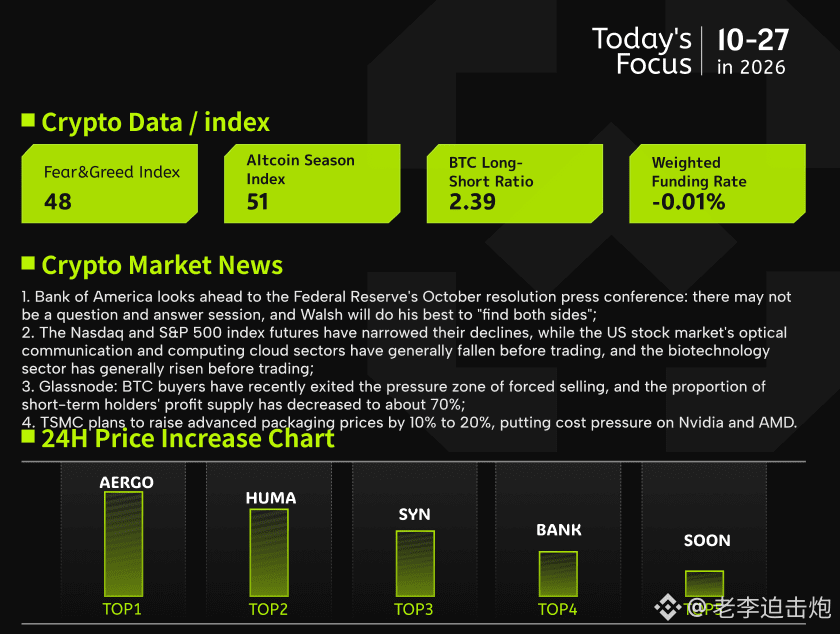
1. BofA previews the Fed’s October decision press conference: There may be no Q&A session, and Warsh will try to walk a fine line;
2. Losses in Nasdaq and S&P 500 futures narrow; optical communications and AI computing cloud stocks broadly fall in premarket trading, while biotech stocks broadly rise;
3. Glassnode: Recent BTC buyers have moved out of the zone of intense selling pressure, and the share of short-term holders’ supply in profit has fallen to around 70%;
4. TSMC is reportedly planning to raise advanced packaging prices by 10% to 20%, putting cost pressure on Nvidia and AMD.
With the October 2026 policy meeting approaching, the market is sharply divided. BofA expects Warsh to stick to brief remarks. If the Fed raises rates, he would only need to reiterate that inflation remains high and the economy resilient, while guarding against excessive tightening. If the Fed holds rates steady, he would need to shore up confidence in the credibility of its policy; otherwise, the market could see a repeat of a distorted Treasury yield curve, a weaker dollar, and sell-offs in risk assets. BofA maintains its forecast for rate hikes in stages in December and next March, and does not even rule out larger hikes if inflation proves more persistent than expected. Moody’s Analytics, however, opposes a rate hike. Its risk matrix is flashing warning signs, suggesting that policy missteps have themselves become a risk.
For crypto markets, especially BTC, the impact is not symmetrical. Expectations of tighter policy often push up real interest rates and the dollar, increasing the opportunity cost of holding bitcoin and weighing on its valuation. Recent on-chain data shows that the share of short-term holders in profit has fallen from near-universal profitability to around 70%. Selling pressure from profit-taking has eased noticeably compared with a month ago, improving entry conditions. But this is merely a cooling of market positioning, not sufficient evidence of a trend reversal. If the meeting delivers a stronger hawkish signal and further locks in a December rate hike, expectations of tighter liquidity will continue to weigh on BTC in the short term. Conversely, a dovish tone could revive risk appetite and give crypto markets some breathing room. The direction of the market will depend more on how investors reassess the subsequent policy path than on the outcome of any single meeting.
1. BofA previews the Fed’s October decision press conference: There may be no Q&A session, and Warsh will try to walk a fine line;
2. Losses in Nasdaq and S&P 500 futures narrow; optical communications and AI computing cloud stocks broadly fall in premarket trading, while biotech stocks broadly rise;
3. Glassnode: Recent BTC buyers have moved out of the zone of intense selling pressure, and the share of short-term holders’ supply in profit has fallen to around 70%;
4. TSMC is reportedly planning to raise advanced packaging prices by 10% to 20%, putting cost pressure on Nvidia and AMD.
With the October 2026 policy meeting approaching, the market is sharply divided. BofA expects Warsh to stick to brief remarks. If the Fed raises rates, he would only need to reiterate that inflation remains high and the economy resilient, while guarding against excessive tightening. If the Fed holds rates steady, he would need to shore up confidence in the credibility of its policy; otherwise, the market could see a repeat of a distorted Treasury yield curve, a weaker dollar, and sell-offs in risk assets. BofA maintains its forecast for rate hikes in stages in December and next March, and does not even rule out larger hikes if inflation proves more persistent than expected. Moody’s Analytics, however, opposes a rate hike. Its risk matrix is flashing warning signs, suggesting that policy missteps have themselves become a risk.
For crypto markets, especially BTC, the impact is not symmetrical. Expectations of tighter policy often push up real interest rates and the dollar, increasing the opportunity cost of holding bitcoin and weighing on its valuation. Recent on-chain data shows that the share of short-term holders in profit has fallen from near-universal profitability to around 70%. Selling pressure from profit-taking has eased noticeably compared with a month ago, improving entry conditions. But this is merely a cooling of market positioning, not sufficient evidence of a trend reversal. If the meeting delivers a stronger hawkish signal and further locks in a December rate hike, expectations of tighter liquidity will continue to weigh on BTC in the short term. Conversely, a dovish tone could revive risk appetite and give crypto markets some breathing room. The direction of the market will depend more on how investors reassess the subsequent policy path than on the outcome of any single meeting.