
#anthropic滚动12个月营收增长约1200% Korean, Hong Kong, and A-share intraday market briefing (October 27): U.S. semiconductor stocks surge—which sectors are funds moving out of, and where are they heading?
The Philadelphia Semiconductor Index jumped 2.82% last night. ARM rose 6%, and Intel gained 4%. You'd expect Asia's chip stocks to catch some of that upside today, but looking at the market, the money simply didn't flow this way.
South Korea was the wildest market.
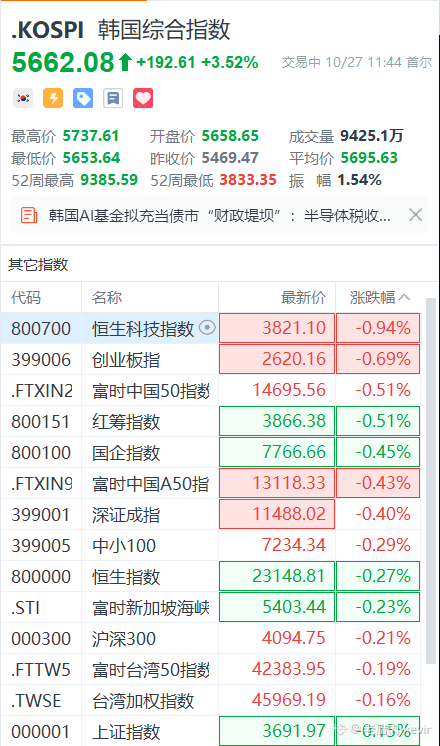
The KOSPI surged more than 4% today, with SK Hynix soaring 6.8% and Samsung up 5%. But this rally was a catch-up move driven by the upbeat mood on Wall Street overnight. Yesterday, foreign investors were hammering Korean stocks over AI investment costs and oil prices. Today's move is short-covering, not fresh money coming in.
In Hong Kong, mainland Chinese investors' southbound funds have recorded net outflows for nine consecutive days, with another HK$2.08 billion flowing out today. Alibaba saw HK$600 million in net selling, CNOOC HK$500 million, and SMIC HK$310 million. Where did the money go? Zhipu AI attracted HK$430 million, Baidu HK$270 million, and UBTECH HK$140 million. In other words: money is being pulled out of large caps and flowing into AI applications and small robotics companies.
A-shares were the most honest. The three major indexes turned negative, and more than 2,900 stocks fell. Major funds pulled out of AI hardware across the board: 6.6 billion yuan from components, 4.8 billion from semiconductors, and 4.5 billion from communications equipment—a total of 16 billion yuan. But the humanoid robotics sector bucked the trend, attracting 2.6 billion yuan, while digital chip design drew in 990 million yuan. The indexes are down, but money is still buying—someone is positioning for an opportunity.
The big rally in U.S. semiconductor stocks was someone else's party. What Asian markets were really doing today was pulling money out of AI hardware and shifting it toward robotics, AI applications, and defensive sectors. South Korea saw a short-covering rebound, Hong Kong continued to see southbound funds flow out, and A-shares saw buying amid the decline, with capital rotating between sectors. $KORU $ZHIPU $SKHYNIX