Musk: SpaceX Completes $40 Billion GPU Debt Financing, Says More Than 200 New Cloud Providers Will Be Forced Out on a Large Scale
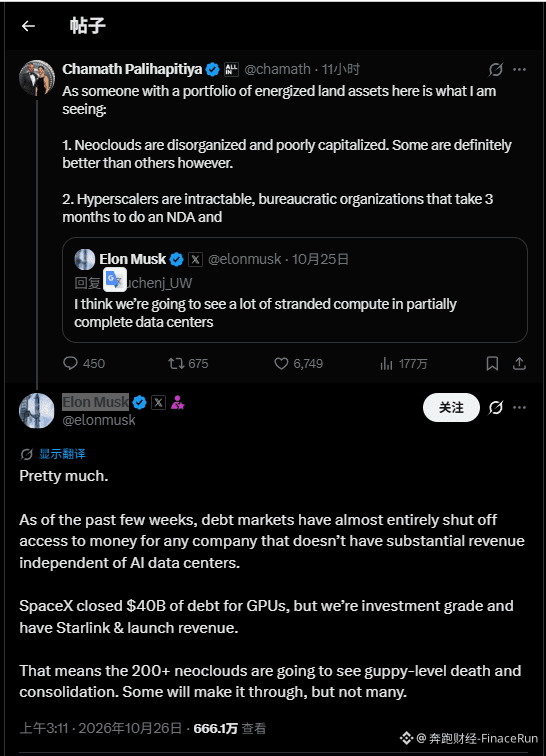
October 26 — SpaceX CEO Elon Musk said in a reply on X that the company has completed $40 billion in debt financing, with the funds to be used to purchase GPUs for AI workloads.
He stressed that SpaceX secured the financing thanks to its investment-grade credit rating and steady revenue from its Starlink satellite internet and rocket launch businesses.
Regarding the purpose of the financing, Musk said it was mainly callable debt to cover GPU purchases scheduled for delivery in the first and second quarters of 2027, and may have limited impact on this quarter’s results.
Bloomberg previously reported that the financing was planned through a special-purpose vehicle (SPV) and would not appear on SpaceX’s balance sheet, preserving its investment-grade rating.
With credit conditions tightening, Musk offered his outlook for the compute cloud industry, saying that in recent weeks debt markets had largely opened their doors only to companies with independent revenue streams beyond AI data centers.
This means that more than 200 new cloud computing providers (neoclouds) may face large-scale shakeouts and consolidation, with only a handful ultimately surviving.
Specifically, neocloud providers want to expand but lack the funding and organizational capacity to deliver, while hyperscalers have the money but are hampered by bloated organizations, bureaucratic processes, and difficulty executing. This has also stalled the IPO plans of several peers.
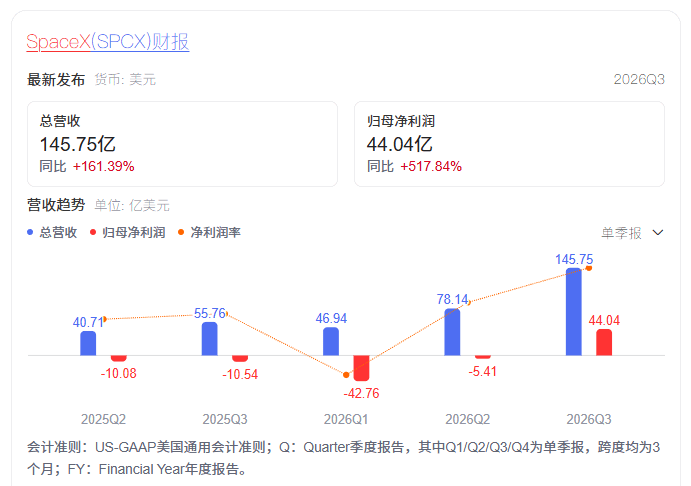
Musk’s confidence is backed by the recently released quarterly results: SpaceX’s third-quarter revenue rose 161% year over year to $14.58 billion. Its AI business turning profitable for the first time, along with its diversified operations, is key to the gap between SpaceX and companies that solely lease computing power.
Overall, the market is divided: some see this as a bursting bubble, while others view it as the survival of the fittest in the industry. What is clear, however, is that the AI compute race is no longer just about securing chips—it has shifted to financing capacity and the ability to repay debt.
#SpaceX融资