

Introduction
Polkadot ($DOT ) is a protocol where specialized blockchains operate under shared security and exchange messages with one another. In 2026, the project has three major developments: a hard cap on DOT supply (2.1 billion), the launch of smart contracts on Polkadot Hub, and the TDOT spot ETF.
The main tension: tokenomics have been fixed, but demand has yet to be proven. The price is around $1.03, approximately 98.1% below its all-time high. This is a speculative asset. It may suit those who study infrastructure projects and understand that launching a technology does not necessarily mean its usage will grow.
Technology
Consensus: Nominated Proof-of-Stake (NPoS). DOT holders select validators, who secure the network.
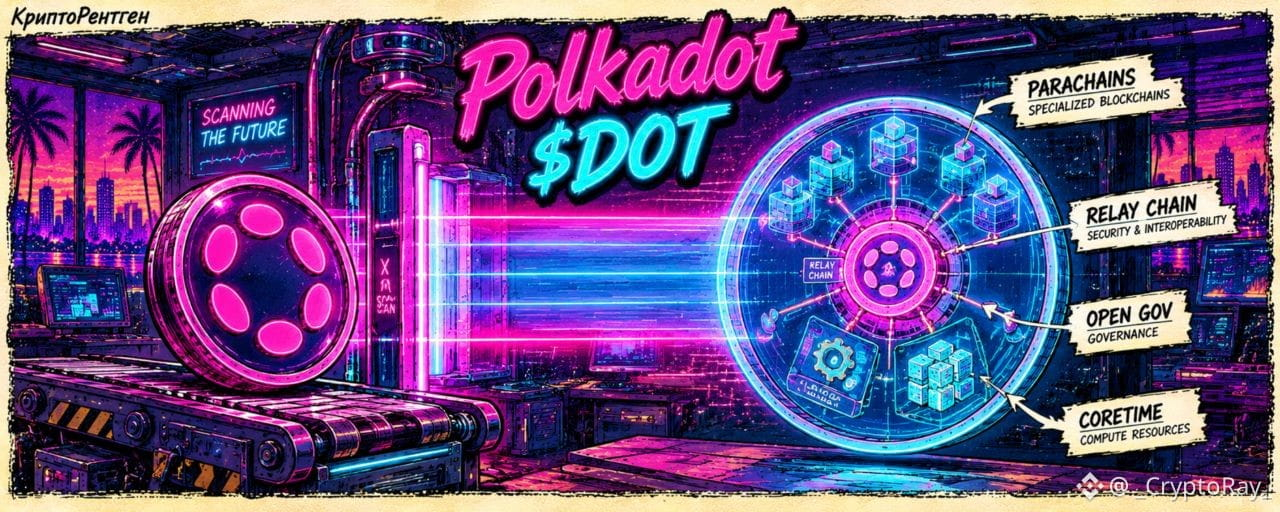
Architecture: Relay Chain (shared security layer), parachains (specialized networks), Polkadot Hub, and eventually JAM.
Polkadot Hub: Since January 27, 2026, it has supported contracts through REVM (compatible with Ethereum and Solidity). PolkaVM, a RISC-V-based execution environment, is also under development.
JAM (Join-Accumulate Machine): a planned architecture intended to expand the range of tasks the protocol can perform. Development and testing are underway, but there is no confirmed mainnet date.
What this means in practice: Ethereum developers don’t need to learn a new language to try the Hub. JAM, meanwhile, is still a promise, not a working product.
Tokenomics
OpenGov Referendum No. 1710 introduced a supply cap and a stepped slowdown in issuance.
Maximum supply: 2.1 billion DOT.
Circulating supply: ~1.709 billion DOT.
Remaining until the cap: ~391 million DOT.
Issuance before the reform: ~120 million DOT per year.
Issuance after 14.03.2026: ~55.68 million DOT per year.
Gross issuance: ~3.26% of circulating supply.
Price: ~$1.02–1.05.
Market capitalization: ~$1.75–1.79 billion.
FDV at the supply cap (at $1.03): ~$2.16 billion.
What’s important to understand:
Inflation: 3.26% is gross issuance. Net inflation depends on the methodology and actual token flows.
Burning: Systematic DOT burns have been halted as part of the transition to the Dynamic Allocation Pool (DAP). Burns currently do not offset issuance.
FDV: It cannot be considered equal to market capitalization because DOT has a supply cap of 2.1 billion.
A cap ≠ deflation: supply continues to grow, just more slowly. According to the model, the cap is reached around 2160 (this is a projection).
DOT utility: staking, governance through OpenGov, and payment for Coretime (the network’s computing resources).
Investors and regulatory status
The project is associated with the Web3 Foundation. The 2017 ICO raised about $145 million.
TDOT ETF (21Shares): launched on March 6, 2026, with a 0.30% fee. It provides exposure to DOT, not direct ownership of the tokens.
The ETF’s name includes the word “Staking,” but the factsheet lists a staking utilization rate of 0%. The name does not prove that the fund’s tokens are staked.
The fund is not registered under the Investment Company Act of 1940, so it offers a different set of investor protections than registered funds.
On-chain activity
Only this is confirmed: contracts on the Hub went live on January 27, 2026, and about 19 contracts had been deployed there a week later. This is an early indicator, not a measure of current activity or proof that the platform has failed.
Assessing actual usage requires comparable data series: active addresses, transactions, contracts in actual use, TVL, and Coretime sales. There are no recent confirmed figures for these here, so no conclusions can be drawn about whether activity is growing or declining.
Market snapshot as of 25.10.2026 (aggregators report different figures):
24-hour volume: ~$85–160 million.
ATH: ~$55 (November 4, 2021).
ATL: ~$0.73 (August 18, 2026).
Down from ATH: −98.1%.
Above ATL: +42%.
The inside story
Facts:
Referendum No. 1710 set a cap of 2.1 billion DOT and a stepped issuance schedule. Confirmed.
The first issuance reduction took effect on March 14, 2026. Confirmed.
The proposal to rename DOT to JAM was rejected by a vote. Confirmed.
TDOT launched on March 6, 2026; staking is listed at 0% in the factsheet. Confirmed.
Rumors and insider claims:
“JAM will automatically push the price up” — unconfirmed; this is a hypothesis.
“Lower issuance guarantees DOT will rise” — disproven: price depends on demand and liquidity.
“The ETF has already generated significant institutional demand” — unconfirmed; there is no data on fund flows.
“19 contracts means the Hub has definitively failed” — a premature conclusion.
Strengths and weaknesses
Pros:
A hard supply cap of 2.1 billion DOT.
A stepped model that slows issuance.
DOT has utility within the network: staking, voting, and Coretime.
The Ethereum-compatible Hub lowers the barrier to entry for developers.
The TDOT ETF broadens access to DOT exposure.
Cons:
Sustained demand for the Hub has not been proven.
There is no confirmed mainnet date for JAM.
Issuance remains positive (~3.26% gross).
Burning has stopped, with no mechanism offsetting issuance.
The price is 98.1% below its ATH.
Conclusions about the ETF are limited: there is no flow data, and staking utilization is zero.
Sources
Referendum No. 1710
Parity economic reform and DAP
Polkadot Hub launch, DL News
TDOT launch
