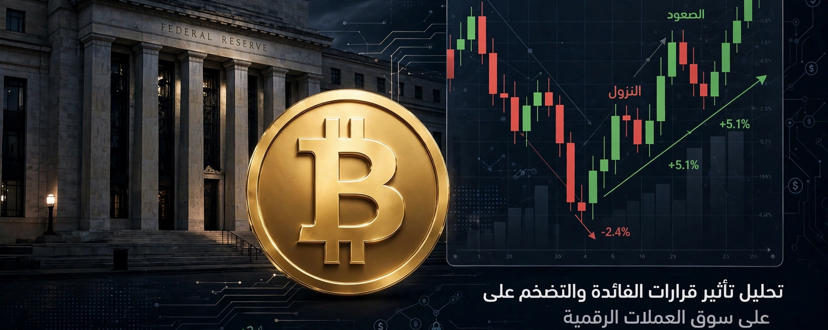

The cryptocurrency market is bracing for a decisive week, with all eyes on the U.S. Federal Reserve meeting on October 27 and 28, as Bitcoin trades near critical levels around $80,000.
After failing to hold above $83,000, the leading cryptocurrency’s fate is now directly tied to what comes out of Washington.
What can we expect from the meeting?
Market expectations suggest that the Fed will leave interest rates unchanged. But the actual decision is not what will really drive the market; it is the press conference by Fed Chair Jerome Powell and the tone of his remarks on inflation and future policy.
The meeting comes amid a complex set of factors:
- Brent crude has risen to $116.72, driven by supply tensions in the Middle East.
- U.S. September inflation data will be released on October 29, one day after the rate decision.
- U.S. Treasury yields have risen, reducing the appeal of riskier assets.
Three channels through which the Fed influences cryptocurrency markets:
First: Interest rates, the main driver of risk appetite
When the Fed raises interest rates, the dollar and government bonds become more attractive, and liquidity flows out of risky assets like Bitcoin. When it signals rate cuts, the opposite happens. So any indication that a monetary easing cycle could begin in 2027 would be a powerful bullish catalyst.
Second: Liquidity and the money supply
The historical relationship is clear. During the period of quantitative easing in 2020–2021, when the Fed injected trillions of dollars, Bitcoin surged from $10,000 to $69,000.
Today, however, the Fed is pursuing quantitative tightening, withdrawing liquidity from the market. Continuing this policy puts pressure on crypto, while announcing an end to it would be seen as a major turning point.
Third: Institutional behavior
The crypto market is no longer dominated by individual investors. Institutions and exchange-traded funds (ETFs) now account for more than 60% of current trading volume.
Data from last week revealed how sensitive these institutions are to the Fed’s decisions: $1.05 billion flowed into Bitcoin funds on October 19 and 21, then $635.6 million flowed out on October 22 alone as concerns mounted ahead of the meeting.
Post-meeting scenarios:
1. The hawkish scenario (currently the most likely):
If Powell confirms that energy-driven inflation remains elevated and that interest rates will stay high for longer, Bitcoin is likely to break below the psychological support level of $80,000 and head toward $77,876, followed by the support range between $76,700 and $72,500.
A break below this level would put the average cost basis of companies’ Bitcoin holdings (around $80,000) underwater, which could significantly weaken confidence.
2. The dovish scenario:
If Powell signals that the tightening cycle has ended and rate cuts are near, Bitcoin could quickly reclaim $83,000, invalidating the bearish scenario entirely. Liquidity would also flow strongly back into altcoins, 80% of which fell over the past week.
Bottom line:
Bitcoin is no longer an asset isolated from the traditional financial system. It has become an amplified mirror of Wall Street’s mood. This week’s Fed meeting will determine not only Bitcoin’s price, but also the market’s direction for the coming months: will we see a flight from risk, or a return to risk appetite?
The most important level this week will not be $80,000 or $83,000, but one sentence Jerome Powell says on Tuesday evening.