

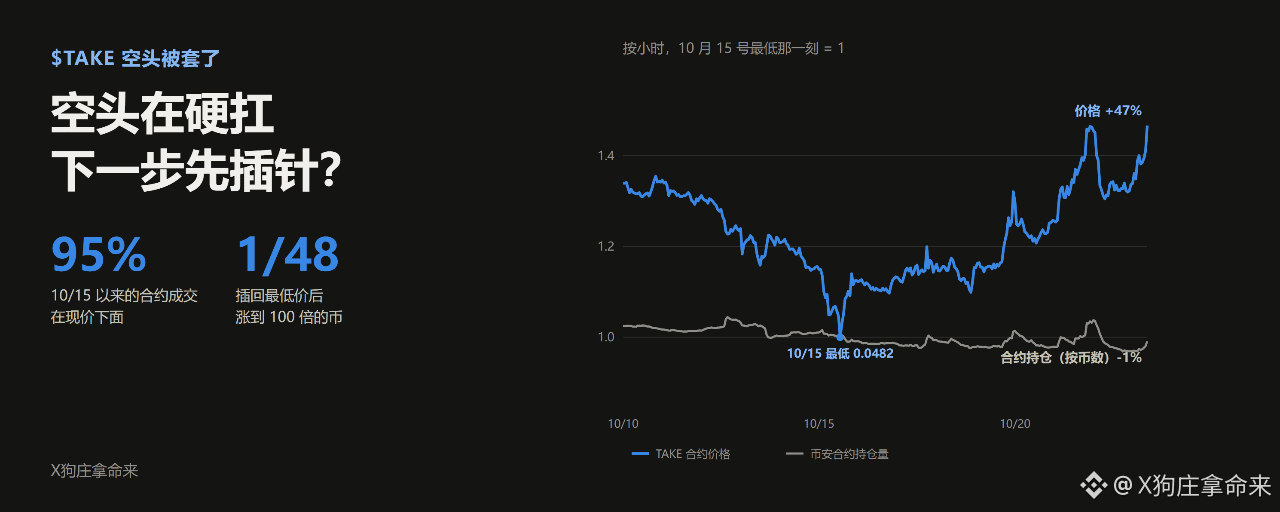

Honestly, I think the shorts in TAKE are trapped. My guess is that next it will first wick down near the low, shake out the people crowded into longs, and then rise hundreds of times like AKE.
This is my assessment, not a fact. Below, I’ll lay out all the data I can find, including evidence both for and against my view.
▍First, a quick explainer: how to tell whether shorts are trapped
In contracts, every short position opened has a long position on the other side, so the total long and short open interest is always equal. If open interest increases, it means someone is opening new positions; if it decreases, someone is closing positions or getting liquidated.
To see whether shorts are trapped, look at three things: what prices most short positions were opened at, whether they're in profit or loss now, and whether they're getting out.
▍The shorts really are trapped
TAKE bottomed at 0.0482 on October 15 and is now at 0.0707, up 47%.
Since October 15, Binance futures have seen around $23 million in total trading volume, with 95% of it traded below the current price. The average traded price was 0.0602. Shorts opened during this period are already down an average of 17%. Going back to September 25, 99% of trades were below the current price.
The key thing is that open interest has barely moved. The price is up 47%, but futures open interest has stayed between 77 million and 82 million tokens. If shorts were closing or getting liquidated, open interest would fall as the price rose. It hasn't—so the shorts are trapped and still holding on.
▍But the shorts aren't feeling the pain yet
First, the shorts are getting paid. TAKE's funding rate has stayed positive, so longs pay shorts 0.005% to 0.024% every 4 hours. Since August, there have been 500 funding settlements, and only 2 were negative. If they're trapped but still earning interest, the shorts have no reason to rush for the exit.
Second, it's the longs who are crowded in. On Binance futures, 77% of accounts are long. Long and short positions have equal open interest, which means the 23% of traders who are short have positions 3.3 times larger on average than those of the longs. Shorts are the minority, but their positions are big.
These shorts may not be betting on a price drop. They could be people holding the token or waiting for monthly unlocks who are hedging: they profit when the token rises, lose on the short, and the two offset each other. These shorts won't be forced out just because the price goes up. I can't tell who they are specifically—this is only a possibility.
Third, there's not much fuel, but liquidity above the price is thin too. All short positions together total just 79 million tokens, worth around $5.6 million at the current price. On the Binance futures order book, there are only $360,000 worth of sell orders within 20% above the price, versus $560,000 in buy orders within 20% below it. If a short squeeze really gets going, just a few million dollars of buying could push the price a long way.
▍Why I think we'll see a wick down first
The longs are too crowded. With 77% of accounts long, the easiest way to drive the price up hundreds of times may be to dump it first, shake those traders out, and then rally.
That's exactly how AKE played out. After its first surge in April to 0.0012966, it moved sideways for over two months. It dropped 28% on July 4, then another 35% on July 7, and fell to 0.0001729 on July 10—below where it was before the first rally. Five days later, on July 15, it surged 257% in a single day, then kept climbing all the way to 0.1647, a 952x gain from the low.
TAKE is still around 5x its low. The huge green candle on September 23 came with over $600 million in volume, almost all of it above the current price. Those buyers still haven't broken even. In my view, it's hard for the price to take off until that supply has been shaken out.
In terms of timing, I'll be watching October 25. Around the 25th of every month, nearly 20 million more TAKE tokens enter circulation. This time, that's equivalent to 5% of the current circulating supply.
▍After a wick back to the low, does the price really take off?
I went through every Binance USDⓈ-margined futures contract, including delisted ones, looking for coins that had an initial rally of more than 5x and then fell back near their lows. There were 48 coins without a Binance spot listing.
In the six months after buying near the low: 35% rose to 2x, 13% to 5x, 8% to 10x, and only one reached 100x—AKE. The second-best performer was PIPPIN at 88x.
More often, the wick down is a one-way trip: 79% of the coins later fell more than 20% below their lows, and after three months they were typically worth only 80% of their price at the time.
Among the coins with especially strong first rallies—over 8x (TAKE's was over 14x)—not one of the 23 reached 10x, and 87% later fell more than 20% below their lows.
There were 46 coins with spot listings that fit the same pattern, and not one reached 10x. TAKE not having a spot listing is one point in its favor.
So honestly, a wick down followed by a rally of hundreds of times has happened just once in 48 cases. I think TAKE has a shot, but I wouldn't bet heavily on it.
▍How high would a 100x or 300x take it?
From an entry around 0.0135, 100x would be 1.35. With a total supply of 1 billion TAKE, that implies a fully diluted valuation of $1.35 billion. At 300x, the price would be 4.05 and the fully diluted valuation $4.05 billion. AKE's peak fully diluted valuation was $16.5 billion, so the size isn't outlandish.
But buying in now at 0.0707 is a different story: even reaching 4.05 would only be a 57x gain. Hundreds of times upside is only for those who get in near the low.
▍What I would do
I wouldn't chase a long position now. With 77% of traders long and funding positive, chasing here puts you on the side that could get shaken out.
Wait for a wick down. If it really wicks back near the low, I'd buy in two or three tranches, without leverage.
After the wick, I'd look for two things to confirm it: first, the price needs to reclaim quickly and close back above the low; second, there needs to be a genuine ignition afterward—a day's trading volume more than 50 times normal, a close up more than 100%, and no giveback the next day.
I'll admit when I'm wrong: if the monthly close is below the low, then it's not the AKE playbook. Historically, that usually means it keeps going down—and that's when you get out.
There's another scenario I'd acknowledge: if it goes straight up without a wick down, and open interest starts falling as the price rises, then the shorts are the ones who can't hold on. The playbook changes to a short squeeze first.
What do you think happens first with TAKE: a wick down, or the shorts getting squeezed? Let me know in the comments.
This is not investment advice.