Texas Instruments’ profit surges, but midpoint of Q4 revenue guidance is nearly flat sequentially
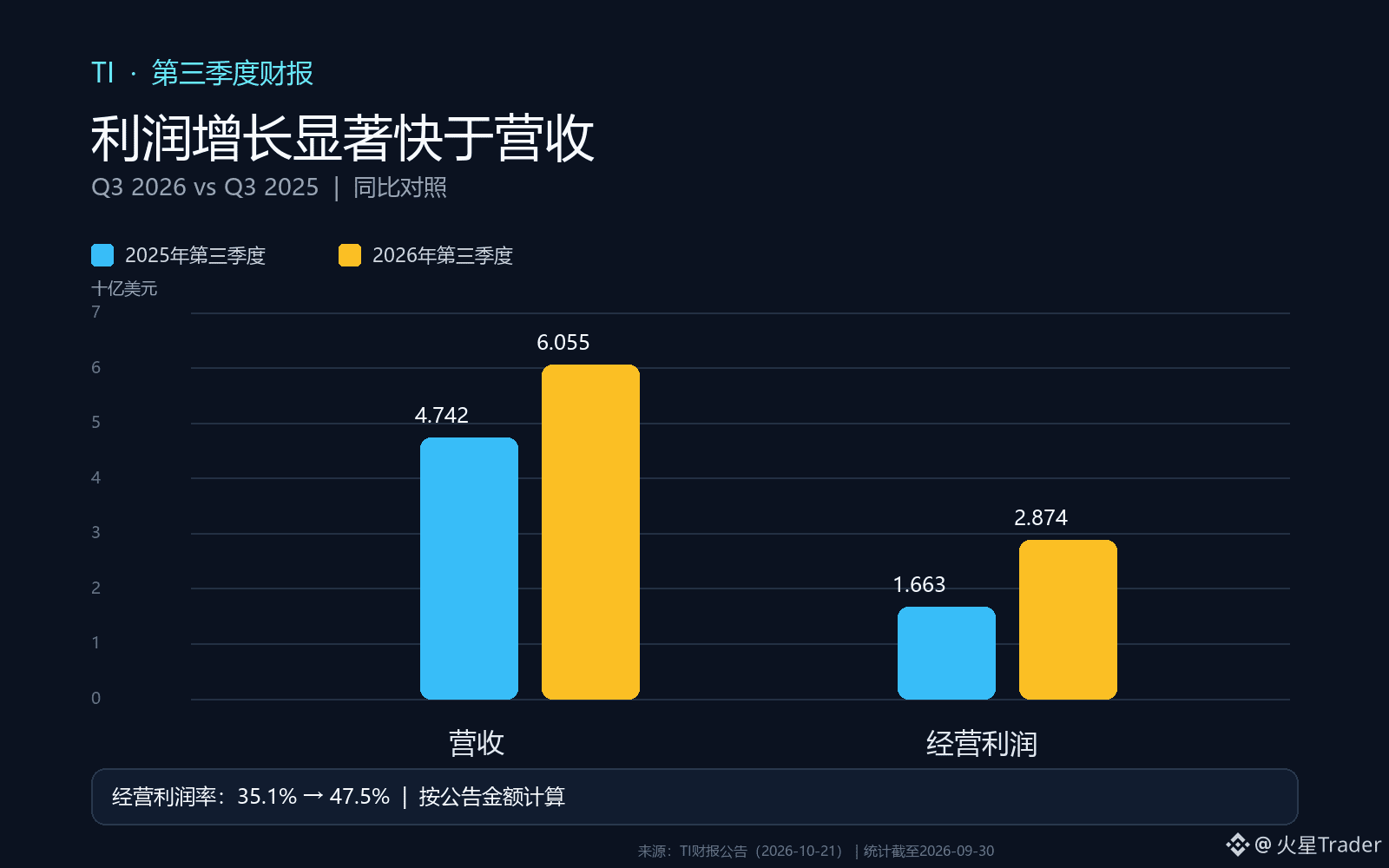
TI’s third-quarter profit recovery was striking, but I’d rather look at year-over-year growth and next-quarter momentum separately. Revenue grew 28% year over year, while operating profit rose 73%. This shows that earnings recovery is outpacing revenue growth significantly, but it doesn’t directly imply that revenue will accelerate sequentially in the fourth quarter.
For Q3, ended September 30, TI reported revenue of $6.055 billion, compared with $4.742 billion in the same period last year. Operating profit was $2.874 billion, up from $1.663 billion. Calculated as operating profit divided by revenue, the operating margin rose from about 35.1% to 47.5%, an increase of approximately 12.4 percentage points. The most notable takeaway from the chart isn’t simply that both bars are taller, but that profit grew much faster than revenue: as revenue expanded, costs and expenses became less burdensome relative to sales, magnifying the increase in profit.
However, this margin change cannot be attributed entirely to operating leverage in the quarter. The year-ago quarter included $85 million in restructuring charges, while this quarter had none; this quarter also included $7 million in acquisition charges. These amounts are small relative to the change in operating profit, but they’re a reminder that the comparison isn’t on a perfectly like-for-like basis. The more measured conclusion is that profit performance improved significantly. To assess whether this is sustainable, we’ll need to keep watching revenue mix, manufacturing costs, and spending in subsequent quarters rather than simply extrapolating 73% year-over-year growth.
There is also support on the demand side, although the evidence so far comes from the company’s description of the quarter. TI said that industrial, automotive, and data center businesses continued to see broad-based growth. That’s more resilient than growth driven by a single end market, but the announcement doesn’t specify the contribution from each market in this statement, so I wouldn’t characterize it as a synchronized recovery across every product line. We’ll need to see whether orders in these end markets and the company’s segment data continue to confirm the trend.
Q4 revenue guidance is $5.8 billion to $6.3 billion, with a midpoint of $6.05 billion—almost flat compared with Q3 revenue of $6.055 billion. The range itself is wide, meaning the company is providing a conditional range, not a commitment to the midpoint. At a minimum, it doesn’t offer clear evidence that revenue will continue to rise next quarter. On the other hand, Q4 revenue could also come in near the top of the range. The year-over-year comparison, seasonality, and timing of end-market demand will all affect the actual result, so we can’t conclude that growth has stalled based on the midpoint alone.
For now, I read this earnings report as showing that the profit recovery has materialized, while sequential acceleration remains to be confirmed. The key things to watch next are where actual Q4 revenue lands within the guidance range and whether the operating margin can sustain its current level. If revenue is broadly flat while margins continue to improve, we’ll still need to determine whether the improvement comes from product mix, cost efficiencies, or the timing of expenses. If revenue weakens and margins fall, the year-over-year profit growth this quarter is more likely to reflect a combination of cyclical recovery and a favorable comparison base.
Sources: Texas Instruments’ third-quarter 2026 earnings announcement, published 2026-10-21, for the period ended 2026-09-30; checked on 2026-10-23. Operating margin is calculated as operating profit divided by revenue and rounded to one decimal place. The Q4 guidance midpoint is the arithmetic average of the range endpoints. The accompanying chart was created using data from the announcement.
Source: https://investor.ti.com/news-releases/news-release-details/ti-reports-third-quarter-2026-financial-results-and-shareholder