

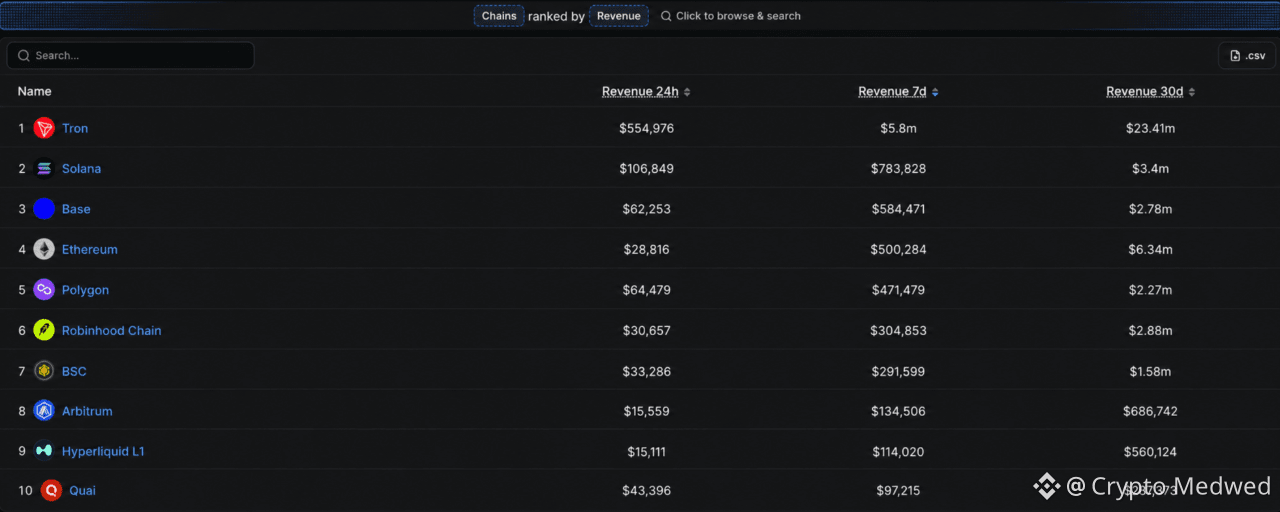

TRON continues to demonstrate strong economic activity. According to data from analytics platform DefiLlama, shared by Lookonchain, the blockchain ranked first among tracked networks by revenue across three periods: 24 hours, 7 days, and 30 days.
Over the past 30 days, revenue reached $23.41 million, significantly surpassing the figures for Ethereum, Solana, Base, and other major blockchains.
TRON leads in three metrics
According to DefiLlama statistics, TRON’s figures at the time the ranking was compiled were:
Over 24 hours — $554,976.
Over 7 days — $5.8 million.
Over 30 days — $23.41 million.
The network’s lead over the monthly period is particularly impressive. For comparison, over the same period Ethereum generated $6.34 million, Solana $3.4 million, Base $2.78 million, and Polygon $2.27 million.
Thus, TRON outperformed Ethereum by about 3.7 times and Solana by almost 7 times.
Meanwhile, the combined figure for the next nine networks after TRON in the ranking was lower than TRON’s figure alone. This demonstrates the blockchain’s significant lead under the selected methodology for calculating network revenue.
Where does TRON get these figures?
Transactions involving stablecoins, primarily USDT, remain the main source of economic activity on TRON. The network is widely used for transfers between cryptocurrency exchanges, wallets, payment services, and other market participants.
Unlike blockchains whose activity largely depends on memecoin trading or short-term speculative trends, TRON has a substantial flow of regular transactions involving digital dollars.
These transactions require the network resources Energy and Bandwidth. If a user does not have enough resources, a transaction may involve burning TRX.
It is the TRX fees that are burned that DefiLlama counts in the Revenue metric for the TRON blockchain.
Why shouldn’t Revenue be confused with total fees?
When analyzing rankings like these, it is important to understand the difference between the Fees and Revenue metrics.
Fees refers to the fees users pay for transactions.
Revenue reflects the portion of fees that, according to a platform’s specific methodology, is counted as network revenue.
For TRON, DefiLlama uses the value of the TRX burned.
Therefore, Revenue figures cannot be directly compared with companies’ financial statements or the profits of traditional businesses. The ranking also excludes all revenue from applications running on top of blockchains.
For example, a significant share of Solana’s economic activity takes place on individual applications and trading platforms, whose revenue is counted separately from that of the network itself.
Nevertheless, $23.41 million in a month is a significant indicator of real economic activity on the TRON blockchain.
Growing USDT use supports the network’s economy
Previous analytical reports have already recorded an increase in the supply of stablecoins on TRON. By mid-October, their combined market capitalization had approached $95 billion.
The high concentration of USDT creates conditions for regular use of the network for international transfers, exchange transactions, and other settlements. The more actively digital dollars are used, the greater the potential demand for network resources.
However, there is an important caveat: growth in USDT volumes does not necessarily lead to a proportional increase in network revenue.
Results are influenced by the cost of resources, the number of operations, Energy delegation mechanisms, and changes in network fees. Therefore, assessing long-term trends requires considering several indicators at once, not just stablecoin market capitalization.
Conclusion
DefiLlama statistics highlight one of TRON’s key strengths: the network’s popularity for regular financial transactions.
$23.41 million over 30 days and first place among the tracked blockchains is a significant result.
It is especially notable that TRON outperforms Ethereum, Solana, and other major networks specifically in blockchain-level Revenue.
TRON has infrastructure whose use generates a measurable economic impact through network fees and TRX burns.
And if the growth of payments, crypto cards, and other services continues, the network will have additional opportunities to expand its practical applications.