



Source: Hua Li Hua Wai
The previous two weeks may have been affected by the macroeconomic environment, compounded by issues such as generally weak ETF inflows. Bitcoin’s price remained in a narrow trading range between $80,000 and $82,000 (corresponding to the daily EMA55 and EMA21).
Generally speaking, periods of narrow-range consolidation are often the calm before a new bout of volatility. Perhaps the market has been responding to some news and sentiment catalysts over the past few days—for example, JPMorgan Chase released its first 10-year return forecast for Bitcoin, projecting an annualized return of around 10% (compared with the bank’s forecast of about 5.5% a year for gold).
For example, the US Office of the Comptroller of the Currency (OCC) has issued the first final implementing rule under the GENIUS Act (the new rule will take effect on January 18, 2027). This means US stablecoin regulation is moving from legislation to implementation, giving Wall Street a clearer compliant path for participating in stablecoins and the crypto market.
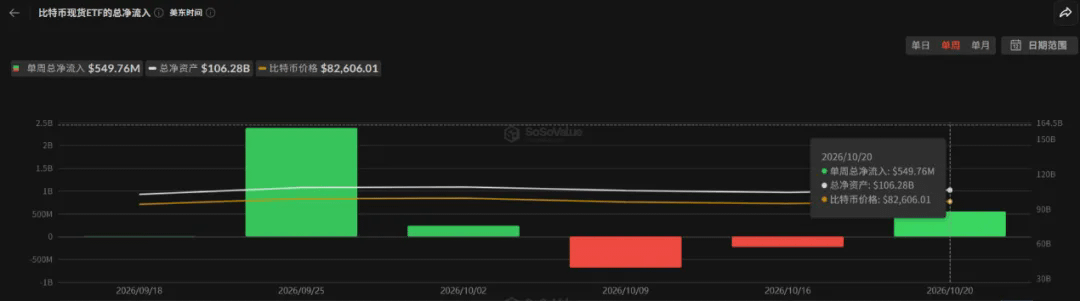
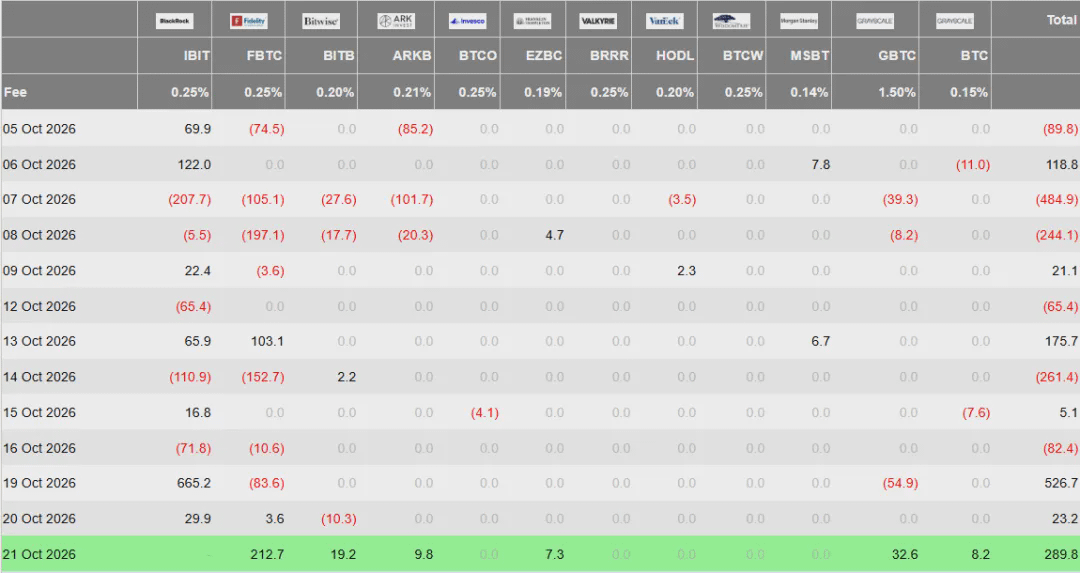
Another example: since the start of this week (October 19), ETFs have once again seen sustained net inflows—about $527 million on Monday, $23 million on Tuesday, and $290 million on Wednesday, as shown in the chart below.
... Before the market gets new direction from the Fed’s FOMC meeting, it has already broken through the short-term resistance level of $82,000. Buoyed by some positive news and a recovery in ETF demand, the price has moved back above the daily EMA21. The calm and sideways trading that lasted nearly two weeks seems to have been broken.
Of course, the price moving back above the daily EMA21 only means that the short-term structure has improved. It does not guarantee that prices will continue to rise from here. The next question is whether the $82,000 level can hold, turning from resistance into support.
In our previous article (October 16), we discussed a similar question: don’t try to guess whether prices will rise or fall in the short term. Instead, act as needed in line with your own plan and expectations, at prices that are relatively favorable for you. A truly favorable price isn’t simply one where the asset looks supposedly expensive or cheap. Those terms are relative. Just because you saw Bitcoin below $60,000 four months ago doesn’t mean you should categorically consider today’s $80,000 price expensive. We need to look at price in context and align it with our current plans, personal position sizes, and risk tolerance.
It’s true that the market can only go up or down, but if we think about it across different time frames, that doesn’t seem quite so accurate. Besides rising and falling, there’s a third state in the market: prices remain more or less unchanged. This state can last far longer than we imagine. For example, from the relative low on June 30 to now, Bitcoin is up about 42.7%. But during those 114 days, there were 64 days when the closing price moved by less than 1% compared with the previous day. In other words, for more than half that period, Bitcoin’s closing price barely rose or fell at all.
Yet beneath these calm prices, sharp short-term swings are often lurking. Take this week: the market gave us another classic roller-coaster ride. On October 19, news that the US and Iran might reach a compromise agreement sent Bitcoin’s price up from $81,200 to $83,344 in just a few hours. The report was later denied, and Bitcoin fell back below $82,500. During these swings, about 91,875 traders across the market were liquidated, for a total of approximately $319 million—about $185 million in long positions and $134 million in short positions.
If you only check the market occasionally, most of the time it may seem relatively calm. But beneath the apparent price stability, leverage and liquidity in the market may be changing just as dramatically. So for those who like using leverage and betting on short-term price moves, trading based solely on so-called short-term market news and trying to guess in advance whether each news item will push prices up or down carries a high risk of liquidation. As ordinary retail investors, we find it difficult to judge whether some news or rumors are true, and it’s also hard to control when the market will make a sharp short-term move. As we’ve repeatedly discussed in earlier articles, what we can truly control is our own position size and trading discipline.
Time and again, liquidation events remind us that the vast majority of people who use leverage will eventually lose everything in sharp price swings. By contrast, patiently holding spot assets is the only way to weather each bout of volatility safely.
After experiencing losses or failures, many people come to agree again that investing requires patience. But patience can take two forms. One is constantly hoping to wait for a lower or higher price—for example, hoping to buy at $40,000 when Bitcoin falls to $60,000, or hoping it will reach $150,000 after it rises to $120,000. The other is sticking with your plan over the long term and remaining steadfast even while you’re in the dark. From a human perspective, the darkness before dawn often feels like the longest wait. But the people the market truly rewards are often those who hold firm through long stretches of calm and uncertainty.
What’s more, true commitment often means putting your beliefs into practice and taking action before you can prove they’re right. Otherwise, if you only decide to stay the course once everyone knows it’s the right thing to do, the best opportunity has already passed. It’s like realizing you should have bought gold only after its price has surged, or realizing you should have bought Bitcoin only after it has surged. Then you keep missing one spectacular rally after another.
Why does this keep happening? As we mentioned earlier, the market mainly rewards those who persist before dawn, not those who only see it after it has arrived. The same is true of every market opportunity: when everything looks perfectly clear, the best opportunity to stay the course has already passed.
Fortunately, the market is never short of new opportunities. If we can truly understand what it means to stay the course, manage our position sizes properly, and follow our trading discipline, then when the next new dawn arrives, we too will have new gains to show for it.
Let’s imagine a little further: suppose you’re looking at a Bitcoin worth $80,000, and over the coming years its price may rise by 100% or more at certain times. The journey won’t be smooth, and most of the time things may seem relatively quiet. What would you do now?
Would you keep watching from the sidelines and wait in cash? Would you keep accumulating for the long term? Or would you plan to sell and buy in stages? ... These questions may be far more worthwhile than spending time trying to predict whether Bitcoin will rise or fall tomorrow.
In short, dawn will eventually come. We have once again endured a long period of darkness. Before most people realize that dawn has arrived, we need to keep protecting our capital (don’t invest in what you don’t understand, and keep an appropriate amount of cash on hand to deal with downturns or black swan events), focus only on high-quality assets with long-term investment value (build a list of projects you believe in), and continue to manage our positions and risks well (set clear buying and selling targets).
We study the market to be prepared, not to predict prices. Trading can be a very dull business, and that very dullness often seems to be one of the main reasons most people lose money or fail in the market. If one day trading feels dull to you, but you can face it calmly—and your mindset has shifted from chasing the thrill of short-term price swings to prioritizing risk management and discipline—then perhaps you’ve found the right way to trade.
We should treat trading as one part of life, not as all of life. Life is unfair to many people. Some are born with money and status, while others start with nothing but their dreams and a difficult struggle to get by. We don’t need to deliberately pursue so-called equality for everyone; it isn’t realistic. People have never had the same things, and that was true thousands of years ago and will still be true thousands of years from now. We shouldn’t spend all our time complaining about what we lack, because that makes us overlook what we already have. Perhaps we can’t change much in the short term, and it’s hard to seize the perfect moment or opportunity. But by continuing to learn, continuing to think, and staying focused, we can strengthen ourselves with clear plans and decisive action. When we stop complaining about what we don’t have and start thinking about what we can do now, our own progress has already begun.
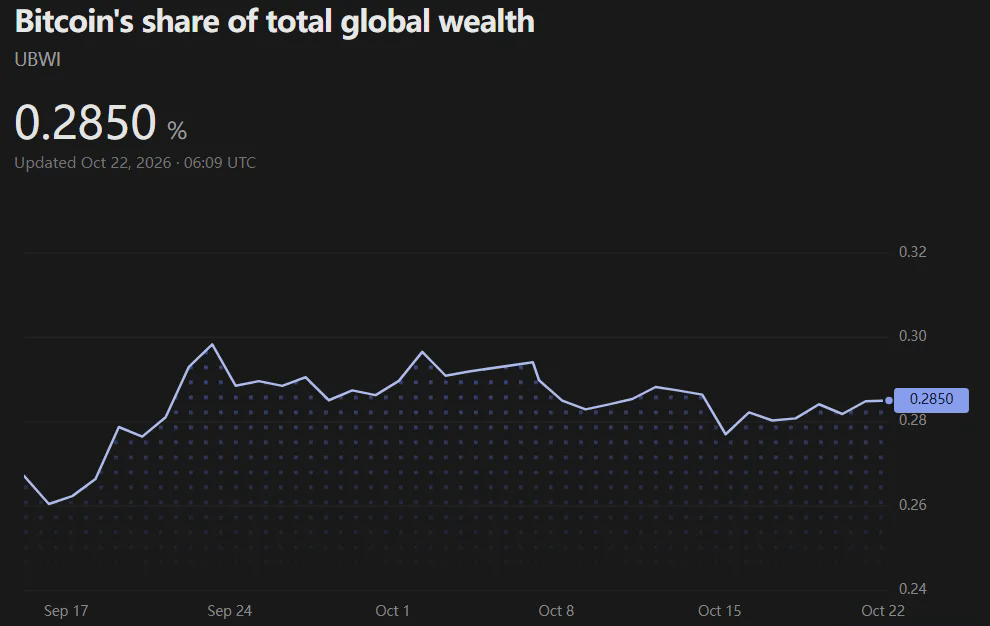
Here’s another interesting data point: Bitcoin currently accounts for about 0.29% of global investment capital. As shown in the chart above, if global capital were to allocate 1% of its funds to Bitcoin in the future, the corresponding Bitcoin price could reach $310,000. (This is only a simple static estimate.)
One final note: The Federal Reserve will hold an FOMC meeting on October 27–28, when the market may reprice its expectations for the path of interest rates. This will determine how much more capital in the market is willing to flow into Bitcoin. On the same day, the largest Bitcoin treasury company, Strategy (MicroStrategy), will hold a special shareholders’ meeting to vote on whether to change the dividends on its four preferred stock classes (STRC, STRF, STRK, and STRD) to accrue daily. For example, STRC could move from paying twice a month to accruing daily, with entitlements determined each day. The aim is to facilitate more financing and then use the proceeds to buy more Bitcoin. October 31 will also mark the 18th anniversary of the Bitcoin white paper published by Satoshi Nakamoto.
Meanwhile, on October 29, the US will release its advance estimate of third-quarter GDP and September PCE inflation data. The last week of October is also earnings week for US tech giants such as Microsoft, Alphabet, and Amazon, which will be releasing their latest quarterly results in quick succession.
In a way, the final week of this month brings together three stories: interest rate decisions, corporate financing, and the founding vision of Bitcoin. What will happen when the cost of money, the direction of capital flows, and the original purpose behind Bitcoin all intersect? We’ll wait and see.
That’s all for this issue (20261022). Everything above reflects my personal views and analysis and is intended only as a record of my thoughts and for discussion. It does not constitute investment advice.