

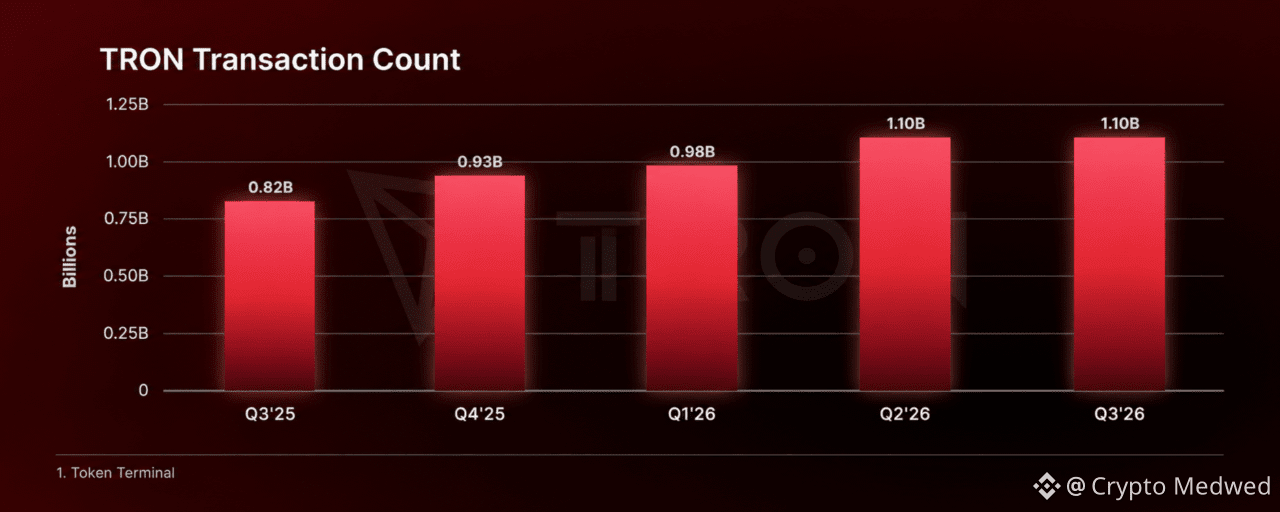

The TRON blockchain continues to show high network activity. According to Token Terminal data, the number of transactions reached 1.10 billion in the third quarter of 2026, up 33.7% from the same period last year.
The number of active addresses is also growing, not just the number of transactions, confirming the scale of network usage.
More than a billion transactions in three months
According to Token Terminal, the number of TRON transactions over the past five quarters has changed as follows:
Q3 2025 — 820 million transactions.
Q4 2025 — 930 million.
Q1 2026 — 980 million.
Q2 2026 — 1.10 billion.
Q3 2026 — 1.10 billion.
Thus, the number of transactions increased by 33.7% year over year, and for the past two quarters the network has maintained a level of around 1.1 billion transactions. That averages roughly 12 million transactions per day.
The number of active addresses rose to 18 million
Another important metric was the increase in the average monthly number of active addresses. In the third quarter of 2026, it rose by 9.8% compared with the second quarter, reaching 18 million. This is particularly interesting given the stable number of transactions.
This means the network is expanding its base of active addresses even when the total volume of transactions remains virtually unchanged. It is important to understand, however, that one user may control multiple addresses, so this metric cannot be directly equated with the number of unique people.
What is happening in the fourth quarter?
According to the data presented, the current number of active addresses over a rolling 30-day period is 14.8 million.
This is below the previous quarter’s average, but the fourth quarter is still underway. Therefore, it is too early to draw definitive conclusions about a decline in activity.
The coming trend will show whether TRON can once again approach 18 million average monthly active addresses.
Why does this matter for the TRON ecosystem?
TRON remains one of the major blockchain infrastructures for stablecoin transfers, primarily USDT. These transactions account for a significant share of the network’s practical use. However, it is important to distinguish between the number of transactions and the volume of funds transferred.
1.1 billion transactions does not mean 1.1 billion payments for goods and services. The statistics include transfers between wallets, exchange transactions, interactions with smart contracts, and other activities.
Nevertheless, a consistently high number of transactions shows that the infrastructure continues to be actively used. For TRX, increased activity may be significant in terms of network resource consumption, but it does not guarantee an increase in the token’s value.
Conclusion
The most interesting metric was not so much yet another billion transactions as the combination of two factors.
TRON maintained its record quarterly activity level of 1.1 billion transactions while also increasing the number of active addresses by almost 10%.
This suggests that the network continues to expand, even without a noticeable acceleration in the total number of transactions. However, it will be particularly interesting to see whether this momentum continues in the fourth quarter.
TRON’s main advantage today is its established infrastructure, which is regularly used to transfer digital assets.
The next stage of development is not simply increasing the number of transactions, but expanding the network’s real-world use in payments, financial services, and everyday transactions.