


Introduction
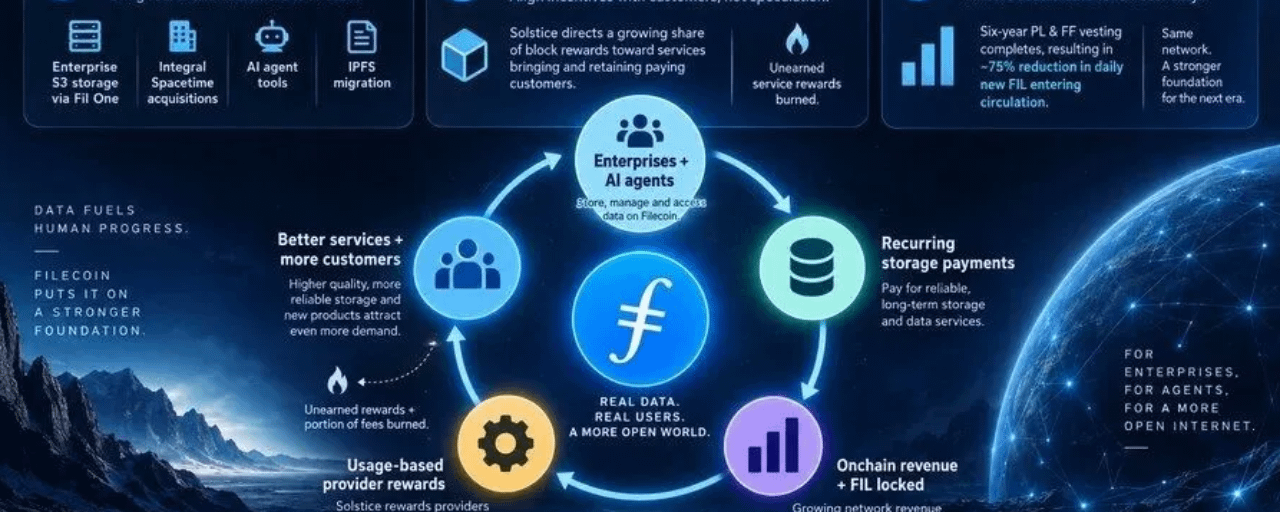
In 2026, Filecoin celebrates its sixth anniversary. Molly Mackinlay of the Filecoin Foundation unveiled a poster announcing a major gift for the occasion: a new economic flywheel model designed specifically for the AI era.
For the past six years, the Filecoin network’s main incentive has been to encourage storage providers to scale up and increase the network’s total storage capacity. This new flywheel represents a major shift in the network’s underlying logic: from rewarding storage capacity to rewarding real paying customers and genuine demand for storage.
I. Three Pillars: Building a Framework for the New Growth Flywheel
The poster breaks down this new system into three core components: generating new demand, distributing rewards based on actual usage, and slowing the growth of token supply.
① NEW DEMAND|New demand: Bringing real-world customers to Filecoin
The flywheel starts with a steady stream of real business customers, rather than relying solely on storage providers to add storage power. The official definition identifies four customer sources:
• Enterprise customers: Connect through Fil One to access S3-compatible object storage services, making it easy for traditional businesses to bring their data onto the Filecoin network;
• Acquisition and integration of Integral Spacetime: Expand and serve commercial storage customers through an ecosystem business entity;
• AI agent tools: AI agents and various AI applications are a key growth segment targeted by this flywheel. AI generates large amounts of memories, datasets, and output files that need to be stored long term;
• Migration of existing IPFS data: Move data already on the IPFS network to Filecoin for persistent storage.
The goal is clear: bring in real, paid storage business—not idle storage power added just to earn rewards.
② REWARDS FOR REAL USAGE|Reward actual usage, aligning incentives with customer interests rather than speculation
The core mechanism is Solstice. Under the old mechanism, block rewards were mainly based on how much storage power a provider had. Solstice changes how rewards are distributed:
• A greater share of block rewards goes to storage providers that bring in paying customers and retain them;
• Rewards are tied to actual business usage, rather than simply to hard-drive capacity;
• Unclaimed service rewards are burned, reducing the release of tokens that do not contribute to productive use.
In short: Providers that retain paying customers and deliver reliable storage services earn more incentives, discouraging speculative storage power built up purely for mining.
③ LOWER SUPPLY GROWTH|Slower token supply growth for a sustainable network economy
The poster highlights a key point: the six-year vesting period for early investors and the Foundation (PL & FF) has been completed. This brings two key changes:
1. The amount of new FIL entering circulation each day decreases by about 75%;
2. With the same level of network activity, fewer new tokens enter circulation, strengthening the Foundation’s reserves and supporting the network’s long-term development.
The core value of this section: As network revenue grows, the increase in token supply slows, creating a healthier, more sustainable network economy.
II. How does the complete flywheel work?
The circular diagram in the center of the poster illustrates the complete virtuous cycle:
1. Businesses and AI agents store, manage, and retrieve data on the Filecoin network, generating demand for long-term storage services and paying storage fees to create recurring storage payments;
2. These payments generate on-chain revenue, with some FIL locked within the ecosystem;
3. Solstice rewards storage providers based on actual service usage; unclaimed rewards are burned;
4. Storage providers receive stable incentives and invest resources in upgrades, delivering higher-quality, more reliable storage services;
5. Better storage products and services attract more real customers, bringing in more network revenue;
6. More customers further increase providers’ business revenue, keeping the cycle turning.
The poster’s closing summary is this core formula:
More customers → more network revenue → stronger provider economics More customers → more network revenue → healthier business returns for storage providers
Core message: Real data and real users are building a more open networked world.
III. A fundamental shift: From competing on hard-drive capacity to competing for business customers
Many people’s impression of the old Filecoin is that providers competed on hard drives: the more storage power they had, the more block rewards they earned. This model led to a huge amount of storage capacity, much of it idle capacity—hard drives were there, but they held no data from real, paying customers.
The flywheel unveiled on Filecoin’s sixth anniversary represents a shift in the underlying logic:
✅ Old system: Reward storage capacity; compete on hard-drive size
✅ New system: Reward real paying demand; compete on service and customer retention
Filecoin is no longer focused on expanding capacity alone. Its goal is to become an open, decentralized storage infrastructure for businesses and AI agents.
IV. Key ecosystem highlights
1. AI agents become core customers
AI agents and AI tools generate significant demand for persistent data storage, making them the most important source of incremental growth for this flywheel. AI agents need to retain memories, datasets, and generated content over the long term—needs that are a natural fit for Filecoin’s decentralized persistent storage.
2. Commercial entities serve enterprise customers
Ecosystem projects such as Fil One and Integral Spacetime develop front-end products and connect with traditional businesses, lowering the barrier to entry and bringing real-world business activity onto the Filecoin network.
3. Solstice is the key driver of the incentive layer
Solstice aligns the interests of paying customers and storage providers, tying provider earnings to customer retention and service quality rather than just the amount of storage capacity.
V. A closer look: Can the flywheel keep turning?
After six years of development, this economic flywheel marks a strategic shift in direction for Filecoin, intended to address a long-standing pain point: the disconnect between growth in storage power and demand for real storage services.
The model’s logic is compelling, but whether the flywheel can truly keep turning depends on two key factors:
1. Whether it can consistently attract more real, paying storage orders from businesses and AI agents;
2. Whether, after the Solstice incentive mechanism launches, it can effectively encourage storage providers to shift toward commercial services and reduce unproductive, idle storage power.
Conclusion
From a storage network initially focused on capacity to a paid storage infrastructure for the AI era, Filecoin is entering a new phase of development on its sixth anniversary. The focus is no longer on competing for hard-drive capacity, but on driving network growth through real customers and real data. This new economic flywheel will be the central theme of Filecoin’s next stage of development.
Source: Official media and online news
Disclaimer: The content published by this account is for learning and discussion purposes only. The materials in this article are sourced from publicly available online materials. If you believe there is a copyright issue, please leave us a message and we will correct or remove the content promptly. This article is intended to share market information and does not constitute investment advice.