


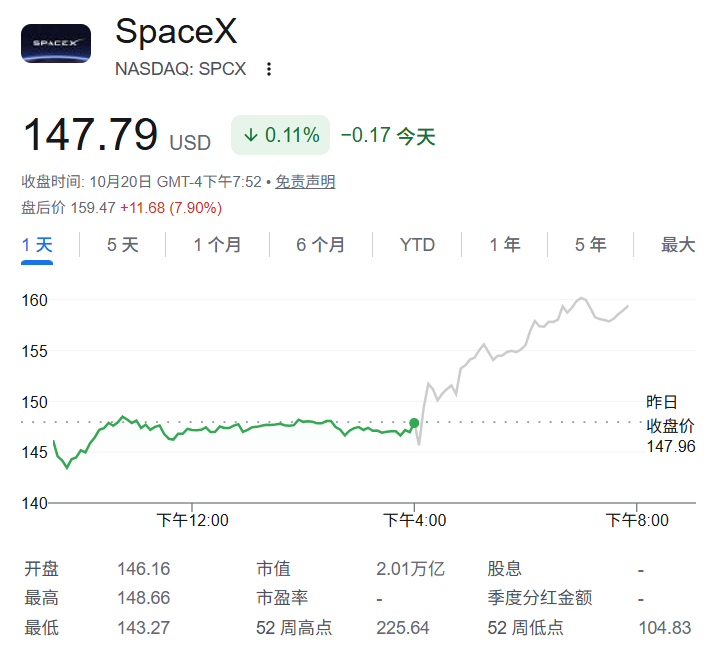
SpaceX shares rose nearly 8% in after-hours trading on Tuesday after the company reported third-quarter revenue growth of 161%, beating Wall Street expectations and achieving its first-ever profit. Revenue from its superintelligence business surged 830% year over year, making it the company’s largest source of revenue for the first time.
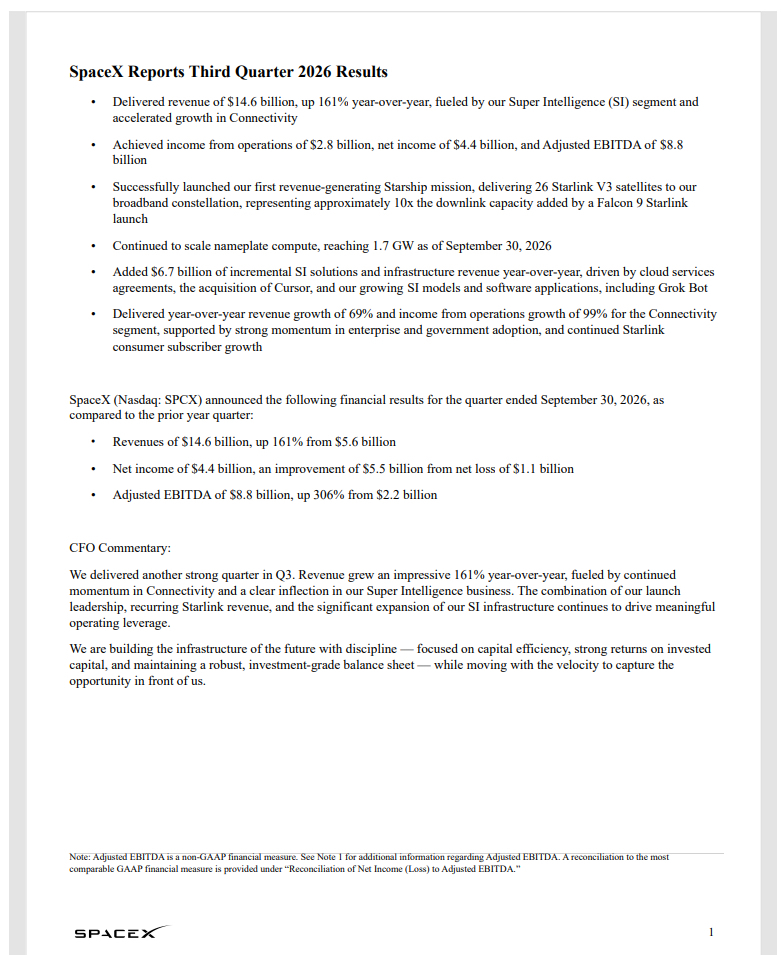
Specifically, the earnings report showed that SpaceX had third-quarter revenue of $14.58 billion, up 161% year over year and about 87% from $7.814 billion in the second quarter, exceeding analysts’ expectations of $12.8 billion. Net income was $4.4 billion, a significant improvement from a net loss of $1.054 billion in the same period last year, marking a return to profitability and far exceeding analysts’ expectations of $1.88 billion. Earnings per share were $0.35, compared with an estimate of $0.15.
However, SpaceX’s capital expenditures in the third quarter reached $19.59 billion, up approximately 185% from $6.88 billion in the same period last year, mainly reflecting the company’s continued investment in superintelligence computing infrastructure.
According to SpaceX CFO Bret Johnsen’s forecast, the company’s revenue in the first quarter of next year will fall in the range of $33 billion to $37 billion, far exceeding analysts’ average expectation of $22.2 billion. Johnsen attributed the forecast to “improved visibility into computing contract projects over the next six months.”
Additionally, after forecasting last quarter that SpaceX would reach $100 billion in annual recurring revenue by the end of this year, management has raised its expectations further. Musk said on the earnings call that infrastructure for the Grok AI model and products, cloud services deals, and paid-user revenue would bring the company’s annual recurring revenue to between $500 billion and $1 trillion by the end of next year.
Regarding his “two trump cards,” Musk also stated explicitly for the first time that a merger was under discussion. He said that acquiring Tesla Motors would be “a good idea,” adding that the boards of both companies had formed special committees to discuss a merger.
However, he also noted that a merger between Tesla and SpaceX was not a foregone conclusion and would require shareholder support, although a merger between Tesla and SpaceX would indeed have many advantages.
Business Breakdown
By business segment, the superintelligence business was the main driver of SpaceX’s third-quarter growth. In the third quarter, revenue from SpaceX’s superintelligence business reached $7.56 billion, up 830% from $813 million in the same period last year and 195% from $2.561 billion in the second quarter, accounting for approximately 52% of the company’s total revenue.
Among its businesses, revenue from superintelligence solutions and infrastructure reached $7.022 billion, surging from $359 million in the same period last year, mainly driven by the launch of new cloud services agreements, the acquisition of AI coding company Cursor, and the expanded use of the Grok model in enterprise and consumer markets.
Earlier this year, SpaceX acquired Musk’s AI lab, xAI, formally entering the artificial intelligence field. The company rapidly expanded this business by renting out computing capacity to Google, Anthropic, and others.
SpaceX reportedly completed its acquisition of AI coding startup Cursor on August 14, in a deal implying an equity valuation of $60 billion. According to its financial report, Cursor contributed $608 million in revenue to SpaceX between the completion of the acquisition and September 30.
However, nearly all of SpaceX’s profits came from its connectivity business, which includes its Starlink satellite internet service. The superintelligence business posted operating income of $431 million in Q3, turning profitable from an operating loss of $1.722 billion in the same period last year and an operating loss of $1.257 billion in the second quarter.
Meanwhile, Q3 revenue from the connectivity business reached $5.248 billion, up 69% year over year and 22% quarter over quarter, compared with analysts’ prior forecast of $4.84 billion. Revenue from consumer Starlink users was $3.12 billion, while revenue from government and enterprise customers was $2.13 billion. Operating income reached $2.367 billion, up 99% year over year, and adjusted EBITDA reached $3.499 billion, up 82%.
Starlink’s subscriber base grew to 13.6 million this quarter, up from 12 million in the previous quarter. SpaceX said continued expansion in developed markets drove subscriber growth. In addition, more than 3,800 aircraft worldwide were equipped with Starlink service as of the end of the third quarter.
Finally, in the space business, SpaceX’s third-quarter revenue reached $1.767 billion, up 6% year over year and 84% quarter over quarter. Launch services revenue was $1.13 billion, up 13% year over year, while launch and development revenue was $637 million, down from $666 million in the same period last year.
However, due to continued increases in R&D investment in the Starship program, the space business still posted an operating loss of $7 million in the third quarter, compared with operating income of $259 million in the same period last year.