



Macroeconomic Turmoil and Geopolitical Black Swans: The Hidden Risks Behind Soaring Oil Prices
In the latest market update, several sudden developments have emerged that warrant close attention. Although the market had generally believed that while Bitcoin (BTC)’s rebound was sluggish, it was only a matter of time before it broke above the $84,000 mark, short-term momentum has now clearly weakened. The earlier volatility in U.S. stocks and the rise in France’s 10-year government bond yield were disturbances that the market could have shaken off in the short term.
However, international crude oil prices have suddenly surged back above $100 a barrel, signaling that something highly unusual may be afoot. Although Iran has recently made repeated overtures, saying the seven-day ceasefire agreement remains in effect, and Trump has also repeatedly expressed his wish to end the conflict in the Middle East as soon as possible and bring oil prices down, oil prices remain elevated. This suggests that savvy insider money is already pricing in geopolitical risks ahead of time.
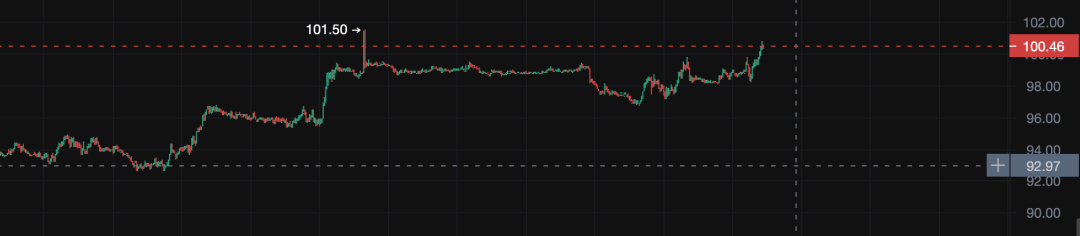
With Israel’s election approaching and the Netanyahu government making clear that it will never tolerate a “nuclear Iran” and is determined to overthrow its current regime, a renewed outbreak of fighting may be only a matter of time. If a major geopolitical event occurs unexpectedly within the next 1 to 3 days, the current narrow trading range could very likely break. If Bitcoin falls below the key psychological level of $80,000, the existing bullish thesis will temporarily be invalidated. Those holding leveraged long positions are advised to move their stop-losses up to around $80,600 and take precautions in advance.
Is There an AI Bubble? A Hard-Nosed Perspective from Oaktree Capital’s Founder
The debate over whether AI is in a serious bubble has been growing increasingly heated in the market recently. Ray Dalio of Bridgewater previously made bearish comments (which we analyzed in depth and critically in an earlier episode). Howard Marks, founder of Oaktree Capital and author of *The Most Important Thing*, offers a markedly different and measured assessment: the market has not yet entered a genuine AI bubble.
Marks points out that a true asset bubble must have three core characteristics:
Irrational exuberance
Reckless, indiscriminate investing
Investors being completely unaware of the risks
When Alan Greenspan warned of “irrational exuberance” in 1996, the Nasdaq was only around 2,000. By the time the bubble actually burst in 2000, the Nasdaq had soared to 5,000. This clearly shows that even when signs of irrationality emerge in the market, it does not mean a crash is imminent.
More importantly, actual valuation data show that:
· Forward P/E: The forward P/E ratios of the S&P 500 and Nasdaq have actually declined this year. The five largest tech giants have an average forward P/E of only around 23, far below the 65 seen at the peak of the dot-com bubble in 2000.
· Rational restraint: Institutional investors are currently scrutinizing valuations and financing risks, deliberately keeping forward premiums in check.
Although the Shiller P/E (CAPE) has reached 41, close to the historic extreme of 44 in 1999, overall, current market sentiment and valuations are nowhere near the fervor seen before past bubbles burst. The AI bubble will not suddenly collapse while everyone is constantly watching out for it. With the midterm elections behind us and geopolitical tensions easing for a time, U.S. stocks are likely to see another impressive rally.
In-Depth Technical Analysis: Have U.S. Stocks Bottomed?
Let’s look back at the Nasdaq daily chart. After a large bullish candle appeared before yesterday’s market open, the index quickly pulled back near the overhead downtrend line and the channel’s upper boundary, once again confirming the effectiveness of resistance above.
Many investors are wondering whether U.S. stocks have bottomed. Based on the technical structure, this can currently be viewed only as a minor, short-term support level or a temporary rebound; a true bottom has yet to form.
A confirmed major historical bottom must meet three strict conditions:
The correction lasts long enough
The pullback is deep and extensive enough
Three or more RSI oversold divergences appear on the daily chart or higher time frames
At present, the RSI has registered only 1–2 oversold readings in the strictest sense. The potential bottom divergence on the 1-hour chart was merely a “potential pattern” before the breakout.
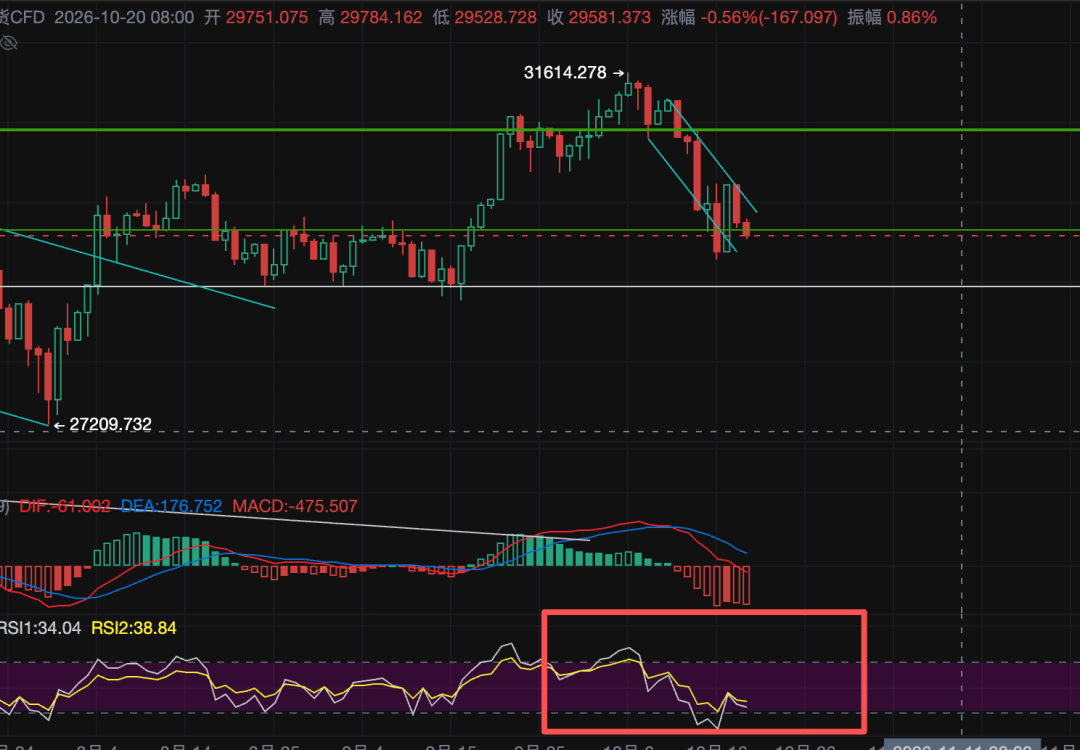
In addition, there is a “parallel bottom zone” below the Nasdaq, formed by several tests of the same area. Using the market’s typical liquidity-sweep tactics, the market will very likely break below this zone during the roughly two-week window remaining before the midterm elections, liquidating the large number of long-position stop-losses clustered below it.
The conclusion is clear: the market still needs at least one “final drop.” Blindly buying the dip in spot assets with large positions is unwise.
Personal Investing and Trading Strategy Recommendations
Given the current interplay between macroeconomic conditions and technical factors, we recommend the following targeted strategies:
Spot dip-buying strategy: Don’t rush to “catch a falling knife.” A true bottom still needs time and price action to confirm. Wait patiently for the market to make its “final drop” and clear out the liquidity below before taking positions.
Futures and short-term trading: For the storage sector (such as SanDisk and Micron), despite a sharp short-term rebound, the broader trend remains clearly downward, with lower highs and lower lows. The ADX indicator also shows that downward momentum remains strong. Selling short into strength when the rebound reaches the resistance-flip level above and the confluence zone around the moving-average channel offers a higher-probability setup.
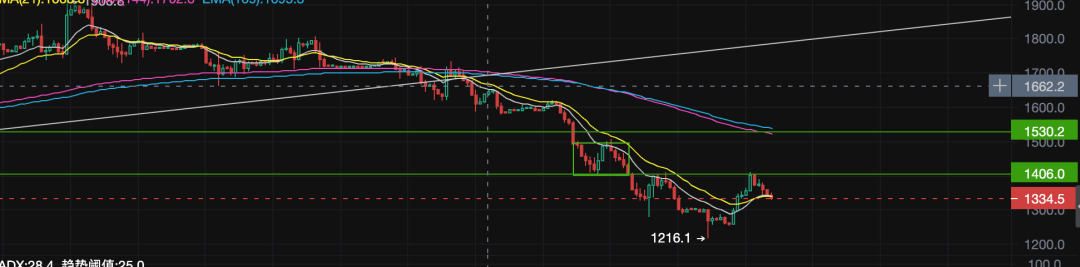
3. Risk management: For short positions, we recommend using only a small position of no more than 5% to test the trade. Avoid blindly chasing the downside at current lows, as this could expose you to squeeze risk from crowded trades.