




Recently, I noticed something strange about Bitcoin’s market cap dominance. As this chart shows, from September 2025 until now, Bitcoin’s share of the market cap has remained steady at around 57%–60%, while Ethereum’s has stayed at around 10%.
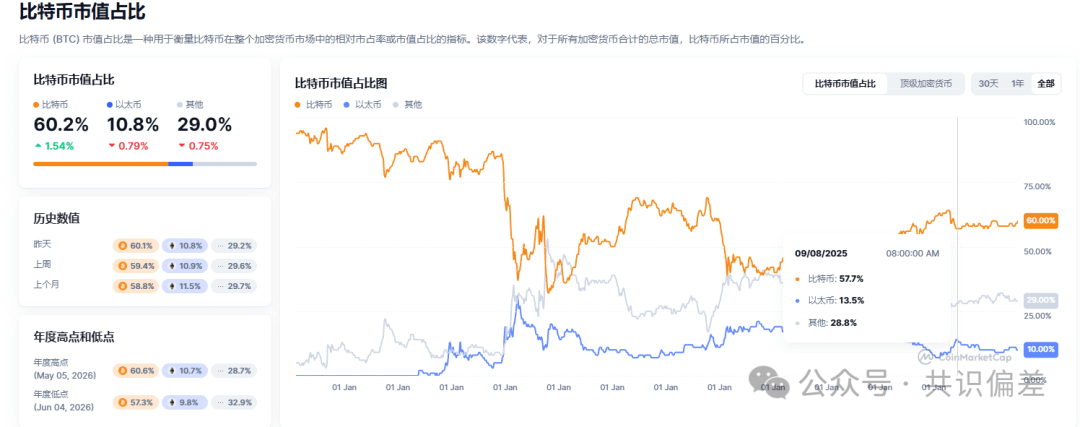
Keep in mind that Bitcoin has experienced huge swings over the past year. It peaked at 120k in October 2025, then hit a low of 58k in June—nearly cutting its value in half. Yet Bitcoin’s market cap dominance barely changed.
Historically, when a general market rally begins—that is, when a bull market kicks off—Bitcoin tends to rise first, sucking the liquidity out of all the altcoins. We can see this in the period from 2022 to 2024: Bitcoin’s market share climbed from 40% to around 60%. The same pattern played out in early 2019, when Bitcoin’s market share rose from a low of around 37% in late 2018 to a peak of 75%.
Altcoins don’t rise during this phase, including Ethereum, the second-largest altcoin, which gets drained by Bitcoin. The altcoin catch-up phase comes in the latter half of Bitcoin’s run—that is, toward the end of the bull market. That’s when you can see Ethereum start to rise, and then Bitcoin begins to fall.
But over the past year, this pattern has disappeared. In theory, during the bear market from late 2025 to early 2026, Bitcoin’s market share should have declined, but that hasn’t happened this time around.
I think there are a few main reasons:
1. We haven’t had a large-scale altcoin season this time, so Bitcoin’s market share hasn’t declined.
2. ETFs have taken the lead in driving Bitcoin’s price movements this time around. Bitcoin hasn’t moved much on weekends; it only sees significant volatility when the U.S. stock market opens. But ETF money hasn’t flowed into altcoins on a large scale, so altcoins have performed very poorly. Altcoins have also been tracking Bitcoin’s movements much more closely this time, rising and falling together—although their price swings are more extreme.
3. The increase in the stablecoin market cap. The stablecoin market cap has grown significantly this time around, and stablecoins are also counted in the altcoin market cap. Meanwhile, high interest rates in the U.S. have actually boosted stablecoin yields. Stablecoins offer more reliable annualized returns, so investors are still more inclined to put their money into stablecoin products with relatively high, stable yields rather than altcoins.
Looking at it this way, the 10/11 event clearly left many people and investors deeply shaken, and now everyone is afraid to trade altcoins.
4. There are too many altcoins, diluting the available capital. For example, since the emergence of launch platforms like Pump and Four, there have been far too many meme coins—tens of thousands a day. Each one may attract only a small amount of capital, but there are so many of them. The amount of money in crypto is limited: after the big money chooses Bitcoin, meme coins siphon off more of it, making it very difficult for other altcoins to have independent rallies.
So, based on the current pattern, Bitcoin may become the crypto market’s index, with its share likely to stabilize around 57%–60%. As I’ve said before, a broad-based, large-scale altcoin season is unlikely in the future. That’s why Bitcoin remains the best choice. Altcoins will have to follow Bitcoin’s lead, and most of them will probably continue to underperform Bitcoin (if Bitcoin maintains this market share).
Only a very small number of altcoins will be able to outperform Bitcoin—for example, those tied to this cycle’s key narratives, such as generating revenue and buying back and burning tokens. But these will certainly be in the minority, because altcoins’ share has been capped below 40%.
So it’s important to understand the overall state of the crypto market right now, and the right way to allocate your portfolio should be pretty obvious! We mustn’t blindly rely on the past and mechanically apply old patterns to this market cycle!$BTC #比特币突破8.3万美元
