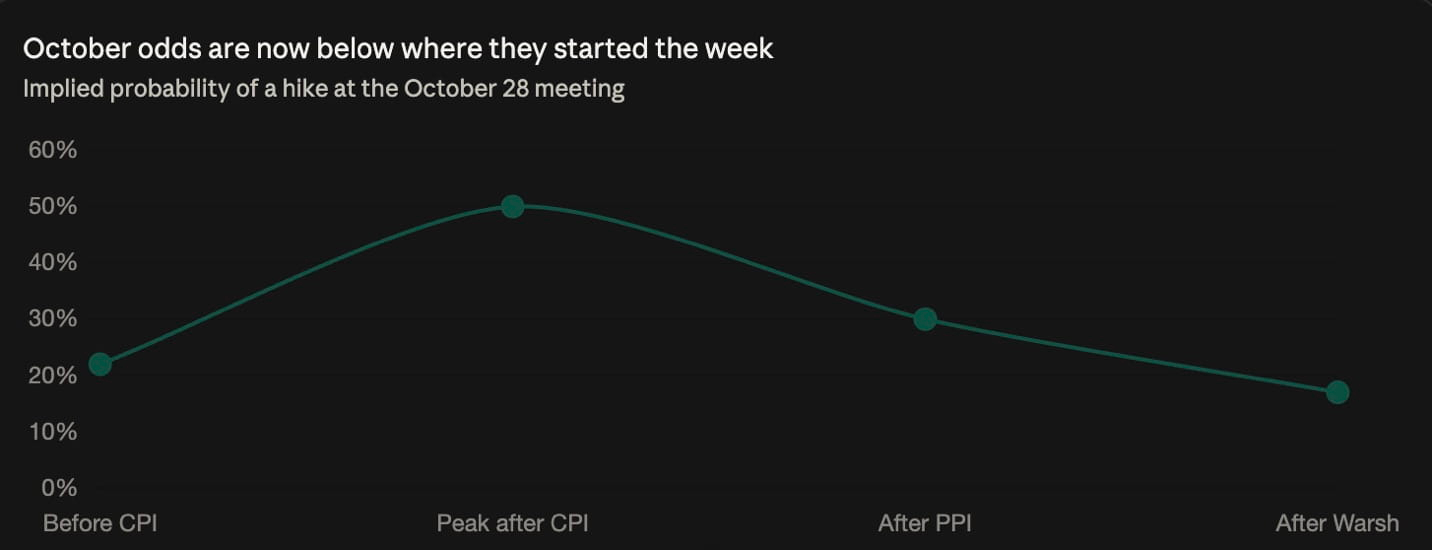
Warsh declined to signal October’s outcome at the IMF/World Bank meetings in Bangkok, cutting October hike odds from 30% to 17% — but December sits at 90%, meaning the hike moved one meeting back, not off the table. Two hot prints (CPI 3.7%, core PPI 0.7% vs 0.3% expected) produced zero hawkish guidance. Bitcoin held above $82,000 after defending $80,000 for a third time this week, but short-term holders’ unrealised cushion has compressed from 16% to 10% with the newest buyers entering at $82,000-$86,000 — 8.8% above the pain threshold. Crypto equities fell while Bitcoin rose. Optical stocks rallied while memory names dropped, suggesting AI rotation rather than full exit. Tesla unveiled the new Roadster with SpaceX thrusters; production 2028.
Bitcoin Recovers to $82,000 in Two Hours as Seoul Rebounds — Though TSMC Still Fell on Good News
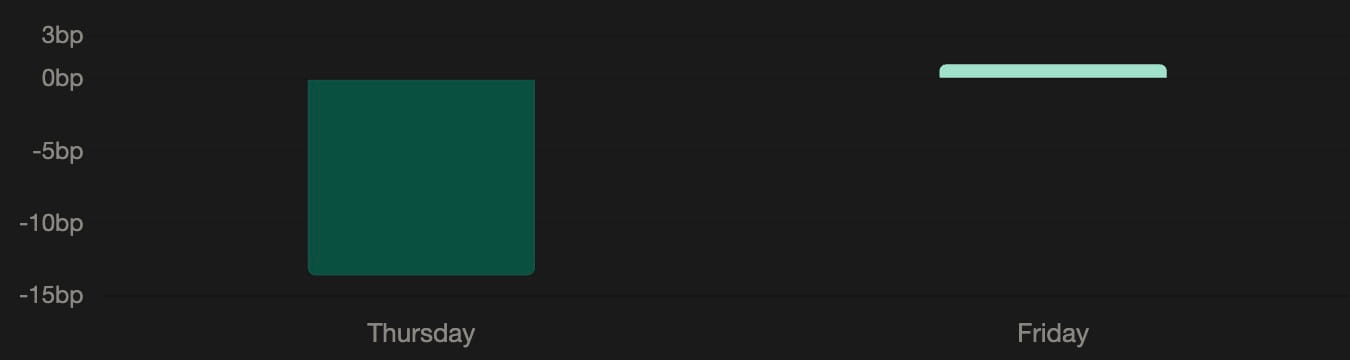
Bitcoin dipped to $79,800 Thursday before buyers rebuilt it to $82,500 within two hours — the third defense of the $80,000 area in five sessions. A level that breaks and is reclaimed within hours tells a different story from one that holds cleanly: the bid is real but it sits lower than a week ago. KOSPI +3% after seven consecutive sessions totaling ~21% of losses — the bounce repairs about one-seventh of the damage. MSCI Asia Pacific +1.3%, Samsung and SK Hynix each +2%+. TSMC slipped despite record Q3 revenue of NT$1.49 trillion and analysts projecting ~65% profit growth — when the best fundamental news in the sector fails to lift the stock, the problem is credit availability for the buildout, not earnings. Bonds gave back 1bp of Thursday’s 13.6bp rally, with the 10-year at 5.07% — equities pricing a rebound while the bond market holds 93% of its growth-concern position is a disagreement worth watching. $84,000 is the level that confirms real buying; that’s where Wednesday’s post-CPI bounce ran out of steam.
New Bitcoin Buyers Have Added 422,000 BTC Since July, Lifting Holdings to a Four-Month High
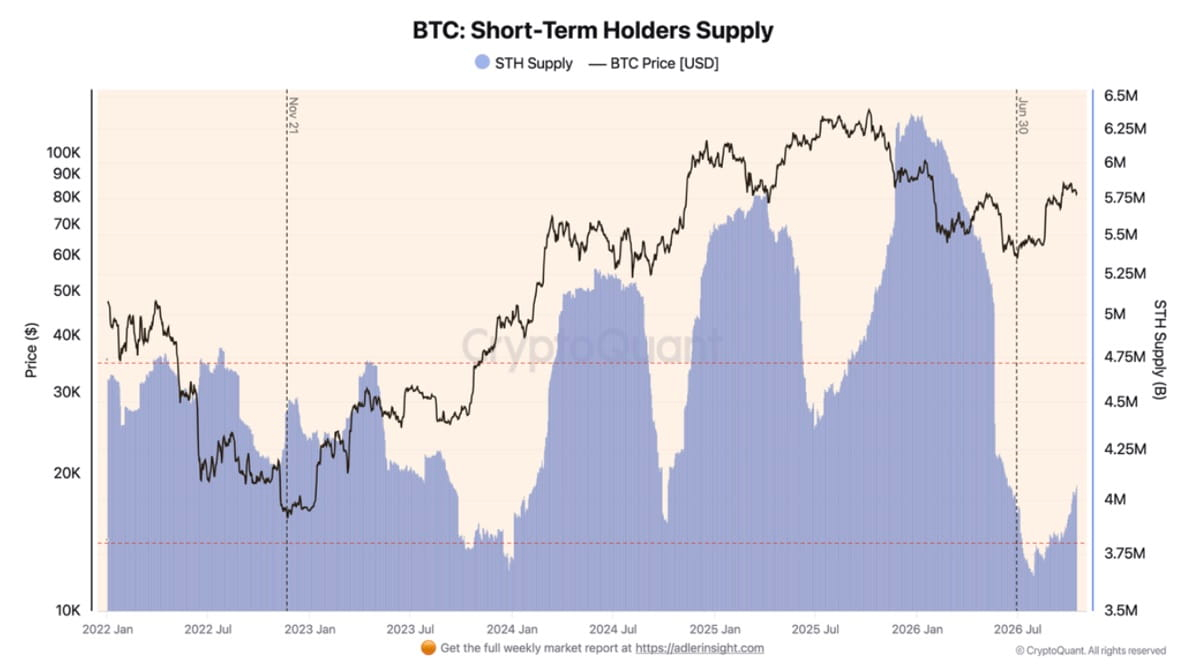
Short-term holder supply reached 4.08M BTC — a four-month high, up 422,000 from the July 29 low. New buyers are entering at $82,000-$86,000, straddling the current price, meaning a meaningful share of the newest cohort is already at or below water. The group’s unrealised cushion compressed from 16% to 10% through two forces simultaneously: price fell, and the average cost basis rose as purchases above the old average pulled break-even toward current price. The weekly buying pace has more than halved: ~106,000 BTC the week before last, ~48,000 BTC last week. The $74,900 group cost basis sits 8.8% below current price — that’s the distance to the level where the entire short-term holder cohort moves into unrealised loss, the threshold that historically triggers selling from recent buyers. Bitcoin tested $79,800 as recently as Thursday. Contrast with long-term holders at $48,600 (72% cushion, 40% decline needed before average loss) — a decline that’s uncomfortable for one cohort is irrelevant to the other.
Crypto Stocks Fell While Bitcoin Rose, and Optical Beat Memory as the AI Trade Splits
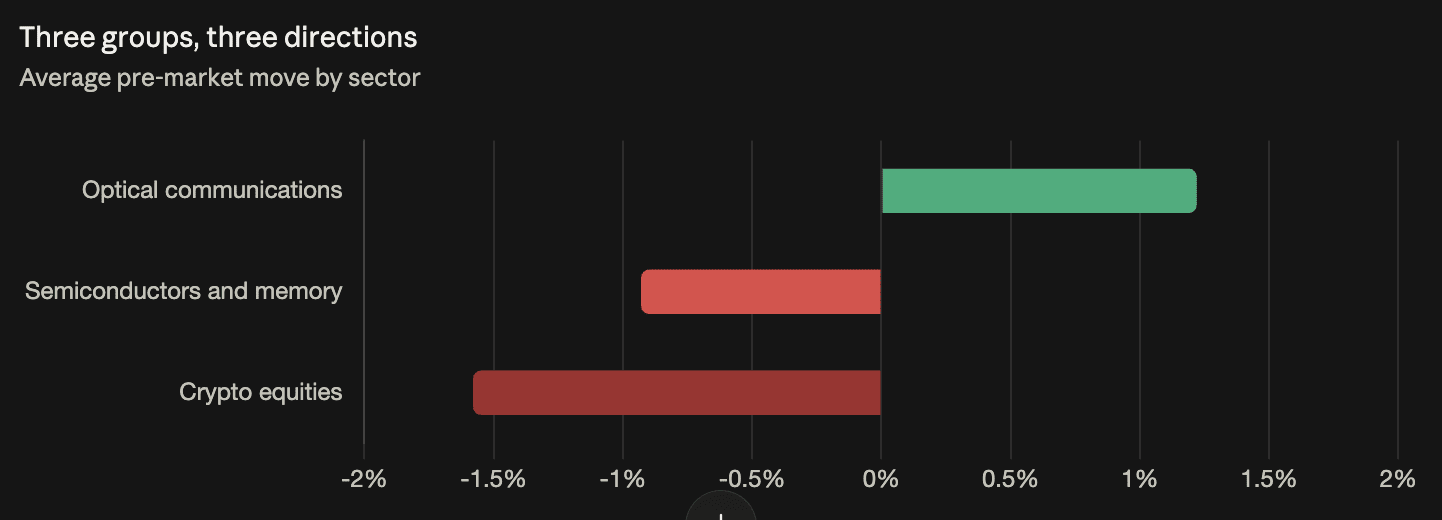
All five tracked crypto equities fell in US premarket Friday while Bitcoin gained 1.67%: Strategy -2.66%, Circle -1.81%, SharpLink -1.34%, Coinbase -1.15%, BitMine -0.92%. These names normally amplify Bitcoin’s direction — moving against it points to equity markets pricing something broader (the AI financing problem, hot inflation) rather than just spot price. Within AI infrastructure, optical communications rose (AAOI +2.11%, Coherent +1.25%, Ciena +1.20%, Lumentum +0.80%, AXT +0.74% — average +1.22%) while memory and semiconductors fell (SanDisk -1.69%, AMD -1.58%, Micron -1.53%; Nvidia the sole gainer at +0.41%). Both sectors sell into the same AI buildout — they moved in opposite directions, meaning capital is rotating within the AI theme (toward networking, away from memory) rather than exiting it entirely. That’s a meaningful refinement of Thursday’s story, when the Korean selloff looked like a wholesale AI unwind.
Tesla Unveils Long-Awaited Roadster With Thruster-Powered Aerial Stunts, Production Set for 2028
Tesla unveiled the new Roadster at a SpaceX testing facility near Waco Thursday — the prototype used air thrusters developed with SpaceX engineers to drive up a ramp, flip, and jump over Tesla’s vehicle lineup. Zero to 60mph in under 1 second; two seats; Cybertruck-style steer-by-wire. Three tiers: road-ready performance version, invite-only “Rocket” (single-seat, not road-approved), and a limited “Thrust” race package. Production: 2028. The original Roadster launched in 2008 and was discontinued in 2012; this reveal comes after consecutive annual EV sales declines and a stagnant product lineup. CFRA’s Garrett Nelson: “long overdue” and the brand needs something buzzy. Zacks’ Andrew Rocco: high price, small total addressable market, “not going to be a needle mover.” The SpaceX collaboration intensifies merger speculation — Musk said on a recent earnings call that the companies “overlap on so many fronts,” pointing to Terafab, their joint semiconductor plant.

October Is Priced Out at 17%, but December Sits at 90% — Warsh Bought Time, Not a Pause
Warsh’s Bangkok speech cut October odds from ~30% to ~17% by saying essentially nothing: “I don’t prejudge meetings” after two hot inflation prints. October odds are now lower than before Wednesday’s CPI despite the data running hotter. The 17% October read is misleading in isolation — December at 90% means the hike moved one meeting, not off the table. Warsh on AI: “probably the most consequential change” in his lifetime, with near-term inflationary effects (capex-driven demand) and long-term disinflationary payoffs (productivity expansion). “The road ahead is likely to be a very bumpy one.” On synchronised global tightening: “no free riders” — removing the usual offset where easier policy elsewhere cushions a domestic squeeze. DBS Bank’s Wei Liang Chang: Warsh’s medium-term AI productivity framing could ease inflation expectations; broader moves depend on whether US equities stabilise. The market judgment that silence = pause is exactly what Warsh’s rejection of forward guidance was designed to prevent — but markets filled the gap anyway, as they did after Jackson Hole.