

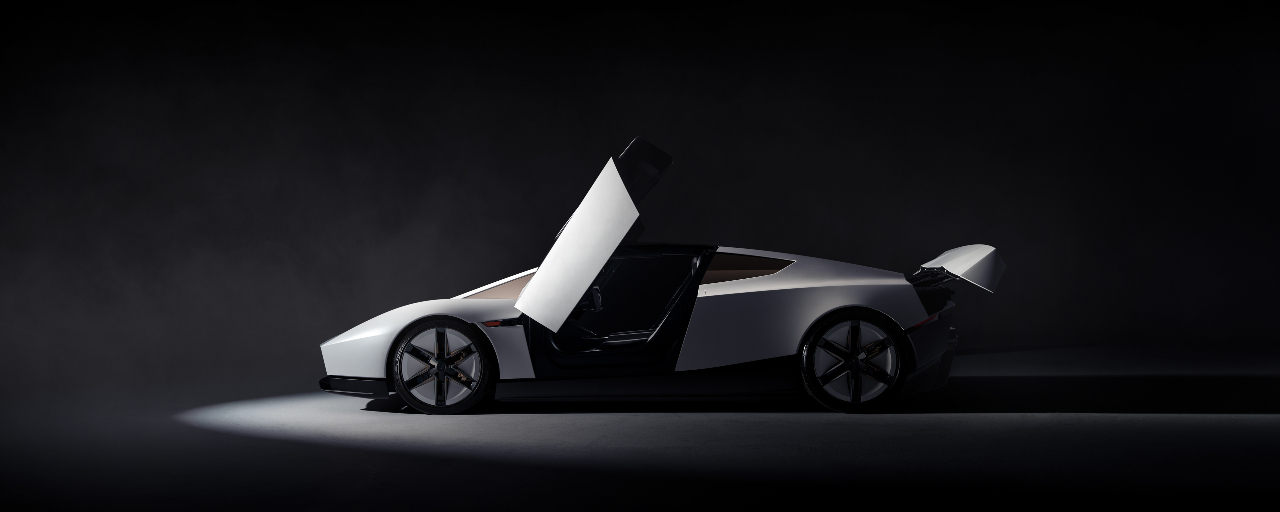


Tesla unveiled its long-delayed new Roadster sports car Thursday in Texas, reviving a model the company stopped producing more than a decade ago, Bloomberg reported. The demonstration, held at a SpaceX rocket testing facility near Waco and livestreamed online, was no typical reveal: powered by air thrusters developed in partnership with SpaceX engineers, the prototype drove up a ramp, did a controlled flip, then jumped and flipped over Tesla's vehicle lineup including the Tesla Semi, performing other mid-air stunts. Elon Musk, CEO of both Tesla and SpaceX, has been hyping the return, saying it "might be one of the most spectacular demos ever." "We need an audience to prove that it's not AI or SI," Musk said on stage Thursday. "You're going to see the results of what happens when you have a collaboration with the world's best car company and the world's best rocket company."
The vehicle leans into aerospace aesthetics with two seats and a Cybertruck-style steer-by-wire system, and Tesla showed a video of it accelerating from zero to 60 miles per hour in under 1 second. Still, the long-overdue car isn't expected to start production until 2028: the Roadster website takes reservations for the road-ready performance version and a limited-release "thrust" race-ready package adding acceleration thrusters and a multi-mode suction system, while the flying version is reserved for an invite-only "Rocket" package that is a single-seat and not approved for public roads. The vehicle has been subject to numerous delays since it was first announced in 2017; the original Roadster, Tesla's first product, launched in 2008 and was discontinued in 2012.
Tesla's auto business could use a boost after consecutive annual sales declines and criticism over a stagnant product lineup; while Musk works to reorient the company around AI and robots, EV sales still account for the majority of revenue and profit. Before the event, Andrew Rocco, a stock strategist at Zacks Investment Research, said the demonstration could generate enthusiasm but that a high price tag and small total addressable market mean the Roadster will likely do little to change Tesla's sales or earnings prospects. "It's going to be an exciting product. Likely, it's going to build a lot of hype, but I don't think that it's going to be a needle mover," Rocco said. "Musk loves to build hype around the brand." Executives have also emphasized the Roadster is an ode to manual driving even as the company increasingly focuses on autonomy.
The new version adds to a limited consumer lineup of the Model 3 and Model Y plus the slow-selling Cybertruck; Tesla discontinued two consumer models earlier this year, also makes the commercial Semi truck, and is producing the two-person Cybercab robotaxi that isn't yet for sale to outside customers. Garrett Nelson, a senior equity research analyst at CFRA, said the revived Roadster is "long overdue" and the Tesla brand could use a buzzy new model. "They've had this lull in their product pipeline for years now," Nelson said. Tesla has suggested for years that the Roadster could include a SpaceX option package, and some investors and analysts cite the companies' overlap as justification for a merger — Musk said on a recent earnings call that Tesla overlaps "on so many fronts with SpaceX," pointing to Terafab, a joint effort to build a semiconductor plant. "We've seen the companies grow closer and closer," Nelson said. "It's approaching the point where Musk can make the argument that the companies collaborate so closely that it just makes sense to merge."