

What if the next evolution of DeFi isn't about making transactions faster, but making strategies private until the right moment?
That is the idea that makes Nillion particularly interesting to me.
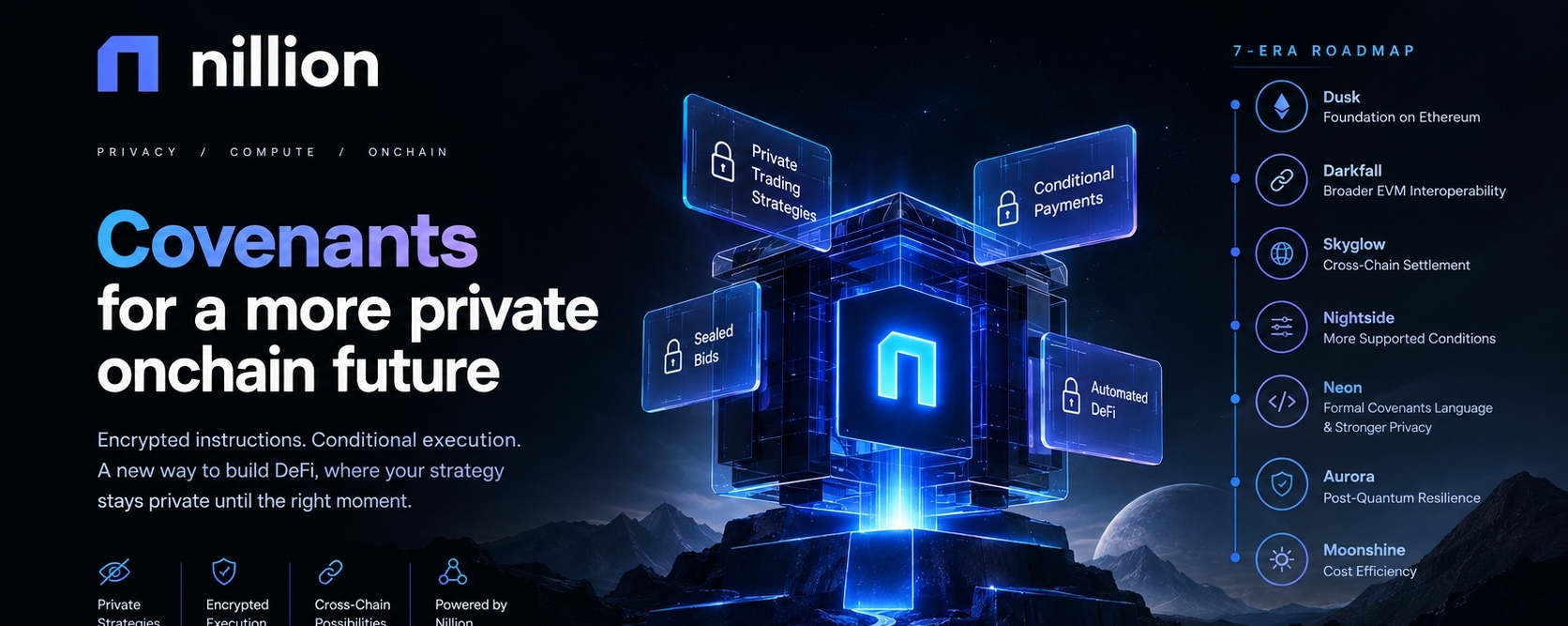
With DUSK live on Ethereum mainnet, Nillion's Covenants introduce a different approach to onchain execution: instructions remain encrypted until their specified conditions are met. Imagine private trading strategies, conditional payments, sealed bids, and automated financial applications that don't have to reveal their intentions before execution.
This matters because transparency and privacy shouldn't always be opposites. Blockchains provide verifiability, but exposing every strategic decision too early can create opportunities for front-running and information leakage. Covenants aim to explore a new middle ground where instructions can stay sealed until the conditions for their release are satisfied.
What makes this vision even more compelling is Nillion's seven-era roadmap:
Dusk establishes the foundation on Ethereum. Darkfall targets broader EVM interoperability. Skyglow explores cross-chain settlement. Nightside expands the range of supported conditions. Neon focuses on a formal Covenants language and stronger privacy. Aurora targets post-quantum resilience, while Moonshine focuses on making the system more cost-efficient.
These stages represent a roadmap, not guaranteed outcomes, but the direction is worth watching.
My biggest question is this: What becomes possible when smart contracts can act on conditions without exposing the entire strategy behind them?
I believe this is one of the more interesting design spaces in crypto, especially as DeFi becomes more sophisticated and AI agents begin interacting with onchain markets.
Curious to hear the community's perspective: which use case would benefit most from Covenants private trading, DeFi automation, sealed auctions, or something we haven't imagined yet?