

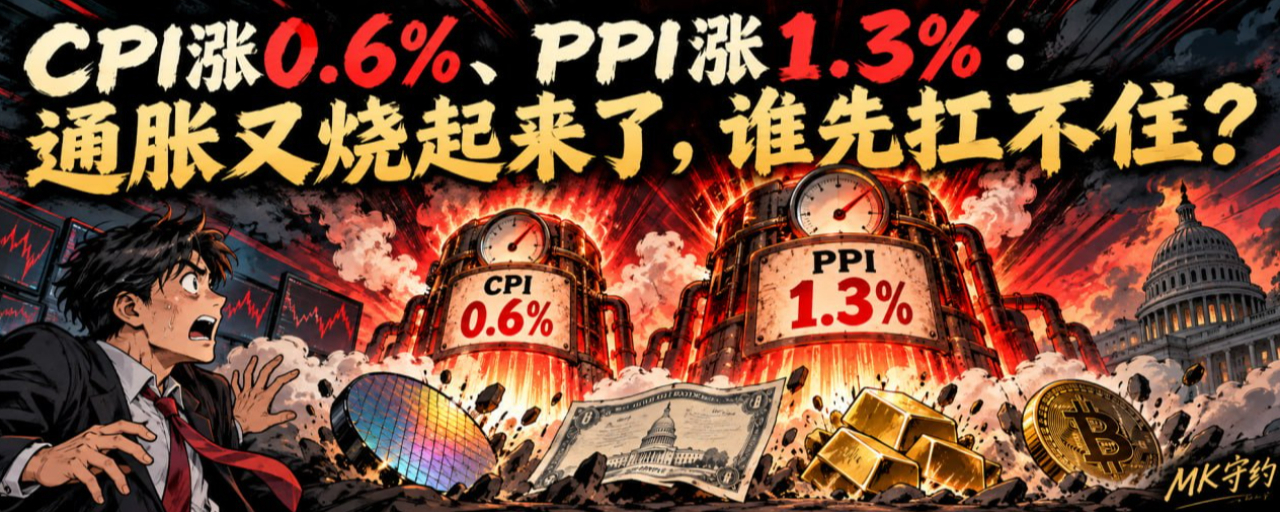


The U.S. CPI rose 0.6% month over month in September.
The U.S. PPI rose 1.3% month over month in September.
One measures what consumers have already paid; the other, the prices that have already risen on the production and services side.
The former tells you that the cost of living has gone up again.
The latter reminds you that price pressures facing businesses are still mounting.
This time, what needs to be recalculated is the valuation of tech stocks, the duration risk of U.S. Treasuries, the opportunity cost of gold, and the capacity of crypto markets to absorb losses.
Here’s my take: These two reports strengthen the case for further rate hikes, but the market still doesn’t see an immediate hike in October as the most likely outcome. The biggest risk right now is that inflationary pressure keeps materializing while the market continues to wait for the Fed to give it a little more time.
I. CPI was already hot; PPI added fuel to the fire
On the evening of October 14, Beijing time, the U.S. released September CPI data.
Overall, prices rose 0.6% month over month, compared with 0.4% in August; they rose 3.7% year over year, compared with 3.4% in August.
Core CPI rose 0.3% month over month, unchanged from August; year-over-year growth increased from 2.4% to 2.6%.
So we can’t say that every component is out of control. It’s a fact that the monthly core rate didn’t accelerate further.
But it’s also a fact that headline inflation has picked up again.
Gasoline prices rose 9.1% in a month, accounting for more than half of the monthly increase in headline CPI. Energy remains a key driver.
If this were the only report, the market could still hope that once oil prices fall, the pressure might ease.
The PPI report on the evening of October 15 made that hope harder to sustain.
September PPI rose 1.3% month over month, its largest monthly increase since March 2022; year-over-year growth was 6.3%.
The month-over-month figure for August was also revised up to 0.5%.
More noteworthy, excluding food, energy, and trade services, September still rose 0.5% month over month, above August’s 0.3%.
Prices for services in the production sector also rose 0.8%.
This shows that we need to worry about more than just the price signs at gas stations.
II. Businesses face two difficult options
PPI doesn’t mechanically translate into next month’s CPI on a one-to-one basis.
But it does pose a very real question for businesses.
Costs are up. What do you do?
If you raise prices, it depends on whether consumers will accept them, and inflationary pressure may continue to pass through to end customers.
If you don’t raise prices, you have to absorb the costs yourself, putting pressure on profit margins.
If consumers aren’t willing to spend more and companies aren’t willing to earn less, they may adjust hiring, investment, and procurement.
That’s why elevated inflation doesn’t mean the economy is so strong that every company benefits.
Prices can rise quickly without sales rising as quickly; revenue may look higher, but profits may not improve.
The data aren’t yet enough to declare that the U.S. is in stagflation, but they do increase the risk of price pressures and growth pressures emerging at the same time.
III. With data this hot, why hasn’t the market fully priced in a rate hike in October?
This is the most important point in the whole article.
After the CPI release, the probability of an October rate hike briefly rose from about 22% to about 37%.
But in a verifiable public intraday snapshot from October 15, even with a very hot PPI report, bets on an October rate hike were still roughly around 30%.
A CME FedWatch snapshot from that day showed a 33.8% probability of an October rate hike; the probability of a cumulative 25-basis-point hike by year-end was about 66%, and that of a cumulative 50-basis-point hike was about 26%.
In other words, in that snapshot, the market put the probability of at least one more rate hike by year-end at about 92%.
It’s important to distinguish between a cumulative increase of at least one hike by year-end and a 92% probability of a hike at the December meeting alone.
These are intraday snapshots, and they can change with trading.
My view is that the market is already highly alert to the possibility of further hikes, but is still leaving room for a pause in October.
So the next additional shock depends on two things:
Will an October rate hike go from a minority bet to the majority expectation?
Will the probability of a cumulative 50-basis-point hike by year-end continue to rise?
The former would mean hikes come sooner; the latter would mean larger hikes overall.
Rate hikes the market has already priced in have a different impact on prices from hikes it suddenly has to price in.
IV. Technology: Inflation weighs on valuations, while costs may also squeeze profits
Technology stocks face pressure from two directions.
One is interest rates. The higher rates are, the lower the present value of future profits tends to be, making companies with a larger share of earnings further in the future more sensitive.
The other is profits. If rising costs can’t be offset through price increases, efficiency, or product advantages, they may erode profit margins.
So my outlook for technology is cautious in the short term, with continued divergence within the sector and a focus on cash flow and earnings delivery.
TSMC’s newly released earnings report can help us see this divergence more clearly.
Third-quarter revenue in U.S. dollars was $46.72 billion, up 41.2% year over year; net profit in New Taiwan dollars rose 68.7% year over year. Fourth-quarter revenue guidance of $52.3 billion to $54.3 billion still points to further growth.
But third-quarter gross margin fell to 66.4% from 67.7% in the previous quarter, and fourth-quarter guidance is 65% to 67%.
This report supports the view that demand for advanced process technologies remains strong, while reminding us to assess revenue growth and margin expansion separately. The specific reasons for the change in gross margin need to be analyzed separately and cannot be directly attributed to U.S. PPI.
TSMC can demonstrate demand in part of the industry, but it can’t offset the higher cost of capital for the entire technology sector.
Companies with orders, profits, and cash coming in are more resilient; companies that need ongoing financing and whose profits are still far off face greater pressure.
V. U.S. Treasuries: Beyond the inflation shock, consider what investors are seeking shelter from
First, let’s be clear about the direction: when yields rise, the prices of existing fixed-rate bonds usually fall.
Rising inflation and rate-hike expectations put pressure on bond prices, with longer-duration bonds especially sensitive to yield changes.
But there’s more than one factor to consider with U.S. Treasuries.
The 2-year yield is more closely tied to the near-term policy path; 10- and 30-year yields are also influenced by long-term growth, inflation expectations, supply, and the term premium.
If the market begins to worry that high prices and high interest rates will weigh on growth, investors may buy long-term bonds as a safe haven, pushing long-term yields down.
So a rally in U.S. Treasuries doesn’t necessarily mean inflation has been brought under control; it could also mean the market is more concerned about the economy’s ability to cope.
My view is that, for now, long-term bonds shouldn’t be treated as a volatility-free haven. If you’re bullish on bonds, be clear about whether you’re betting on easing inflation or weakening growth, and whether that view can outweigh supply and inflation risks.
VI. Gold: Hotter inflation doesn’t mean faster gains in the short term
Gold’s long-term purchasing-power rationale should be kept separate from its short-term trading dynamics.
If rising CPI and PPI push up rate-hike expectations, real rates, and the dollar at the same time, the opportunity cost of holding non-yielding gold increases.
In that situation, gold may come under pressure at first.
If the market then shifts to worrying about growth and credit, real rates fall, and safe-haven demand rises, gold may find support.
So my outlook for gold is to guard against short-term pressure from rate repricing, while retaining its medium-term hedging value. A sustained move higher would require support from real rates, the dollar, and fund flows.
To track real rates, it’s better to look at the yields on inflation-protected bonds; you can’t simply subtract monthly CPI from nominal Treasury yields.
Chasing gold just because “prices are rising” can make you overlook the other side of what the market is trading.
VII. Crypto: At times like this, flows matter more than narratives
Bitcoin has a long-term scarcity rationale, but its short-term price still has to contend with the cost of dollar funding, spot demand, and leverage.
If this round of data pushes real rates and the dollar higher, crypto markets will typically face greater pressure.
High-volatility tokens tend to depend more on risk appetite and require greater vigilance about shrinking liquidity.
My view is cautious in the short term: assess Bitcoin separately from high-volatility tokens, and check the quality of the flows behind any rebound.
Is there sustained buying in the spot market?
Are ETF flows improving?
Is the price rising on spot demand, or because futures positions are rapidly increasing?
If spot buying doesn’t follow through while leverage builds quickly, the rebound is more likely to be volatile.
The Fed possibly not hiking in October only means that it may pause at that meeting; it doesn’t mean liquidity will immediately ease.
Finally, keep an eye on these three changes
First, are rate-hike expectations shifting from “another hike by year-end” to “a hike in October,” and are expectations for the cumulative increase being revised higher?
Second, are real rates and the dollar strengthening together?
Third, do upcoming PCE, employment, consumer spending, and corporate earnings data point to easing inflation, or to the economy beginning to suffer greater damage?
If inflation cools and interest-rate pressure eases, technology, gold, and crypto are more likely to receive support at the same time.
If inflation stays hot and expectations for tighter policy continue to rise, several asset classes may come under pressure together.
If inflation stays hot but growth weakens, divergence will become more pronounced: long-term bonds and gold may benefit from safe-haven demand, while technology and crypto will still face earnings and funding pressures.
CPI at 0.6% and PPI at 1.3% have put the issue squarely on the table.
The question now is whether the market’s existing budget for rate hikes is enough to cover the new bill these two reports have brought.
MK Keeps Its Word
October 16, 2026