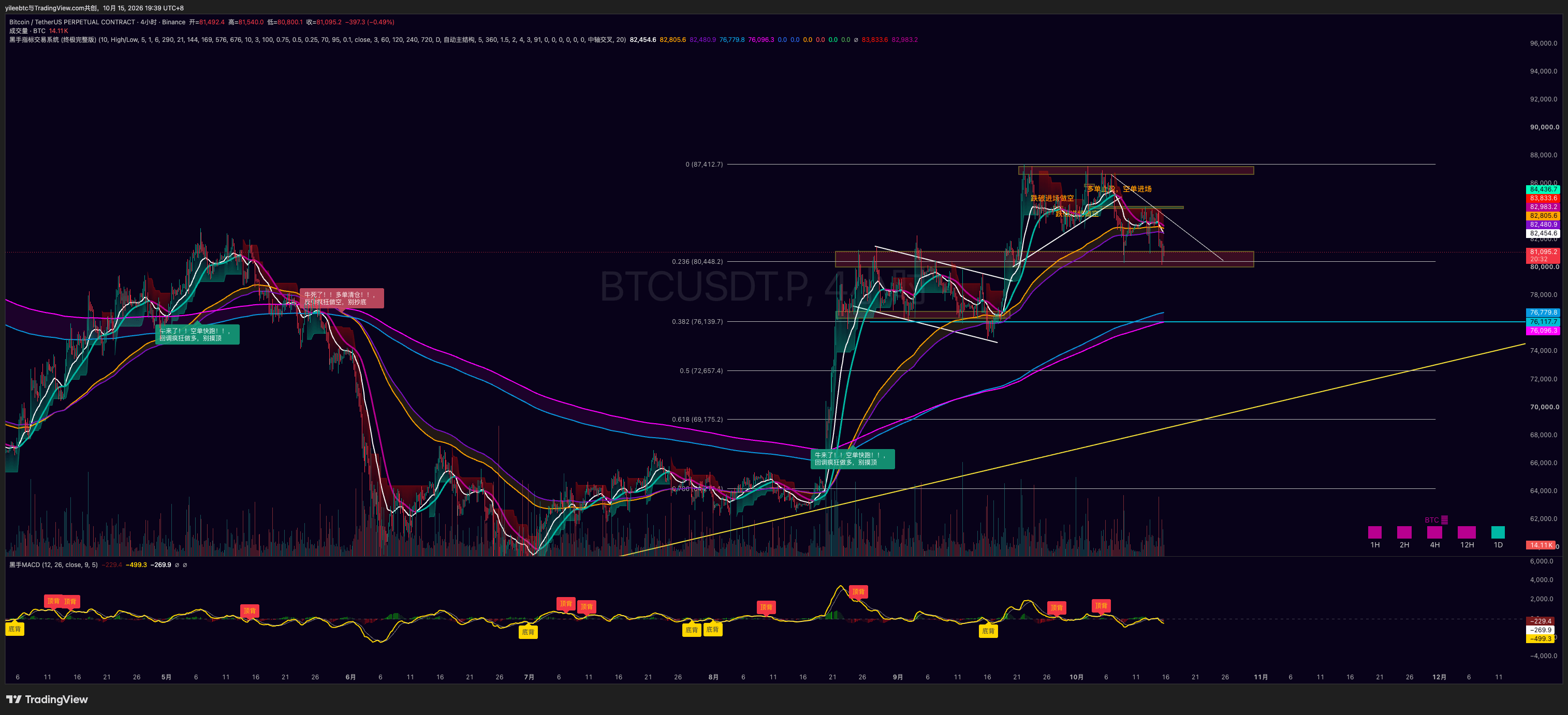


At least for me, 2026 has been the hardest year to trade in recent years.
The challenge isn’t just that there are fewer market moves, or that prices rise and fall more suddenly. It’s that the competitive landscape of the entire market is changing.
As AI tools become widespread, quantitative strategies become more accessible, and professional market makers and high-frequency traders continue to enter the crypto market, the easily identifiable and replicable advantages are rapidly fading.
In the past, a simple moving-average breakout, a trendline break, or even a fixed combination of indicators could offer relatively steady trading opportunities. But as more people and machines recognize these signals at the same time, the market prices them in faster.
Obvious price gaps are quickly closed, and familiar patterns are easier to trade ahead of time. Breakouts happen faster, and false breakouts are more common. Once a genuine move begins, ordinary traders have less and less time to react and get on board.
Related studies also show that Bitcoin’s market is gradually developing a more mature and efficient microstructure: trading volume is rising, spreads and transaction costs are falling, and volatility is converging over the long term. At the same time, clear signs of algorithmic trading have emerged on major trading platforms at the sub-second level, with these systems also participating in the price-discovery process.
A more efficient market doesn’t mean trading gets easier.
Quite the opposite: it means that the simplest, most obvious profits will be taken by machines first.
But machines won’t make the market calm from now on. Crypto markets still have perpetual contracts, high leverage, funding rates, cross-platform arbitrage, and cascading liquidations. Once the balance is broken, the market often doesn’t turn gradually; instead, it reprices through a rapid bout of volatility.
So the market we see increasingly looks like this:
Most of the time, there’s no sustained direction. Prices swing back and forth, wearing down traders who chase rallies and sell off in declines. But when a clear direction does emerge, the market suddenly accelerates, sometimes covering in a very short time a distance that used to take days.
So I believe that anyone who wants to keep making money trading futures in the years ahead must actively choose their time horizon.
The first approach is to trade slowly enough.
Establish your bullish-bearish dividing line on the weekly, daily, or at least 4-hour chart, and define in advance the conditions that confirm or invalidate the trend. As long as the higher-timeframe thesis remains intact, accept the fluctuations along the way, trade less frequently, and let your position follow the full cycle.
The essence of this approach isn’t predicting every rise and fall. It’s using wider stop-losses and longer holding periods to avoid the noise machines generate on shorter timeframes.
The second approach is to move fast enough.
Don’t try to capture the entire move. Participate only at key levels, on structural breakouts, or when liquidity is released. Cut losses quickly when an entry is wrong, and protect profits promptly. If the 15-minute structure breaks down, volume surges in the opposite direction, or momentum clearly stalls, reduce your position proactively.
“Moving fast” here doesn’t mean trading frequently, and it certainly doesn’t mean chasing every sign of volatility.
True speed means making decisions quickly, admitting mistakes quickly, and taking profits quickly:
Wait when the conditions aren’t there; act only when they are. Exit immediately when your thesis is invalidated, and once you’re in profit, don’t assume the market will necessarily hand you the entire move.
Personally, I lean more toward the second approach.
Some of the trading results shared by Coin Circle Star have shown me what may be possible in this market with short timeframes, high turnover, and strict execution. But individual cases can’t prove that an approach works for everyone. What’s really worth studying isn’t the apparent trading frequency, but the underlying selection process, pace, stop-loss discipline, and money management.
Many successful speculative traders in China’s A-share market are also known for limit-up plays and short-term momentum trades. But their edge isn’t simply “chasing stocks that hit the limit.” It comes from an entire execution system built around price-limit rules, market sentiment, the combined force of capital, and expectations about liquidity.
What they truly have in common is that they don’t stay entangled in a losing position for long.
If you’re wrong, exit. If momentum weakens, get out. Hold on only when things are going as expected. Speed isn’t the goal; it’s about resolving uncertainty quickly.
The traders who may struggle the most in the future are precisely those stuck in the middle:
They enter based on 15-minute fluctuations but hold positions based on daily-chart fantasies; they set stop-losses for short-term trades but expect a major trend for take-profit; when they’re profitable, they want to hold for the long term, but when they’re losing, they tell themselves it’s just a normal pullback.
This mismatch of timeframes might occasionally have been rescued by the market in the past. In a more efficient market with faster reversals, the cost will only keep rising.
So what really matters in the future isn’t finding more indicators, but answering three questions:
Which timeframe am I making money from?
Which timeframe do my invalidation conditions belong to?
If the market doesn’t behave as expected, can I exit immediately?
AI and quantitative trading won’t eliminate trading opportunities, but they will keep shrinking the room for vague judgments to survive.
Those who endure in the long run won’t necessarily be the most accurate predictors, but those who can clearly choose a timeframe, manage risk, and adjust quickly when conditions change.
Either be slow enough to filter out noise with a higher timeframe and hold on to the real trend.
Or be fast enough not to argue with the market or let unrealized profits turn back into losses.
The most dangerous thing is to enter as a short-term trader, then decide to believe in long-term value only after you’re in the red.
These are just my thoughts on the current market structure and my personal trading approach; they do not constitute trading advice.#BTC $ETH