


This broad sell-off right after the opening bell is the kind of clean, across-the-board decline we haven’t seen in the U.S. stock market for a long time. Looking at the losses across different sectors, a very clear pattern of tiers emerges—it’s by no means a random flight of capital.
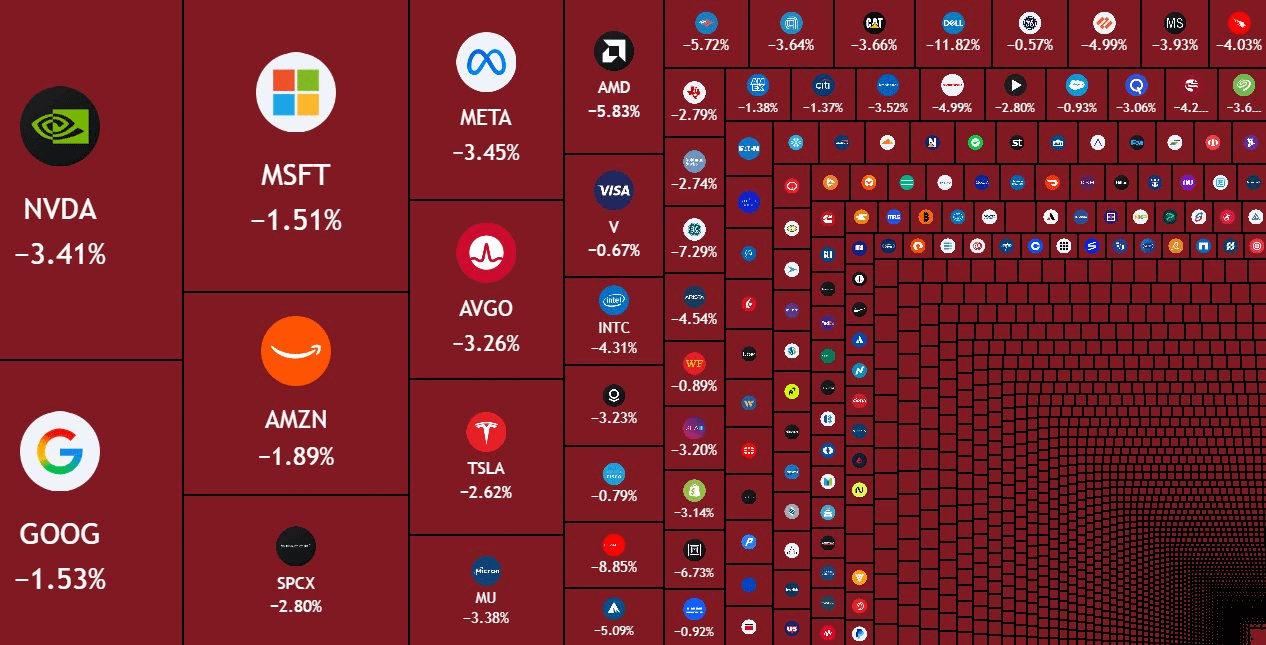
AI stocks plunge—who took the biggest hit?
Rank the sectors in this sell-off from steepest to mildest losses, and the pecking order becomes obvious.
At the top of the list is the computing-power rental sector: CoreWeave fell about 16% and Nebius about 10%, making them the two hardest-hit stocks in the market. Next came AI hardware integrators: Dell fell about 11%, HPE about 8%, and Oracle about 9%.
The third tier was optical communications, with Lumentum down 9.2% and Corning down 5%. Memory stocks ranked fourth: SK Hynix fell about 6%, and Micron about 4%. Chips came fifth. The Philadelphia Semiconductor Index fell about 4% overall, Nvidia dropped about 3%, and TSMC fell about 3.4%.
Cloud giants were the most resilient part of the entire AI supply chain. Microsoft fell 1.8%, Google 1.7%, and Amazon likewise 1.7%. Apple, which is barely part of the AI narrative, actually gained 0.5%.
From compute leasing to integrators, then optical communications, memory, chips and finally cloud giants, the more a segment relies on external financing and AI-driven growth narratives to support its valuation, the harder it has fallen in this downturn. Companies with ample internal funds and businesses supported by stable cash flows have seen smaller declines, and some have even risen against the trend.
A key signal emerged after the close: the AI profitability narrative has been upended
Just after the market closed, when sentiment was at its lowest, Anthropic released its key Q3 operating figures. Quarterly revenue reached $16.8 billion, up 46% from Q2 and 20 times the level a year earlier. The figure fell within the market’s previous forecast range of $16 billion to $18.5 billion, rather than coming in substantially below expectations.
More important than revenue, its adjusted operating profit and cash flow both turned positive, directly challenging the pessimistic view circulating in the market that “AI foundation models can only keep burning cash forever.” This has given earnings expectations across the AI sector a significant boost. The market is gradually digesting the figures, and investors may shift their valuation focus in the AI space from revenue growth to the ability to deliver profits.
U.S. inflation tops expectations, stirring fresh uncertainty over the pace of rate hikes
Almost simultaneously with the sharp drop in U.S. stocks came U.S. September CPI data that far exceeded market expectations. Seasonally adjusted CPI rose 0.6% month over month and 3.7% year over year. Core CPI rose 0.3% month over month and 2.6% year over year. Both measures rebounded from the previous month and exceeded consensus expectations.
This latest rebound in inflation was driven by a broad range of factors, with energy, core goods and rent all contributing at the same time. International oil prices have remained elevated above $100 per barrel, pushing the seasonally adjusted energy index up 5.2% in September. Gasoline prices rose 9.1%, accounting for more than half of the overall CPI increase, while fuel prices surged 15.3% month over month. With geopolitical tensions in the Middle East still unresolved, near-term energy inflation is unlikely to ease quickly.
Core goods inflation, excluding energy and food, has picked up again. On the one hand, back-to-school demand pushed up prices for toys and clothing, while strong demand for used cars in a high-oil-price environment also drove prices higher. On the other hand, price pressures from the data center construction boom continue. Computer software and accessories prices rose 28.4% year over year, while prices for computers, peripherals and smart-home assistants increased 9.7%. Both figures set new records for annual growth, as demand for AI-related hardware continues to support inflation.
Inflation in rents is also proving more persistent. The housing component rose 0.4% in September, with owners’ equivalent rent up 0.3% and rent of primary residences up 0.2%. Rent carries considerable weight in the CPI basket, directly slowing the pace at which core inflation is converging toward the 2% target. However, with U.S. mortgage rates recently climbing and the overall housing market remaining weak, the likelihood of sustained, sharp rent increases is relatively limited.
Inflation in core services excluding rent was relatively moderate. Prices in this category rose 0.4% month over month in September, down from 0.5% the previous month. Wireless telephone service prices, which had surged earlier, were unchanged month over month, suggesting that this price increase was a one-off and will not provide sustained upward pressure on inflation. Transportation services prices rose 0.6%, while airfares increased 1.2%, still a direct reflection of higher oil prices feeding through to transportation.
After the CPI data was released, the U.S. dollar strengthened rapidly, while U.S. stocks and gold both fell sharply. Markets had widely expected the Federal Reserve to slow the pace of rate hikes considerably. The hotter-than-expected inflation figures led investors to reassess the likelihood of a rate hike in October.
Taking current economic data and Fed officials’ comments together, the inflation rebound has strengthened the case for further rate hikes. However, the recent rise in longer-term Treasury yields and the stronger dollar have already tightened financial conditions to some extent. Interest-sensitive sectors such as real estate have been significantly constrained, meaning the market has effectively absorbed part of the impact of monetary tightening already. Based on public remarks by several Fed governors, the Fed is likely to hold rates steady in October, with the next rate-hike window more likely to be in December. But a slower pace of rate hikes certainly does not mean a shift toward looser monetary policy. The Fed is likely to maintain a relatively tight stance over the coming year, and the rate cuts markets are hoping for are unlikely to materialize in the near term. High interest rates will remain the market norm for quite some time.
A recent research report from CITIC Securities also noted that U.S. September CPI exceeded expectations and that inflation is falling far more slowly than the policy target would require. It likewise expects the Fed to hold rates in October and raise them by another 25 basis points in December. With oil prices remaining high, inflation is likely to stay persistent, dollar liquidity will probably remain relatively tight, and there is very limited room for Treasury yields to fall. The conditions underpinning gold’s rally remain fragile.
Several niche developments have landed at once, bringing new changes to crypto regulation
In addition to U.S. stocks and macroeconomic data, several major developments in the crypto asset space this week are quietly reshaping the industry’s long-term outlook.
The EU’s MiCA regulatory framework has reached a landmark implementation milestone. The European Banking Authority (EBA) has classified Circle’s USDC as the first significant electronic money token under MiCA. A total of 45 electronic money tokens have now been notified within the EU. Starting November 12, 2026, supervisory responsibilities for USDC’s reserves, liquidity and other prudential matters will formally transfer from the French regulator to the EBA. The EBA has also signed a memorandum of cooperation with the New York State Department of Financial Services, significantly improving coordination on cross-border stablecoin regulation.
The White House is exploring a new approach to acquiring bitcoin through existing channels for federal fund inflows, with the aim of expanding the U.S. Strategic Bitcoin Reserve. Directly buying bitcoin on the open market would require congressional authorization. The current plan is being pursued under Trump’s earlier executive order and would not require additional taxpayer spending; instead, it would seek to receive or convert some federal funds into bitcoin.
The U.S. OCC has also released a major investigation report on “debanking.” After examining nine large banks, it confirmed that some had previously restricted financial services to industries such as digital assets, oil and gas, and tobacco for reasons unrelated to commercial considerations. Restrictions on digital asset issuers and exchanges were generally justified publicly on the grounds of financial crime risk. The report was prepared under a 2025 Trump executive order. Specific cases involving restrictions on digital asset businesses have not yet been disclosed. Regulators will assess and revise the relevant framework going forward, gradually removing barriers that prevent the crypto industry from accessing banking services.
One final detail from the consumer side: according to feedback from distributors, wholesalers and retailers in Henan, Shandong, Guangdong, Anhui and other regions, inventories across the alcohol distribution channel are still being steadily drawn down. Some merchants interviewed reported year-on-year inventory declines of 10%–20%. Best-selling products from leading liquor brands are turning over noticeably faster, and many retail outlets have brought inventory down to a healthy level of one to two months.
All articles published by this account are intended to share industry information and do not constitute investment advice.$BTC $BNB