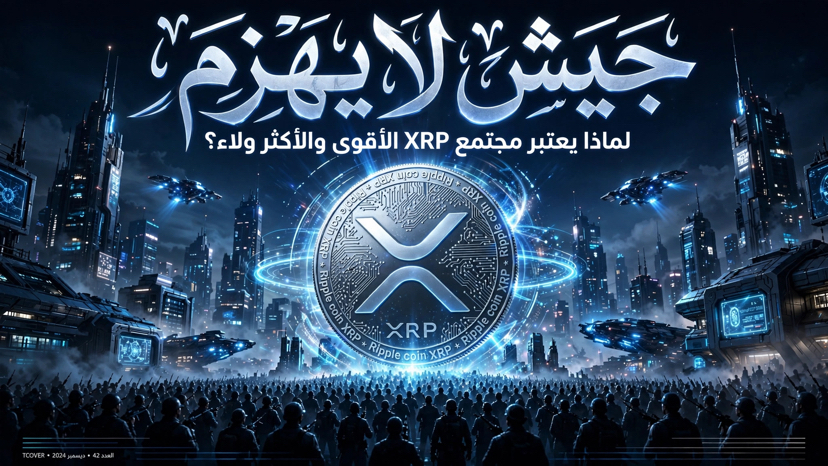
$XRP cannot be understood solely through its price or market capitalization. The true value of this currency lies in its community—the community that calls itself the XRP Army and is now considered one of the largest and strongest communities in the history of cryptocurrency, surpassing the communities of newer and technically larger currencies in loyalty and cohesion.
So, what is the secret behind this strength?
First: Historical roots and early trust
XRP launched in 2012, just three years after Bitcoin. That makes it one of the oldest digital currencies still around today. Its longevity gave it an advantage that newer currencies don't have. Early investors who bought it at low prices and rode out the 2018 crash and the 2021 rally developed an emotional attachment to the project. They were no longer just traders; they became believers in an idea. And that belief is what distinguishes a strong community from a speculative one that shows up when prices rise and flees when they fall.
Second: The U.S. Securities and Exchange Commission case—the ordeal that made its name
You can't talk about the strength of the XRP community without discussing the high-profile case that the U.S. Securities and Exchange Commission (SEC) brought against Ripple in December 2020. The agency accused the company of selling unregistered securities. At that moment, many expected XRP's demise.
But the exact opposite happened. The case became a rallying point. The community felt that its currency was being treated unfairly by regulators, and that the fight wasn't against a company, but against their idea. So they began funding independent lawyers, analyzing court documents day by day, sharing news on X, and applying pressure through the media. The battle continued until 2025, ending in a major partial victory for Ripple and regulatory clarity for XRP.
Five years of legal battles created a disciplined army. No other currency on the market has gone through the same experience.
Third: A clear goal that's easy to understand
Most cryptocurrency projects put forward complex ideas that are hard for ordinary people to understand. XRP's idea, by contrast, is simple and direct: transferring money across borders in seconds for fees that are virtually zero. A worker in the Gulf sending their salary home to their family in India understands this idea, as does a business owner in the Philippines and a bank paying millions of dollars in fees to the SWIFT network.
This clarity helped XRP spread through remittance communities around the world, especially in Southeast Asia, the Middle East, Africa, and Latin America, where there is a real need for cheap, fast transactions.
Fourth: Real institutional support
Behind XRP is Ripple, a real company with offices, employees, and contracts with more than 300 financial institutions and banks around the world. This gives the community a sense of security. They aren't supporting an unknown project run by anonymous developers; they're supporting a company that meets with central banks and takes part in central bank digital currency (CBDC) projects.
Fifth: A culture of patience and holding
The XRP community is known for a unique culture called extreme HODLing. After the currency reached $3.84 in 2018 and then collapsed to less than 20 cents, many people held on to it for years. This long-term patience created a kind of psychological immunity to market volatility. They don't sell at the first sign of a downturn; they buy more.
The strength of the XRP community didn't come out of nowhere. It's the result of a long history, a defining legal battle, a clear goal, real-world utility, and a company backing it. That's why, even during periods when Bitcoin, Ethereum, and Solana outperform it technically, the XRP community remains the most visible on social media, the most vocal in defending its currency, and the most willing to wait years more to achieve its goal.